Inspecting the brain
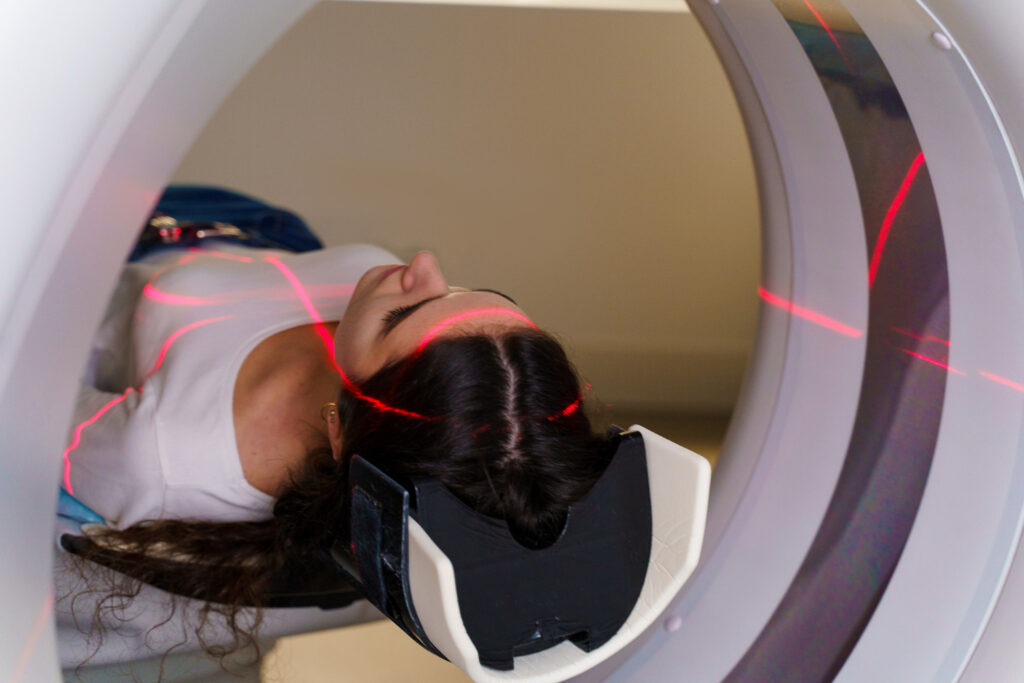
El láser y la luz infrarroja permiten analizar, medir y operar con precisión en medicina, acústica e ingeniería.
X-rays are complemented by images from the nuclear magnetic resonance (NMR) scanner, developed in the late 1970s. It works because atoms in a strong magnetic field rotate at a rate close to that of radio waves. When the wave is tuned, the atoms rotate together and absorb energy. When the wave is switched off, the energy returns, allowing the concentration of atoms to be measured. By varying the magnetic field and the radio wave, and capturing all the measurements in a computer, even delicate tissues such as the brain can be revealed in detail. The colors are generated by the computer. Very little surgery inside the body is often required, but reaching the site of the problem can cause significant damage, producing pain and slowing recovery. Television cameras and lasers now help surgeons operate through small incisions that heal quickly.
Not all technologies respond to a need
Scientists or engineers often create things without an apparent use, developing them simply to see what happens. The laser emerged from advanced ideas proposed in 1917. It was developed into a functional device in 1960, partly to demonstrate that theories about atoms were correct. Within less than ten years, this scientific curiosity had dozens of practical uses. Some, such as holograms, required laser light to function. Others, such as laser surgery, were entirely new. In the nineteenth century, the discovery of infrared light by the English scientist William Herschel (1738–1822) followed a similar path. Infrared light is now an everyday tool, revealing heat loss, while another type of laser reads music from an audio CD.
Isaac Newton (1643–1727)
Isaac Newton studied light and concluded that it was made of particles projected through space. This idea later fell out of favor, but at the beginning of the twentieth century, particles of light—photons—became the foundation of the thinking that led to the creation of the laser.
Checking the sound of a loudspeaker
Pure light helps produce pure sound when a laser examines the performance of a new loudspeaker design. If the speaker generates its own vibrations instead of only following the vibrations of the music, it will not reproduce sound accurately. A laser can inspect the surface of a working speaker to detect unwanted waves. To do this, the brightness of the laser changes rapidly as it moves side to side and up and down, illuminating the moving surface of the speaker. From the way the brightness of the reflected light varies, electronics technicians can determine how fast and in what direction each point on the surface moves. Computer-generated diagrams of these measurements help acoustic engineers identify the cause of any problem, in this case a poor choice of materials for the speaker.
Infrared house
Everything produces a form of radiation similar to light. Radiation from cold objects has a longer wavelength than visible light and is therefore invisible. As temperature rises, the wavelength shortens until a red glow appears and the object becomes hot. Before this point is reached, infrared light (infra means “below” in Latin) is produced. Using a camera that can “see” infrared light is therefore an effective way to observe the temperature of objects that are almost cold. The blue walls in this infrared image of a house show that they are cold, while the red windows indicate they are as warm as the air inside, a clear sign that energy is being lost.
What is infrared light?
A glass prism produces a spectrum that separates the waves of white light. The spectrum darkens toward either end. The temperature increased, showing that invisible energy was falling; these invisible rays were called “infrared” light.
Ear surgery with laser
The working parts of the ear are located deep within the skull, protected by solid bone. When something goes wrong, surgeons must decide whether to operate and risk causing damage, or leave the patient untouched but with a disability. Technology cannot solve every problem, but this argon laser provides an alternative to the scalpel. High-power blue light is directed deep into the ear, where surgeons, observing its effects through a microscope, can remove tumors or reshape small bones.
Ruby laser
The first laser was built by the English physicist Theodore Maiman (b. 1927) in 1960. Its light came from a ruby rod. This laser uses a tube containing helium and neon, and is much less expensive. When electricity passes through a gas such as neon, its atoms absorb energy and become excited. If a photon with sufficient energy strikes it, an excited atom will emit an identical photon. Trapped by mirrors, the photons strike other atoms, causing them to produce more photons; this continues until many identical photons (laser light) emerge from the silvered mirror at one end of the tube.