The objectives of science
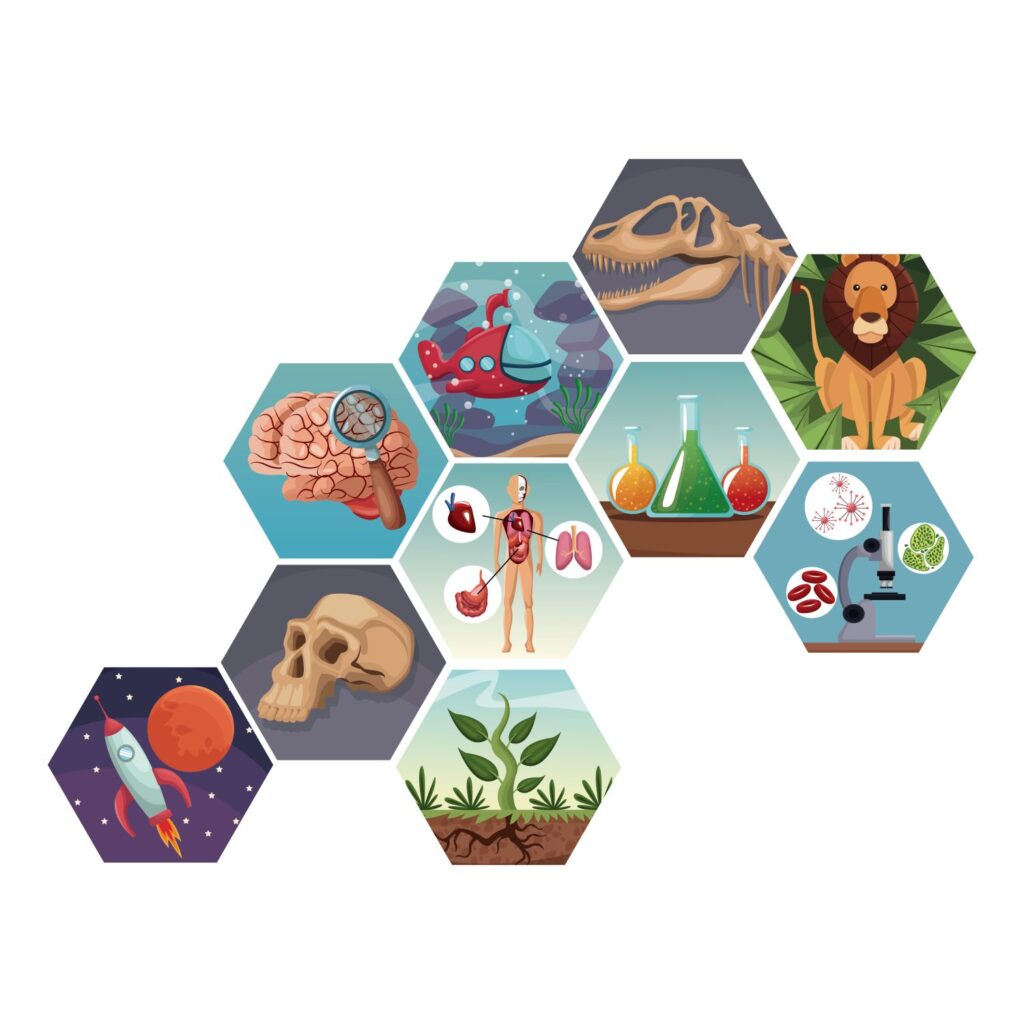
Las ciencias se organizan en disciplinas que analizan la materia, la vida y la sociedad mediante métodos específicos y enfoques diferenciados.
The objectives of this science are primarily oriented toward the study of natural phenomena in which qualitative transformations of substances occur, without the creation or destruction of mass within the system as a whole. Chemistry differs fundamentally from physics in that it investigates changes in the composition of materials, whereas physics—except in its atomic and nuclear branches—focuses on quantitative changes expressed through variations in measurable properties of objects.
Given the diversity of phenomena it examines, chemistry can be divided into several specializations. A common distinction is made between general chemistry, which addresses the overarching laws and principles of the discipline, and descriptive chemistry, which focuses on specific substances and processes. Inorganic chemistry studies compounds formed from simple combinations of metallic and non-metallic elements. Organic chemistry investigates carbon-based compounds formed through combinations with hydrogen, oxygen, and other elements. Biochemistry, or biological chemistry, operates as a hybrid field, examining the material foundations of the processes that sustain living organisms. Medical chemistry connects with therapeutic and pharmacological applications, while other branches further extend the scope of the discipline.
Within the natural sciences, and clearly differentiated from physics and chemistry, the study of phenomena occurring in living organisms and the complex systems that relate them to each other and to their environment is grouped under the scientific discipline known as biology. Although relatively recent in its formal development, some of its divisions trace their origins to early philosophical and scientific inquiry. Biology directs its research toward fields that have produced discoveries with significant impact not only within science but also on the broader social consciousness. Issues such as the origin of life, the evolution of species, the mechanisms of heredity, and the boundary between inert organic matter and living systems have extended beyond scientific domains to influence philosophical interpretations of the universe. This explains the growing prominence of areas such as genetics, biochemistry, and evolutionary theory, largely inspired by the hypotheses proposed by Charles Darwin.
Botany, zoology, and taxonomy are disciplines more closely oriented toward the description and identification of living organisms. Through centuries of work, they have achieved a high level of precision, enabling detailed studies of both individual and collective characteristics of species. Other branches of biology are closely linked to advances in medicine, though their scope extends beyond human concerns. Physiology examines the functions of organs and biological systems, while anatomy focuses on the structural and morphological aspects of living beings. Additional perspectives are offered by ecology, which studies large-scale interactions within ecosystems; ethology, which analyzes animal behavior; and oceanography, which investigates processes occurring in seas and oceans.
The broader framework of natural sciences is completed by disciplines of a primarily descriptive nature such as geology, which studies the mineral composition of the Earth’s crust, and meteorology, which focuses on atmospheric phenomena. Together, these fields provide both general and detailed perspectives on the diverse manifestations of nature observable on the planet’s surface.
Historically, the tendency to approach human events through poetic or narrative description prevented history from being considered a science during ancient and medieval periods. Aristotle, among the first to attempt a classification of knowledge, even suggested that poetry, due to its capacity for symbolic synthesis, held a more scientific character than history. The current landscape of social sciences has evolved significantly since the second half of the 19th century. A key figure in this transformation was the French thinker Auguste Comte, whose positivist philosophy promoted the application of scientific methods to the study of society. This perspective led to the emergence of sociology as a discipline governed by systematic laws, aligned with the methodological rigor of the natural sciences. A similar approach encouraged the development of economic theory, which analyzes the causes and effects of wealth distribution. Both sociology and economics incorporated mathematical tools, particularly statistical analysis, in their pursuit of scientific frameworks for understanding social phenomena.