Composite Materials
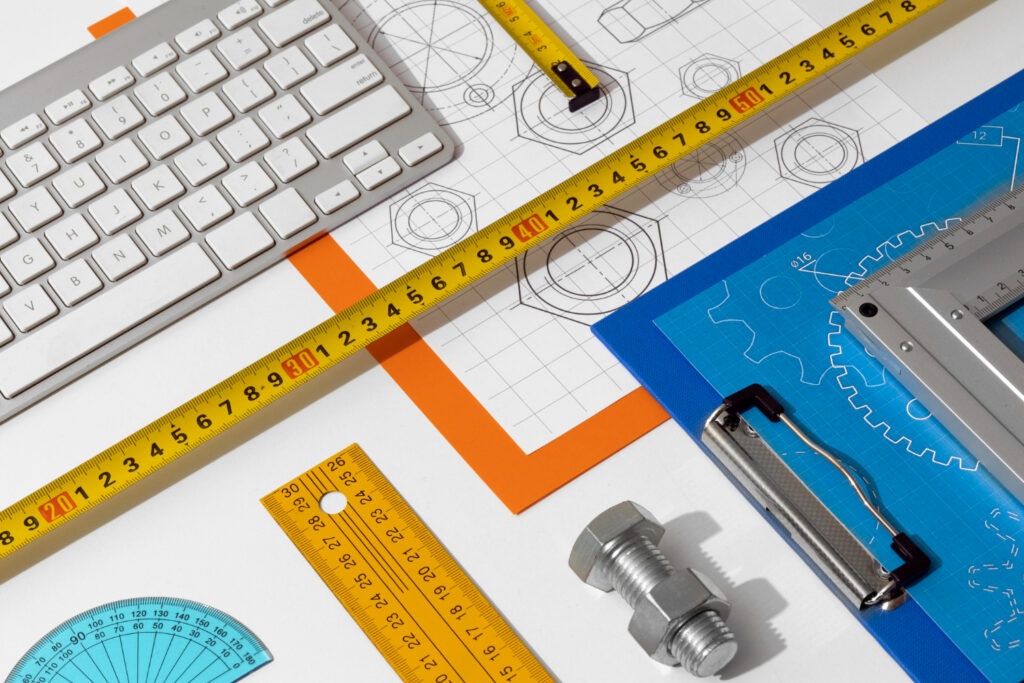
Relación entre innovación en materiales y exactitud en mediciones para la producción tecnológica.
Materials can often be improved by combining two substances so that each compensates for the limitations of the other. This approach has produced high-performance, cost-efficient materials used across industries. Composites are typically formed from materials with contrasting properties. One component, often in the form of fibers or strips, provides tensile strength but lacks resistance to compression. The second component, known as the matrix, binds these fibers together. Although the matrix may be weak or brittle, it distributes stress and prevents cracks from propagating. When a crack encounters a fiber, its progression is interrupted, reducing the forces that would otherwise lead to structural failure.
Measurement Standards
A modern automobile contains thousands of parts manufactured in different countries. Precise measurement ensures that all components fit together seamlessly during assembly. Universal standards define dimensions, positions, weight, electrical properties, and even color, allowing global production systems to function efficiently. Industrial measurement extends far beyond basic tools such as rulers or scales. Mechanical components with tolerances as tight as 0.025 mm (0.001 inches) have been standard for over a century. Optical components can deviate by less than 0.00025 mm (0.00001 inches) and still be mass-produced at low cost. Navigation in maritime and aviation systems has been transformed by satellites capable of determining position from space. For these systems to operate without error, time must be measured with a precision of less than one second per century.
Metric System
The metric system was introduced in France in 1795 during the French Revolution. It replaced a wide range of inconsistent measurement standards with a simplified system based on the meter and the gram. A related unit, the liter, was defined as the volume occupied by one kilogram of water. During the 19th century, standardized measures of volume were widely adopted to ensure consistency in trade and industry.
A Cubic Standard
Technological development both depends on and advances measurement. Accurate knowledge of material properties allows engineers to perform reliable calculations. In 1889, the British Board of Trade used a precisely manufactured standard made of brass and plated nickel to determine the weight of a cubic inch (16 ml) of pure water. Such instruments illustrate the increasing demand for exact reference standards in scientific and industrial applications.
Copper Measure for Distillers
This copper vessel, produced in 1910, was designed for the commercial sale of alcoholic beverages. It belongs to a set covering volumes from two gallons (9 liters) to one pint (0.6 liters). The correct volume is achieved when the liquid reaches a specific narrowing in the container. The interior bears a London certification mark, confirming its accuracy and compliance with measurement regulations.
Bronze Yard (1497)
The imperial system of measurement has roots in Roman practices and was later standardized in England. Its basic unit of length is the yard, divided into three feet, each consisting of twelve inches. While the precision of early physical standards such as the bronze yard was limited by modern criteria, they were adequate for the technological requirements of their time. Today, distance measurement relies on highly accurate methods such as laser-based systems.
Early Surveying Instrument
This theodolite, used in 18th-century England, was a key instrument in cartography. Mapping requires determining the positions of multiple points, often indirectly due to obstacles. By establishing a baseline between two known points, surveyors could calculate additional positions through triangulation. Angles measured from each end of the base determine the location of a third point. Repeating this process allows the creation of extensive measurement networks. The theodolite also measures vertical angles, enabling the calculation of elevation.
Time Around the World
Local time is defined by the position of the sun, reaching noon when it is at its highest point. This occurs one hour later for every 15 degrees of longitude westward. Historically, ships determined their longitudinal position by comparing local time with that recorded on a reference clock. This required highly accurate timekeeping under challenging conditions at sea. The problem was resolved in 1735 with the development of the marine chronometer, which allowed reliable navigation across long distances.