Internal Combustion Engine
Evolución de motores térmicos y su impacto en la fabricación en masa y la ingeniería de precisión.
A steam engine operates in two stages: heat generated in a boiler produces steam, which then expands in a cylinder to perform work. By the mid-19th century, efforts were underway to develop smaller and more efficient engines by igniting fuel directly inside the cylinder. The main challenge was identifying a suitable fuel. The German engineer Nikolaus Otto (1832–1891) solved this by building the first gasoline engine in 1861, followed by the four-stroke engine in 1876, which became the basis for modern automobile engines. Otto introduced electric spark ignition for the fuel-air mixture. In 1893, another German engineer, Rudolf Diesel (1858–1913), developed an engine where the fuel mixture ignites through compression. Diesel engines are heavier but offer greater reliability and efficiency than gasoline engines.
Japanese Bullet Train
Trains require less energy than automobiles to transport passengers. Many modern trains are electric, though their energy still originates from thermal power plants located far from the railway. The high-speed train known as the “bullet train” operates between Tokyo and Osaka on the Shinkansen network, established in the 1960s to provide rapid transit. It reaches speeds of up to 210 km/h (130 mph) on dedicated tracks. The French TGV achieves higher speeds but requires straighter tracks, while trains in England can exceed 200 km/h (125 mph) on conventional lines.
Jet Propulsion Engine
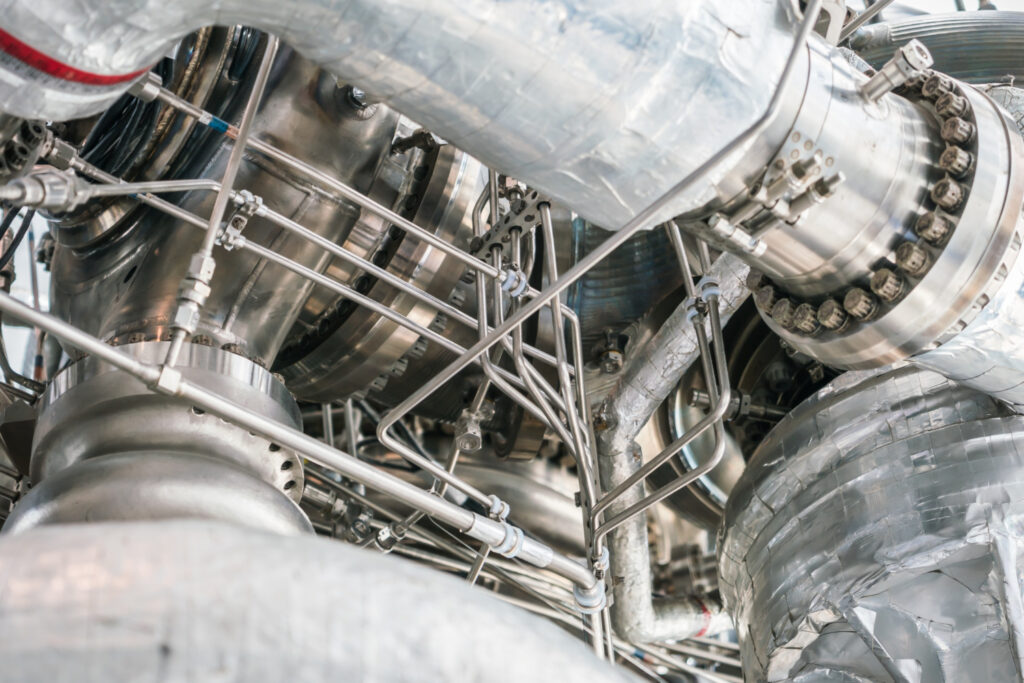
In a jet engine, fuel mixes with air, is compressed, ignited, and expelled in a continuous and smooth process. Unlike piston engines, there are no reciprocating parts to slow the system. In the turbojet—the simplest type—mechanical work is performed by hot gases expelled at high speed, generating forward thrust, similar to a rocket. Modern passenger aircraft typically use turbine engines, which include a large front fan that channels air around the engine. This airflow contributes to propulsion and improves efficiency and noise reduction.
High Compression
Unlike rockets, jet engines require atmospheric air. A compressor, consisting of curved blades mounted on a rotating shaft, draws in and compresses air into the combustion chamber, where it mixes with fuel. On the same shaft, a gas turbine is driven by expanding combustion gases, which pass through additional blades and sustain the rotation of the compressor. This closed cycle maintains continuous operation and efficiency.
Mass Production
There are two ways to manufacture products: one person can complete the entire process, or multiple individuals can perform specialized tasks. The latter approach defines mass production. Dividing manufacturing into simple steps allows machines or less-skilled workers to perform repetitive tasks efficiently. Machines can repeat operations with precision and consistency. The American engineer Eli Whitney (1765–1825) pioneered interchangeable parts while producing muskets for the U.S. government, ensuring that components could be used across different units. This system increased speed and uniformity but reduced the satisfaction derived from producing complete items and required strict precision standards.
Injection-Molded Component
Injection-molded plastics are highly suitable for mass production. Once molds are created, identical parts can be produced thousands of times with precision. Complex shapes can be achieved using molds with moving components, and multiple small parts can be produced simultaneously. These parts often display identifiable marks at the injection point and visible seam lines where mold sections meet.
Precision Engineering
The concept of disposable products emerged in 1903 when King Camp Gillette (1855–1932) introduced disposable razor blades. Since then, the approach has extended to numerous products, from pens to components in technical devices. Precision engineering enables the mass production of low-cost, highly accurate assemblies. However, the widespread disposal of materials raises questions about resource efficiency and long-term sustainability.