Preparation for joining parts
Relación entre técnicas de unión y comportamiento de materiales bajo fuerzas.
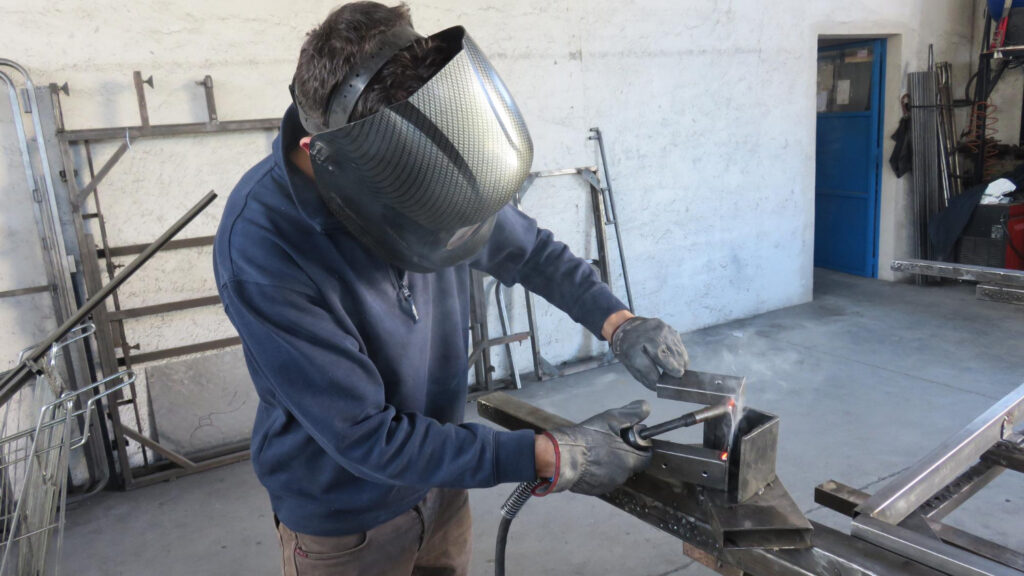
A pop rivet has a central hole through which a steel pin passes. The rivet is placed into a tool head equipped with a multi-lever handle. It is inserted into a hole that runs through the parts to be joined. The lever mechanism transforms a long, low-force push into a shorter, stronger pull on the pin. This action deforms the rivet, expanding its end and fastening the components together. When the pin breaks, a portion remains inside the rivet. Despite the internal cavity, the external finish appears clean. Welding operates on a similar principle: two metal parts are fused into a single continuous material. In processes such as tungsten inert gas welding, the molten metal is shielded from oxygen to prevent defects and ensure structural integrity.
Tension and compression
Materials are only useful if they can withstand forces. Energy moves through structures similarly to an electric current. When a load is applied, forces travel through the structure to the ground, which exerts an equal and opposite reaction. Mechanical stress alters the position of atoms within a material, generating internal resistance. If the applied force exceeds the material’s capacity, atomic bonds break and failure occurs. Engineers must understand how materials respond to tension (pulling forces) and compression (pushing forces) to design efficient and safe structures.
Rope under tension
In structural systems, ropes, chains, and cables are used to carry tensile forces. Steel cables are essential in suspension bridges, where they support loads by resisting pulling forces. Engineers must ensure that cables are placed only where tension occurs. If subjected to compression, cables cannot resist the load and may lead to structural collapse.
Bricks Under Tension
Bricks are not suited to resist tensile forces. Like a rope cannot push, bricks cannot effectively withstand pulling forces. Their internal structure consists of small particles held together by relatively weak bonds, making them prone to separation under tension. Materials such as concrete share this limitation and are considered weak in tension.
Bricks Under Compression
Bricks perform well under compression. When pressed together, they distribute forces evenly and maintain structural stability. This principle is applied in walls, where the combined weight of bricks and structural loads keeps the system intact. Mortar between bricks helps distribute loads across surfaces, increasing overall strength.
Tensile testing of cement
The strength of materials is determined through systematic testing. Engineers rely on standardized data to evaluate performance. New materials must undergo testing to determine their resistance to applied forces. In tensile testing, a sample is subjected to increasing force until failure occurs. Early testing machines, developed in the 19th century, applied controlled loads to measure the breaking point and mechanical properties of materials such as cement.
Structural construction
The construction of buildings, dams, and bridges requires precise planning and detailed calculations. Engineers and architects must account for material behavior, environmental conditions, and long-term stability. Unlike earlier periods, modern construction integrates complex systems such as communications and environmental control, making structures comparable in complexity to advanced machinery. Historical builders worked with limited materials and slower-changing design traditions, yet achieved enduring works such as large European cathedrals.
Pont du Gard

The Pont du Gard is a Roman aqueduct approximately 275 meters long, constructed under the direction of Marcus Vipsanius Agrippa around the 1st century BCE. It transported water from a spring near the Gard River to Nîmes. Built entirely of stone, it relies on a system of arches to span the river. The largest arch, measuring 29 meters, carries the main channel, while smaller arches reduce material use and overall weight, illustrating efficient structural design based on compression principles.