Multiplex Telegraphy
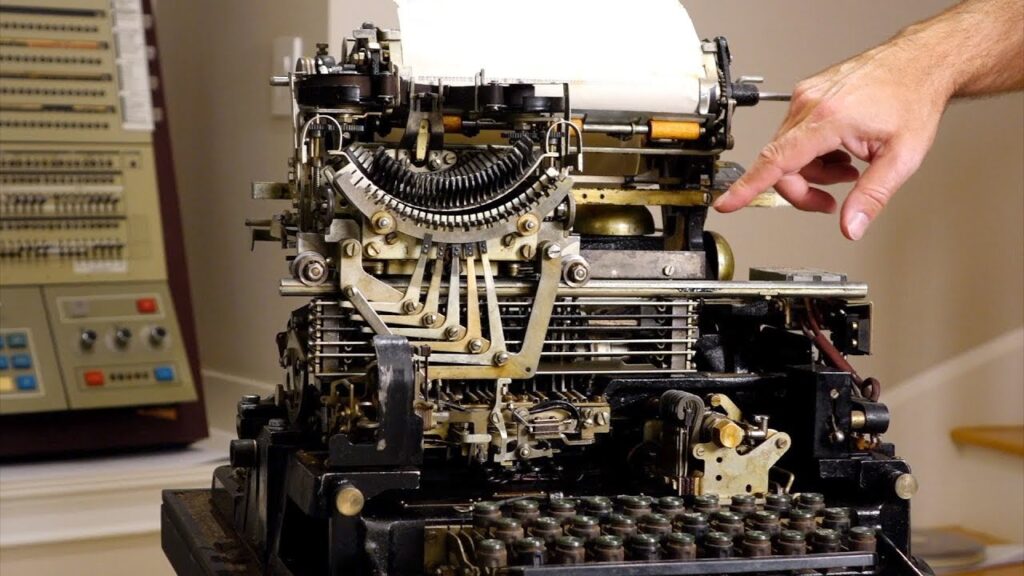
Mecanismo interno de una teleimpresora capaz de decodificar señales en código Baudot, base de la telegrafía multiplexada.
Multiplex telegraphic systems are those that allow the simultaneous transmission of more than one message in the same direction. They may operate by time or by frequency. In time-division systems, messages are interlaced with one another, letter by letter or element by element, taking advantage of the fact already noted: manipulation or transliteration takes longer than transmission. Baudot systems are typical examples of time-division multiplexing.
Frequency-Division Multiplexing
Frequency multiplexing applies the same superposition method used in carrier-wave telephony. The telegraphic signal is an oscillation of defined frequency that is properly manipulated. By assigning a distinct frequency to each message, all of them can be fed into the same transmission path and then separated at the receiving end through filter circuits. In this way, thousands of simultaneous messages can be transmitted through a single pair of wires (coaxial cables) or a single radio path (microwave links).
Telex Service
The telex service, which has spread rapidly in recent years, is a telegraphic service with many similarities to telephone service. Each subscriber, equipped with a teleprinter machine, is connected to a local exchange by a local line. The exchange, in turn, is equipped with the switching facilities required to connect any subscriber with any other, using local lines, long-distance lines, or radio channels. Thus, the telex subscriber is in direct contact with the entire world and can transmit written messages to any other subscriber independently. The main advantages of telex over telephone service are the permanence of the transmitted message and the possibility of delivering it without the recipient being present at the receiving terminal. The called machine identifies itself to confirm that the connection has been correctly established and can operate unattended. This feature is especially valuable for commercial communications between countries with non-overlapping business hours.
Telefacsimile and Telephotography
Telefacsimile and telephotography occupy an intermediate position between ordinary telegraphy and television. Both systems transmit fixed images recorded beforehand on a sheet of paper, such as a linear drawing in the case of telefacsimile, or a standard photograph in the case of telephotography. In both processes, modulation is handled by a photoelectric cell, although other methods may be used in telefacsimile. The sheet containing the image is wrapped around a rotating cylinder, which—through simultaneous rotary and longitudinal motion—allows a concentrated point of light to scan the entire surface. The reflected light, varying with the light-and-shadow pattern of the image, is captured by the photoelectric cell, which generates the corresponding electrical signal and feeds it directly into the transmission line.
Image Reception
At the receiving station, a rotating, longitudinally movable cylinder is covered with blank paper. In telephotography, the paper is photosensitive, and the received signal controls the intensity of a focused beam of light. Synchronism ensures that the receiving light spot matches the scanning point at the transmitter. The exposed sheet is later developed like normal photographic film. In telefacsimile, the photosensitive sheet is replaced by chemically treated paper that darkens when electrical current passes through it. A conductive cylinder supports the paper, and a contact stylus replaces the light beam. The result is a sufficiently detailed reproduction for maps, weather charts, handwritten telegrams, pen drawings, and similar documents.
Ultrafax
The Ultrafax and other very high-speed telegraphic systems operate on principles closer to television than to traditional telegraphy. The text or image is first recorded on continuous photographic film and then transmitted in a manner similar to television scanning. At the receiving end, however, the image is recorded again on photographic film rather than displayed on a screen. Transmission speeds are exceptionally high: while television transmits 25 or 30 frames per second, Ultrafax could transmit up to 30 pages of written material per second, equivalent to roughly 15,000 to 30,000 words.