Direct Memory Access
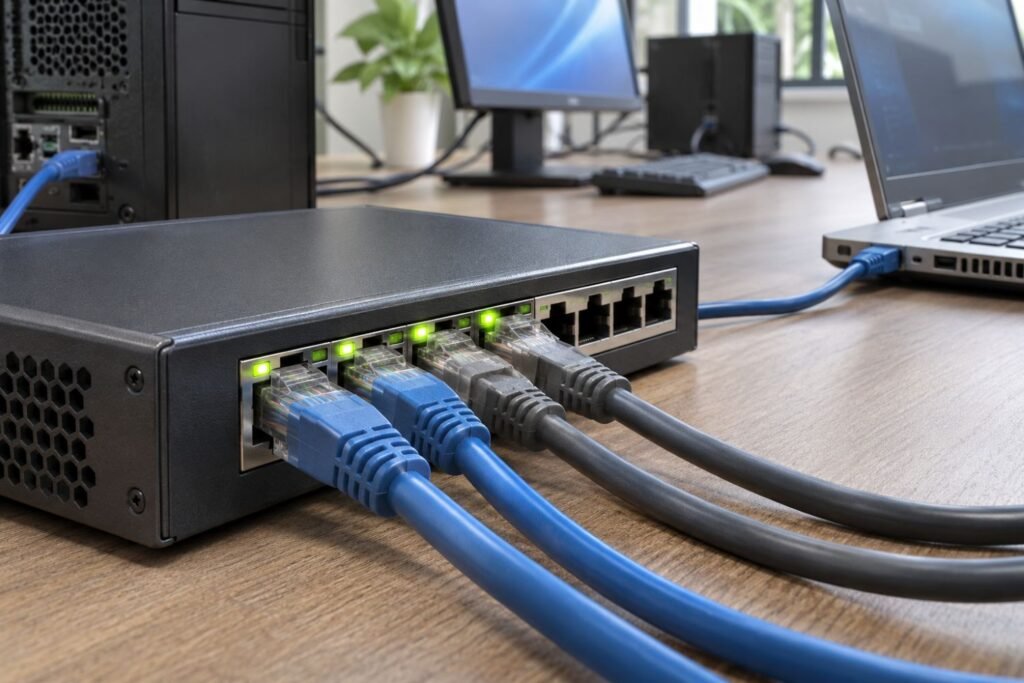
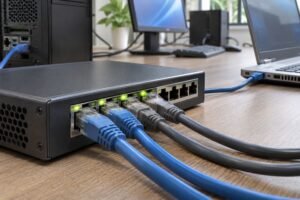
Un switch Ethernet conecta equipos dentro de una red local (LAN).
The concept of telematics grew out of the integration of telecommunications and data processing, or computing.
The combination of these two fields has continually led to new applications and services that require information to be generated, stored and processed.
These services can use standard telephone lines or specialized networks to transmit data:
- Videotex provides access to a database over the telephone network.
- Teletex transmits text between computers and allows it to be edited and printed.
A protocol must allow the parties to:
- Establish the call.
- Maintain the connection.
- Start and end the exchange.
- Transfer messages.
- Check for errors and recover data.
A telephone conversation offers a way to understand what a protocol does.
A telephone conversation between two people requires several conditions. First, a physical medium must carry the voice so it can be transmitted and received. Once the call is placed and answered, both callers need to speak the same language to understand each other. After saying hello, the caller asks for the person they want to reach. If that person is unavailable, there is no need to prolong the call. If the right person comes to the phone, the conversation turns to the reason for the call.
Local Area Network (LAN)
A local area network gives each workstation access to resources on other computers. The software that manages a LAN can be compared to a computer’s operating system. Its programs and utilities act as a bridge between the user and the core of the computer. The LAN software lets users first set up their computers, files, mass storage devices, usernames and user codes. They can then access the local network to share resources and send or receive messages. This software is generally simple enough to use with minimal training.
The hardware consists of a printed circuit board containing network controllers, which connect the system’s CPU to the network through which data enters and leaves. Local area network controllers are complex electronic circuits designed to perform several functions. The controller serializes the data and encodes it. When sending data, it follows a protocol, a set of rules that enables communication with other computers, and checks for possible network errors.
Depending on the manufacturer, local area networks use different transmission media, including coaxial cable, twisted-pair wire and optical fiber.
Coaxial cable is used for long-distance telephone communications and cable television. It is used in local area networks because of its low error rate in data transmission. A twisted-pair cable connection is the least expensive option and has a higher error rate than coaxial cable. It consists of two wires twisted together, with or without a copper mesh shield.
Optical fiber offers a bandwidth of 3,300 MHz, compared with 500 MHz for coaxial cable. It can support transmission speeds above one gigabit per second, or one billion bits per second.
Network Topology
Star Topology
In this configuration, each station connects to a central station. The central computer generally acts as the control station. All information exchanged between stations A and B must pass through it. If the central station becomes overloaded, this type of connection can make the lines difficult to manage. If the central station fails, the entire network stops operating.
Ring Topology
In this configuration, all stations connect to a shared channel that forms a closed loop. Each message sent by a station passes through every station along the path from sender to recipient. Each station reads the message and checks whether it is the intended recipient. If it is not, it puts the message back on the channel. When a station recognizes its address, it keeps the message and signals that the channel is free. When one station on a ring network controls the entire system, the network is said to have a closed-ring structure. In this type of connection, a station failure interrupts the network. Messages are blocked at the failed station and cannot be forwarded to the next one.
Bus Topology
In this configuration, the computers that form the local area network connect along a single central channel. All stations share the bus, and no single station controls it. When a station wants to send a message, it accesses the bus directly and transmits it. Every connected station receives the message, but only the intended recipient accepts it. Compared with the other two topologies, its main advantages are that the network is easy to reconfigure when a station is added and that the failure of one station does not stop the entire network.