Storing an Image in Computer Memory
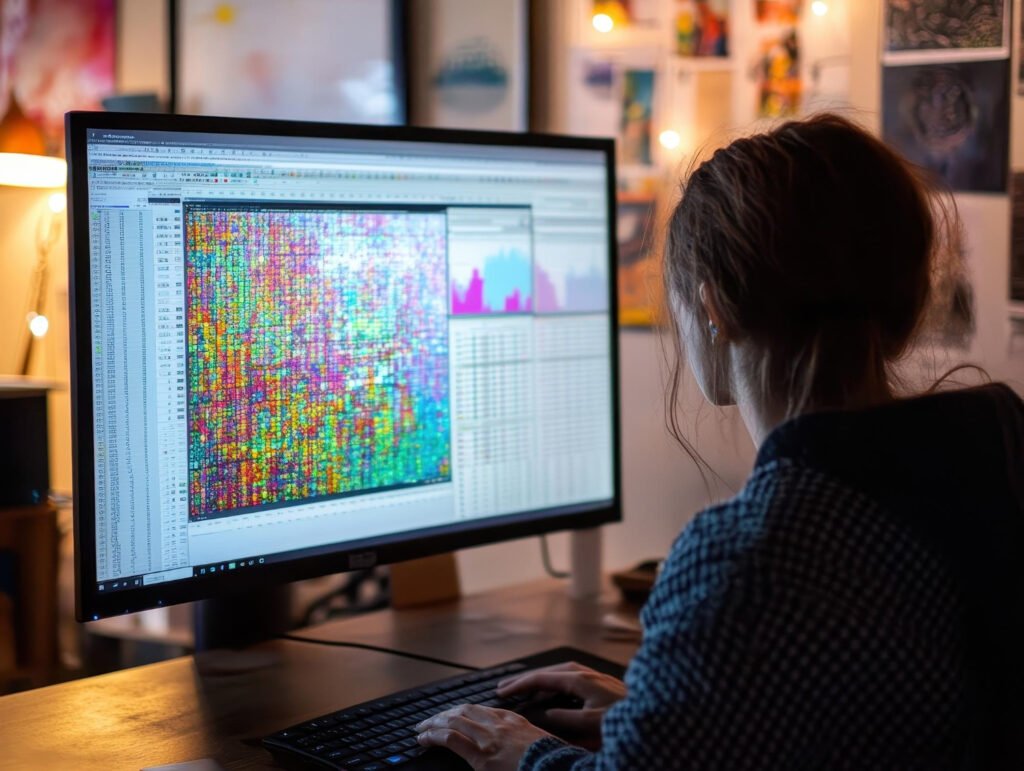
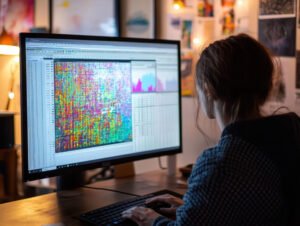
Una cuadrícula de colores en pantalla ilustra cómo una imagen digital puede representarse como un conjunto de píxeles.
The technique used to store pixels in computer memory is known as bitmapping.
Each individual point, or pixel, corresponds to a bit in memory whose value can be 0 or 1. This value determines whether the pixel is on or off. This concept applies to monochrome displays. If one bit can represent two states for each pixel, two bits can represent four possible states. These four states can correspond to four shades on a monochrome display or four different colors on a color display. If we expand the memory map, or bitmap, and assign three bits to each pixel, we obtain eight different colors or eight shades of gray on a monochrome display. The stored bit combinations are the same for grayscale and color. The display is what provides the color. For a monochrome display with a resolution of 640 × 400, we need 32 kbytes of internal computer memory so that each pixel has a location in RAM. More memory is needed to display eight colors or shades of gray at the same resolution. To represent these colors, we need 3 bits per pixel and a total of 96 kbytes of memory.
Line Printer
These printers are the fastest and reach speeds of 300 to 2,000 lines per minute. They are used where speed is the priority, even if the print quality is less than excellent.
Non-Impact Printers
The various types of non-impact printers include thermal, inkjet, and laser printers.
Thermal printers. These are pin-matrix printers in which the printing wires heat up and “burn” the paper without touching it. When the electronic circuitry closes the circuit, approximately 16 volts are applied to the tip of the wire for an average of 1.1 to 1.5 seconds. As the heated point warms up, it marks the paper, which must be heat-sensitive. This type of printer operates very quietly, but its main disadvantage is that it requires special paper.
Inkjet Printers
Inkjet printers have a series of small nozzles in the printhead that spray jets of ink in the patterns needed to produce the full range of letters and characters. This is possible because the printhead consists of small chambers that fill with ink from the cartridge. When the printhead receives the appropriate signal and heats up, the ink is forced out of the chamber onto the paper, where it sets. These printers are known for their speed compared with impact printers and for how quietly they operate. Other advantages include the ability to use standard paper, ease of loading, the ability to print and resize all kinds of characters, and the high quality of the printed text and graphics. They can also print with different ink colors by using several printheads, one for each color, instead of a single printhead with black ink.
Laser Printer
Laser printers are the most sophisticated printers on the market. Once the laser beam has been modulated, it strikes a mirror that reflects it toward a drum, where the page to be printed is reproduced electrically. The drum then rotates. As it reaches the ink applicator, the powdered ink adheres to the electrically charged areas of the drum. The drum then transfers the image onto the paper.
Data Storage Units
Information processed by the computer must be able to be stored on units with a much greater capacity than working memory. These units are known as mass storage devices. They can be internal or external to the computer and are designed to store large volumes of both programs and data. These devices have one fundamental feature. The information recorded on them is nonvolatile and remains stored even after the power has been disconnected. This stored information can later be processed by another computer with specifications similar to those of the computer that originally produced it. The punched card first came into use in the textile industry with J. Jacquard’s loom. It was later used to process statistical data in the United States. The following are some of the data storage media used.