Wet Sand
Desde la fundición en moldes hasta la unión de piezas, el trabajo del metal combina técnica, energía y precisión.
Sandcasting takes advantage of the way damp sand binds together and can be shaped. Because sand melts at temperatures higher than most metals, it is not affected when molten steel or other alloys are poured into it. Once the metal solidifies, the fragile sand mold is easily removed, leaving its shape imprinted. In the process, a wooden pattern is carved into the shape of half the mold, placed inside a steel box, and covered with tightly packed wet sand. The pattern is then removed, leaving an exact impression—like a footprint in sand. Although the mold is destroyed after use, the wooden pattern remains intact, allowing thousands of identical molds to be produced. Channels for molten metal are also cut into the mold.
Ready for Metal
After the wooden patterns are removed, the two halves of the mold are joined together. Molten steel is poured into a channel leading into the cavity. As the metal fills the mold, air is pushed out through another channel known as a vent. Excess metal is also poured in, since metals contract as they cool. In modern foundries, these processes are carried out by automated machinery.
Finished Product
This particular mold was designed to produce a pair of identical decorative pieces. The small steel owls have been coated with glossy black varnish to prevent oxidation.
Cold Rolled Iron
Many modern products are made from finished metal sheets that have been processed after being heated.
Energy Conduction
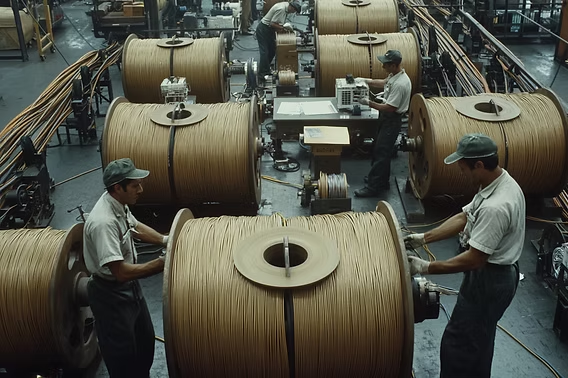
Copper wires are used everywhere to deliver light, power, and information. In metals, electrons—components of every atom—can move freely through the material. This property makes metals such as copper excellent conductors of electricity, allowing energy or signals to travel with minimal loss. Wire is produced by pulling a strip or rod of metal through a series of holes in a hard material, each smaller than the last, until the desired thickness is achieved.
Glowing Rollers
When iron is heated until it glows red, it becomes soft enough to be shaped into complex forms. Blacksmiths use this property when making horseshoes and various steel objects. On an industrial scale, rolling mills compress large steel bars into beams or railway tracks used in construction, where loads must be supported across wide spans. The metal passes through rollers that shape it progressively. The final set of rollers, working when the metal is nearly cool, gives precise dimensions and may even imprint the manufacturer’s name. Railway tracks are produced in the same way.
Joining Objects
Technological products are generally made by joining separate pieces of material. This is because different parts require different properties, or because the final form—such as a bridge or a clock—is too large or complex to be made as a single piece. There are five main methods of joining materials: parts can be drilled and fastened with rivets, bolts, or threaded elements; surfaces can be bonded with materials such as solder or adhesives; materials can be fused together, as in welding; parts can be held by friction, like a nail in wood; or they can be designed to fit together, like pieces of a plastic toy.
Joining Devices
Most fastening devices rely on friction, including nails, screws, and bolts. Screws and dowels hold parts together by tightening and increasing friction. However, screws and nuts may loosen under vibration, so additional elements such as washers or plastic inserts are used to maintain stability. Rivets, while less convenient, are highly reliable because they pass through both parts and deform to create a permanent joint.
Metal Rivet
Rivets depend on friction to prevent rotation and loosening due to vibration. A rivet is a metal pin with a head but no thread. It is inserted through aligned holes in two parts, and the opposite end is hammered flat to secure the joint permanently. This method is commonly used in aircraft structures. Pop rivets are used when access to the opposite side is limited. Metals can also be melted with a flame or electric current and fused along their edges.