Steel columns
Desde estructuras de acero hasta microchips, la ingeniería combina pruebas, diseño digital y control electrónico para desarrollar tecnologías complejas.
Architectural model
Realty building, Chicago, USA. When structural steel became available in the late nineteenth century, American architects and engineers identified a solution for overcrowded cities. The designer of this 1898 building, aware that people were used to stone walls, covered the steel frame with decorative stone. Buildings of the Modern Movement in the 1930s later revealed their true structure. Many designers work with complex systems. Architects and engineers are often assigned the difficult task of creating models that convey a new environment for people. Models like this communicate the planner’s concepts to the client. Living systems are unpredictable and require many years of testing and adjustment before they are ready. Model of a hospital.
Jet test
A large jet engine is complex and powerful; elaborate arrangements are required to test a new design. Engineers know that unexpected defects may always appear. The engine shown here was taken to a test track so that noise levels could be measured using an array of microphones. Radio signals (radiometry) transmit data to a computer. The computer produces reports on speed, temperature, noise, and vibration to help engineers detect faults and correct them.
Wind tunnel test
Customers now demand faster cars that consume less fuel. Aerodynamic drag and air resistance have become important. The airflow over a newly designed car can be examined using smoke in a wind tunnel. If a curve proposed by the designer interferes with the airflow, it may need to be modified.
Computer design
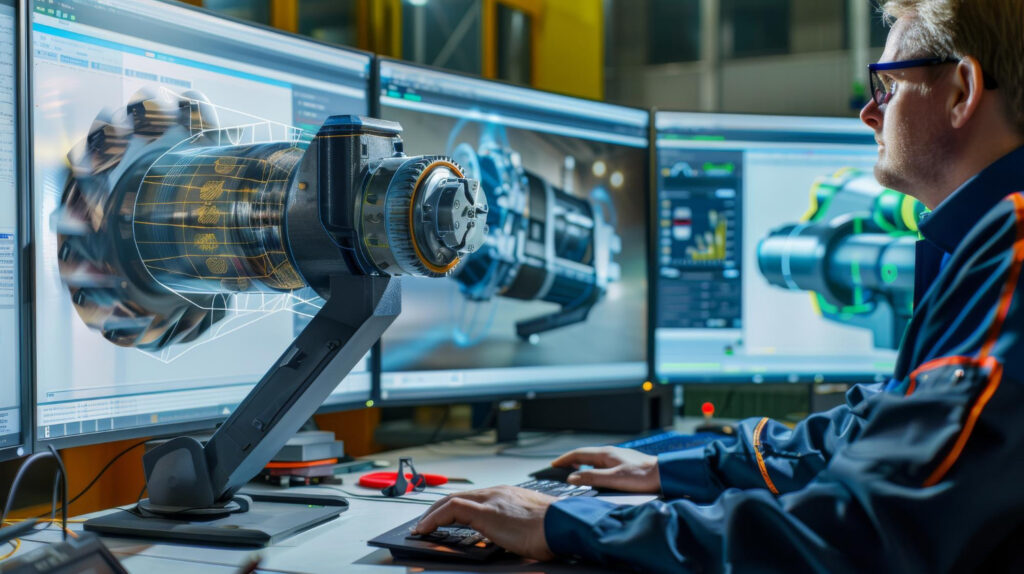
Today it is impossible to imagine design without computers. Engineers fifty years ago did not even have pocket calculators. Many problems remained unsolved because the required calculations would have taken too long. Engineering designers now work on advanced computers where they visualize their creations in color and in three dimensions. Ensuring that all parts fit together saves time. For very complex problems, such as designing shapes for fluid flow, the computer is essential. Once the product is designed with the correct specifications, manufacturing is ordered.
Electronics and computing
Electronics is relatively new
Transistors, key components of microchips, were invented in 1947. Microchips, which made modern electronics possible, appeared in 1962. The principle of electronics lies in how electricity controls more electricity. An electronic switch, unlike a common switch, can be operated by another similar switch. For this reason, large assemblies of switches—transistors—are combined into a single chip and self-controlled, carrying out complex sequences of operations that transform one pattern of electricity into another. The development of electronics, reinforced as computers design better computers, has been remarkable.
The transistor
Like vacuum tubes, transistors control electrons, but the particles move within a solid rather than a vacuum, and no heat is required to release them. Transistors like this are used to control devices such as motors. Because transistors are made by modifying a single material, silicon, they can also be produced in extremely small quantities within a single chip.
Amplifier microchip
The microchip turned electronics into a force capable of transforming the world. The first experimental silicon chip was created in 1958. Early chips contained a few dozen transistors, but now they can contain more than a million.
Altering silicon to make chips
Electronic chips are produced by adding impurities to pure silicon, subtly modifying it to create microscopic patterns that control the flow of electricity. Here, an engineer inspects a vacuum chamber used in the production process. Glass tube with metal parts, under vacuum.
The first vacuum tubes
In 1904 it was discovered that electrons, released from heated wires traveling through a vacuum, could be used in an electrical circuit. In 1906 the American Lee De Forest (1873–1961) found a way to control electrons electrically, creating the first electronic device, the vacuum tube.
Disk drive
Memory makes computers useful. Without it, information and instructions would have to be passed to and from the machine manually, reducing everything to human speed. Computers have fast electronic memory to store everything they process. Slower memory, such as that of this magnetic disk, is better suited for other data: it is cheaper and does not lose its contents when power is cut. If the computer needs something from the disk, it can retrieve it in a fraction of a second.