Data Processing
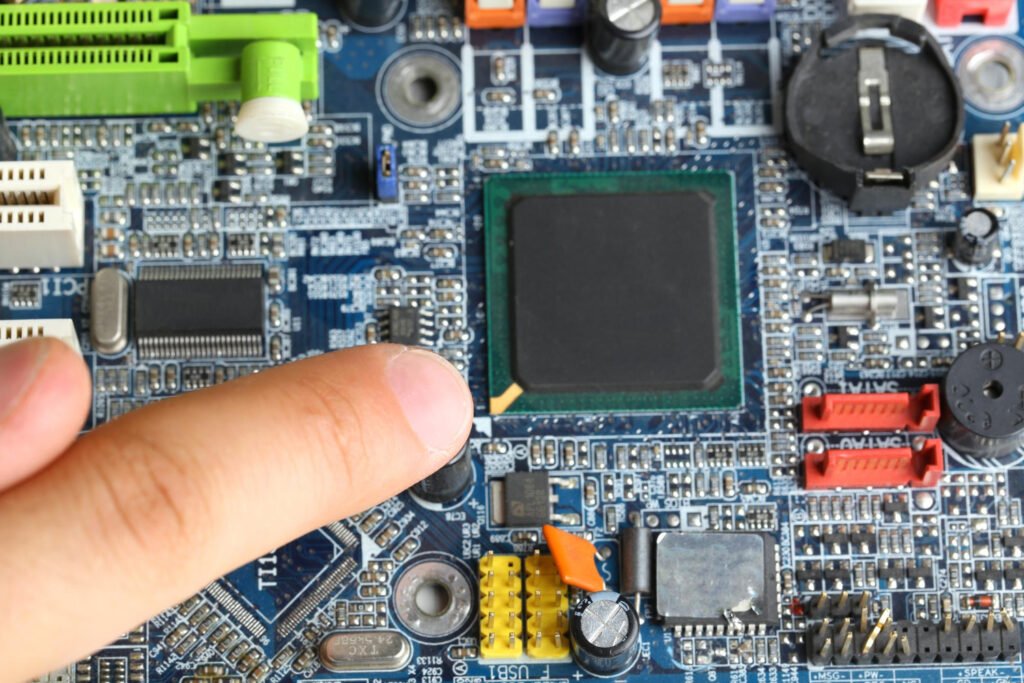
Detalle de un circuito integrado y los conectores de una placa madre.
To process data, a microprocessor executes the instructions of a program stored in memory. The program counter holds the address of the next instruction. The CPU normally moves on to the next instruction in memory. A branch instruction can change that address and alter the order of execution.
The process can be described in two phases. First, the CPU fetches and decodes the instruction. Then it carries out the specified operation. In a synchronous processor, a clock signal coordinates these operations.
Instruction Fetch and Decode
The CPU uses the address in the program counter to fetch the instruction from memory and load it into the instruction register. The control unit interprets the opcode to determine what to do, such as adding two values or transferring data. The instruction can also specify the operands, which are the values involved or the locations where they can be found.
The program counter is updated to point to the next instruction. Register names and their specific functions depend on the processor design.
Execution Cycle
Once the instruction has been decoded, the CPU performs the required operations. The examples below use simplified instructions to show how data is moved and processed.
Reading from a Peripheral
To store a value received from input device 1 at memory address 10, the CPU identifies the device, reads the value, and writes it to the specified address.
Writing to a Peripheral
In this example, WRITE 2, 10 tells the CPU to read the value stored at memory address 10 and send it to output device 2.
Reading and Writing Memory
In a CPU with an accumulator, ADD 5, 6 can represent the addition of the values stored at memory addresses 5 and 6. The result stays in the accumulator. The instruction TRA 10 transfers that result to memory address 10.
Timing
Clock frequency is the number of cycles per second, measured in hertz (Hz). A clock cycle is the interval between two consecutive edges of the same type in the clock signal. A simple model distinguishes three concepts.
- Clock cycle. The basic unit of time set by the processor clock.
- Bus cycle. The time required for a transaction over the bus, such as reading a value from memory. It can span several clock cycles.
- Machine cycle. A basic operation within instruction execution, such as reading or writing memory or communicating with a peripheral.
The time these operations take depends on the architecture and, when external devices are involved, on how quickly they respond. In a pipelined processor, one instruction can be fetched while another is being executed.