Floppy Disk Structure
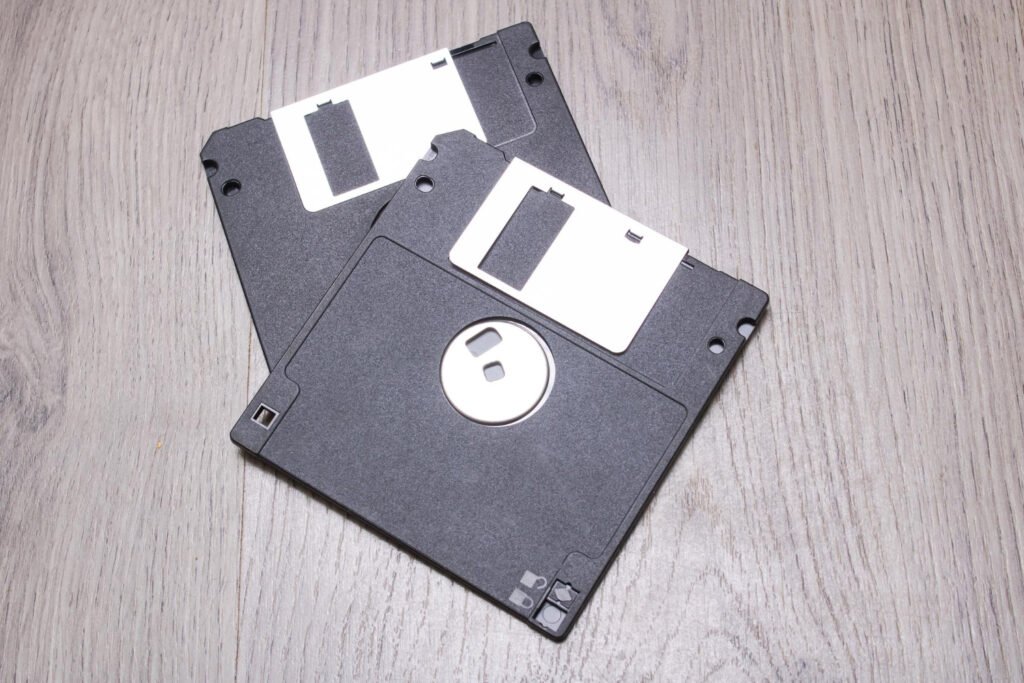
En el reverso del disquete en primer plano se distingue la pestaña de protección contra escritura.
The Mylar substrate and the magnetic material deposited on its surface form an assembly that is inserted into a square protective jacket, which is then sealed. The jacket has several openings, each with a specific function. The central hole allows the drive mechanism to spin the disk once it has been inserted. After being inserted through the drive slot and placed in its operating position, the floppy disk spins at 300 to 360 revolutions per minute. An elongated slot also allows the read/write heads to access the surface of the magnetic medium.
To control the speed of the floppy disk and identify the start of each data recording track, both the jacket and the disk medium of 5¼-inch floppy disks have a small hole that allows a photoelectric cell to detect the start of the track. The ability to record data on a floppy disk and read it later is one of the main characteristics of this type of magnetic storage medium. However, the data on a floppy disk can be important enough to require a mechanism to protect it from accidental erasure. On 5¼-inch floppy disks, there is a square notch on the right side. Covering it with adhesive tape prevents the data on the disk from being erased. On 3½-inch floppy disks, the notch is in the lower-right corner on the back and contains a square plastic tab that can slide up and down. In its upper position, the tab allows data to be erased. In its lower position, it prevents erasure. To reduce the risk of damage to the disk surface when the heads land, an area of the surface is generally reserved where no data is processed. However, if the heads land in a data area when the drive is turned off, no damage occurs because the surface is lubricated to ensure good contact with the heads.
Another notable feature of Winchester-type hard disk drives is the airtight seal on the chamber containing the disks and heads. If a head flying 20 millionths of an inch above the surface of a disk spinning at 3,600 revolutions per minute collides with a speck of dust larger than 500 millionths of an inch, the collision could cause significant data erasure or even scratch the disk surface, resulting in data loss. To address this problem, Winchester-type drives use an airtight enclosure that protects the interior from contamination by outside air. An internal air filter also captures particles that may come off the hard disks.
Head Positioning and Movement
As the number of tracks per inch increases, reaching several hundred tracks per inch in traditional systems, aligning and centering the head over the desired track becomes a problem. One head and one disk surface have been dedicated to control functions to solve this problem. Servo Track Following provides accurate positioning even at very high track densities. It requires a full platter surface, a head, and control electronics dedicated to this task. Lower-cost drives use a stepper motor as the main mechanism for moving the read/write heads. This motor rotates in short, essentially uniform angular steps. With this mechanism, the average head travel time is 66 milliseconds. More advanced hard disk drives move the heads using a linear or voice coil motor. In this type of electric motor, the armature moves in a straight line, as it does in magnetic trains. This makes the drives more expensive and complex, but considerably faster. The average track access time is 21 milliseconds, compared with 66 milliseconds for stepper motors.
Hard Disk Characteristics
Drives based on Winchester technology have dominated the market for several years, and their development has focused mainly on reducing cost and size, with less emphasis on increasing capacity. The field evolves so rapidly that even the latest technologies become outdated in a short time.
Standard formats measure 14, 8, and 5¼ inches. A slim, low-profile 5¼-inch format appeared later. Hard disks store large amounts of information, ranging from megabytes to gigabytes (one thousand megabytes), and that information must be protected. An information processing system must allow data on hard disks to be copied to other storage media. If the computer uses low-capacity hard disks, this backup can be made on floppy disks. A hard disk with a capacity of 40 MB or more would require too many floppy disks, so the backup must be made on another medium, such as a second hard disk or magnetic tape.