Punched Cards
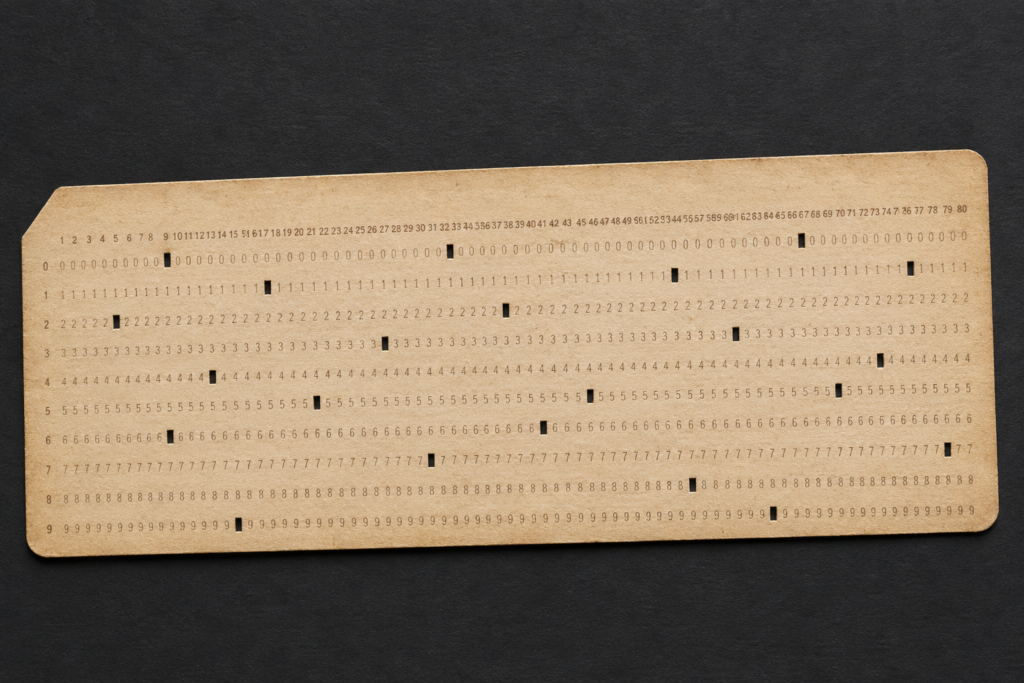
La presencia o ausencia de un orificio en cada posición determinaba la información almacenada en la tarjeta.
These storage media, now a thing of the past, were derived directly from Hollerith’s tabulating machines and consisted of simple rectangular cards arranged in 12 rows and 80 columns. The presence or absence of a hole at each position determined the information stored on the card. Punched cards could not be reused. Once a set of data had been punched into a card, no new data could be punched into it. This type of memory was used when there was only a small amount of information to record. Special devices called card punches were used to record information on a card. The card was then read by a separate device, the card reader, which used photoelectric cells to detect the presence or absence of holes.
Punched Paper Tape
Punched paper tape, once used for data storage, is now obsolete, although it remained in use for some years in certain numerically controlled machine tools.
On punched paper tape, data characters are recorded as combinations of holes arranged across the width of the tape, perpendicular to its length. Paper tape is a continuous medium. Data can be recorded as long as there is tape available. The length of the tape can vary. Like punched cards, paper tape cannot be reused. It also requires the computer to have a tape punch and a tape reader. Another major drawback was that the reading and writing devices were noisy.
Magnetic Tape
Magnetic tape consists of a strip of plastic coated with ferromagnetic material. Characters are recorded on tracks that run parallel to the length of the tape. Each character is recorded as a set of simultaneous magnetic signals (for example, eight for the byte and one additional signal for the parity bit) along a single line across the tracks. These storage media are built and operate in the same way as the tapes used in conventional cassette recorders. One drawback is that accessing a particular piece of information requires reading all the information that precedes it, which takes time. This medium is now used only in large computing centers, where vast amounts of data need to be stored inexpensively and relatively slow access is acceptable.
Magnetic Bubbles
Magnetic bubble memory works by recording small magnetized regions, called bubbles, in a thin crystalline layer of special oxides. The term magnetic bubble comes from the similarity between the movement of these small magnetized regions, which move, appear, and disappear, and that of gas bubbles in a liquid. The bubbles can be moved as needed within the material, allowing information to be accessed without moving the storage medium or risking mechanical failures. This memory is nonvolatile and uses sequential rather than direct access, but its access time is much shorter than that of magnetic tapes and somewhat shorter than that of hard disks. It has a high integration density (108 bits per square inch) and is highly resistant to harsh environmental conditions.
Flexible Disks or Floppy Disks
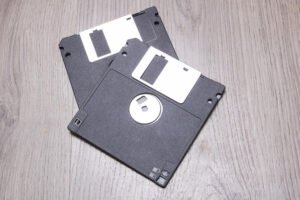
The floppy disk is a variant of the magnetic drum, an older storage medium that has fallen out of use. We will devote more space to this magnetic data storage medium because it is the most widely used in computing. The mass storage devices used before floppy disks generally had limited storage capacity and were slow at both reading and writing. The introduction of the floppy disk made low-cost mass storage available and offered fast read and write speeds.
The floppy disk was created by IBM and introduced in its equipment in the early 1970s. In 1972, the 3740 system was introduced to the market with a floppy disk-based mass storage system.
Floppy disks have evolved in both size and storage capacity. They went from 8 inches to 3½ inches and from a capacity of about 100 Kbytes to 2.88 MB in the 3½-inch format. Floppy disks offer considerable advantages in computing, including:
- storage capacity
- technical reliability, with very few read and write errors
- data integrity
- ease of use