The Factory
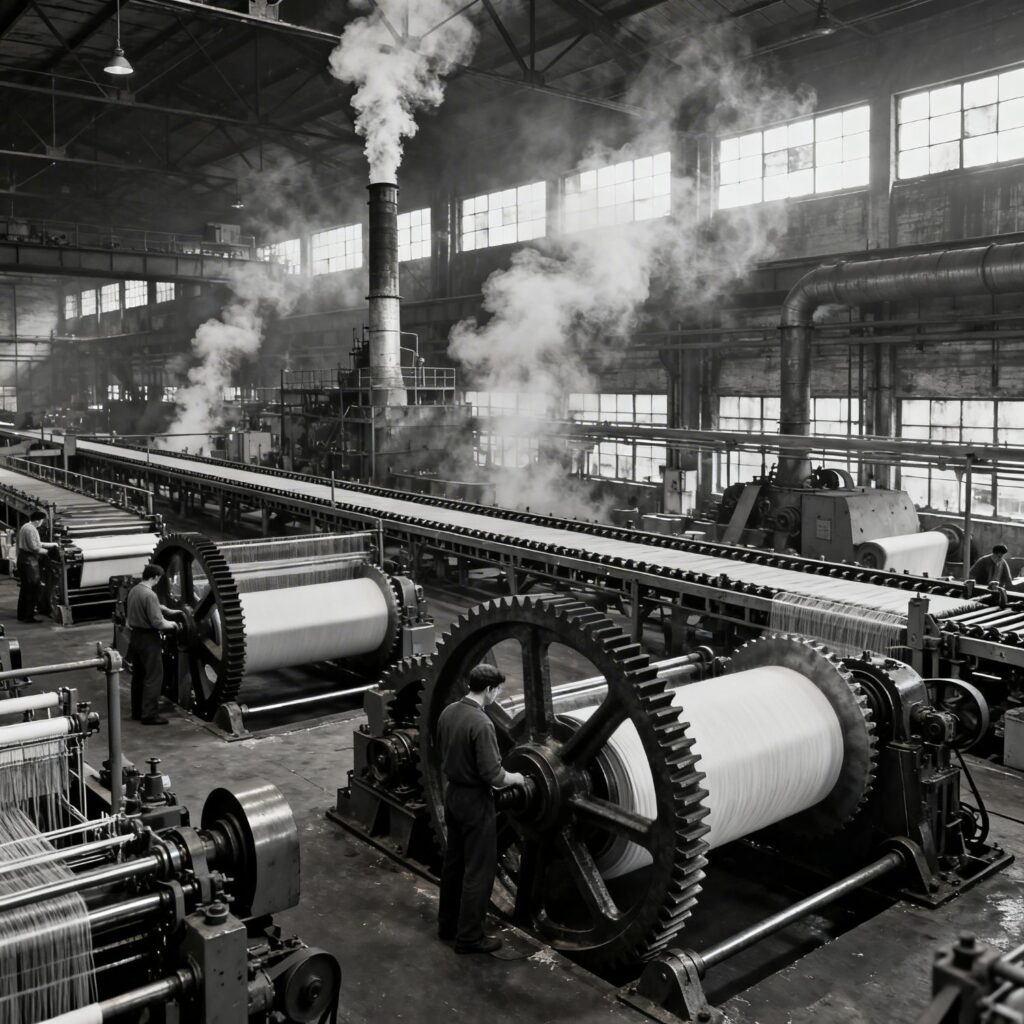
La mecanización y el uso de energía transformaron la producción artesanal en industria masiva.
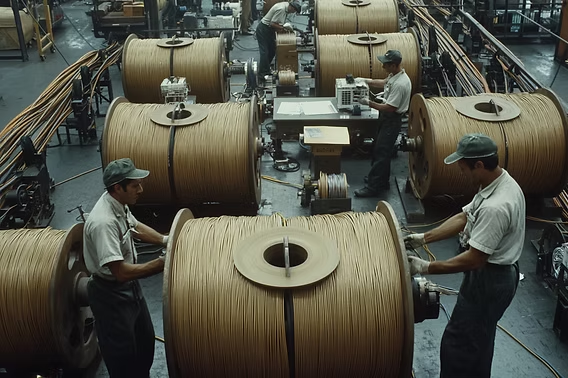
The purpose of the factory was to gather groups of workers around machines that produced goods previously made by hand. This organization reduced time lost when switching tasks and improved efficiency. It led to the system of mass production developed by Henry Ford, still used today. Although early factory owners were not generous, workers could earn more than at home or on farms, and factory labor became a widespread way of life.
Water Power
Water played a central role in the Industrial Revolution, enabling the rise of factories that shaped the modern world. Flowing water turned wheels like this one, providing energy to operate spinning machines and looms in textile mills. Canals also offered a more efficient transport system than dirt roads. Access to energy and communication determined business success, just as it does today.
Mechanization of Work
Work began to be mechanized in the mid-eighteenth century after thousands of years of manual production. Advances in science and mathematics increased confidence in applying new ideas. Factory owners introduced improved methods using water-powered machines, transforming traditional crafts such as spinning and weaving. These innovations led to mass production of textiles, making wool and cotton clothing significantly cheaper.
Spinning Process
Spinning is the process by which fibers of wool or cotton are twisted together to form thread for fabric. Before mechanization, this was done by hand using a spindle. One hand twisted the fibers while the weighted spindle helped maintain tension, producing thread slowly and unevenly. This method became obsolete with the introduction of the spinning wheel, which arrived from India in the twelfth century.
The Spinning Frame
The water frame, invented in 1769 by Richard Arkwright, advanced spinning mechanization significantly. It used a system similar to a spinning wheel but operated vertically. It also automated the feeding of raw fibers and was designed to be powered by water. This allowed faster production with less skilled labor.
Belt-Driven Factory (1900)
In this textile factory, power was transmitted through belts connected to mechanical systems that distributed motion across the workspace. These belts often broke, wasting energy and causing injuries. In the early twentieth century, electric generators and motors replaced such systems, improving both safety and efficiency.
Mechanization for Speed and Efficiency
One way to accelerate production is by processing multiple items simultaneously. A tailor making a custom suit cuts individual pieces of fabric by hand. In contrast, factories producing clothing for mass markets cut hundreds of pieces at once using laser technology. Guided by computers that store digital patterns, lasers can cut multiple layers of fabric precisely without damage.
Heat Engines
Heat and motion are forms of energy. A heat engine converts one form of energy into another. The English engineer Thomas Newcomen built one of the first successful steam engines in 1712 to pump water. Today, steam turbines—machines that spin like fans—drive generators that supply much of the world’s electricity.
The performance of a heat engine is measured by the proportion of heat it converts into useful work and the amount of energy it produces relative to its weight. Heat is transformed into motion by burning fuel in contact with moving parts, as in internal combustion engines or jet engines.