Computer simulation
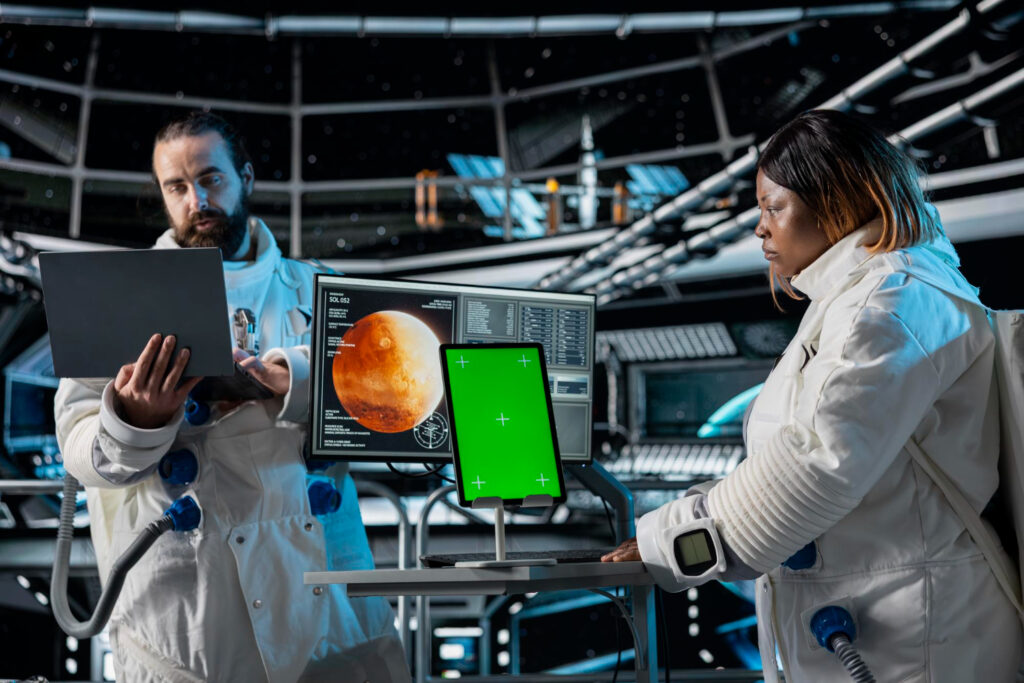
La evolución tecnológica permitió simular fenómenos complejos, explorar el espacio y transformar la medicina mediante diagnóstico e intervención más precisa.
Computers have become essential tools for designers. High-performance workstations—more powerful than standard personal computers—transform mathematical models into visual representations at high speed. In aerospace applications, simulations calculate complex phenomena such as airflow during atmospheric reentry. What would take a human lifetime to compute manually can now be processed in minutes. This allows iterative refinement: designs can be tested, adjusted, and optimized before physical production.
Computer-aided design
Traditional design required manual drafting followed by skilled machining. Today, Computer-Aided Design integrates visualization and manufacturing. Designers create digital models that are directly interpreted by machines, often through CNC Machining, enabling precise cutting and shaping of materials. This reduces error, accelerates production, and allows complex three-dimensional forms to be developed efficiently.
A moon of Jupiter
Modern space exploration depends on computation. Missions such as Voyager Program rely on onboard computers to guide spacecraft and capture data. Images of Io, obtained in 1979, were encoded and transmitted to Earth via radio signals. Ground-based systems then processed and enhanced the data, transforming raw signals into scientifically usable images.
Electronic news gathering
Electronics extends beyond computing into communication. Since the 1970s, advances in cameras and transmission systems have enabled real-time broadcasting. Today, live images from distant locations are captured, encoded, and transmitted instantly, redefining how information circulates globally.
Medical technologies
Before modern science, disease and mortality were accepted as inevitable. Advances in medicine reframed the human body as a system that can be diagnosed and repaired. Technologies such as Medical Imaging allow physicians to observe internal structures without invasive procedures. Surgical techniques now rely on precise instruments and controlled environments, improving survival rates and reducing trauma.
Historical surgical tools
Ancient procedures were performed with limited understanding of hygiene. Instruments such as bone saws were used without sterilization, leading to high mortality rates. By the nineteenth century, anesthesia and antiseptic methods began to transform surgery into a controlled medical practice.
Leeches and circulation
For centuries, Leech therapy was used to treat illness based on the belief that removing blood restored balance. Although largely abandoned, leeches have reappeared in modern medicine due to their biochemical properties. Their saliva contains anticoagulants that help restore blood flow after microsurgery.
X-ray imaging
In 1895, Wilhelm Röntgen discovered X-rays, enabling non-invasive internal imaging. This technique relies on differential absorption: dense materials like bone block radiation, creating contrast on photographic or digital sensors. X-rays remain fundamental in diagnostics and are also used in cancer treatment through controlled radiation exposure.
Rapid bone repair
Modern orthopedic surgery uses materials such as titanium and stainless steel to stabilize fractures. When bones such as the femur break, internal fixation devices restore alignment and allow healing. These interventions combine material science and medical engineering, significantly improving recovery outcomes compared to historical practices.