Agriculture and technology
La agricultura evolucionó desde prácticas manuales hacia sistemas mecanizados y tecnológicos que multiplicaron la productividad.
When humans discovered agriculture around 10,000 years ago, they initiated the first systematic attempt to control their environment. Instead of relying solely on gathering or hunting, food production became organized and more predictable. Agriculture reduced the time required to obtain food and enabled the development of other activities. For centuries, methods changed little after the introduction of the plow, until the late eighteenth century, when mechanization and labor shifts toward industry transformed production systems.
Traditional farming systems
Medieval agriculture relied on manual processes. After plowing, seeds were scattered by hand, with significant losses due to uneven distribution and environmental exposure. Harvesting was carried out with simple tools such as sickles. Soil fertility was maintained through fallow cycles, leaving land unused periodically to regenerate nutrients. These systems required extensive labor and produced limited yields.
The plow and soil transformation
Developed thousands of years ago, the plow became a central tool in agriculture. Its function is to turn over the topsoil layer, producing several effects: incorporating crop residues, exposing soil to climatic conditions that improve structure, and burying weeds to suppress their growth. Modern plows, pulled by tractors, increase efficiency and allow cultivation on a larger scale with fewer workers.
Mechanization and productivity
Technological advances introduced machines that increased output and reduced labor requirements. The seed drill, invented in 1701 by Jethro Tull, improved planting efficiency by placing seeds at controlled depths and spacing. This reduced waste and enhanced crop development.
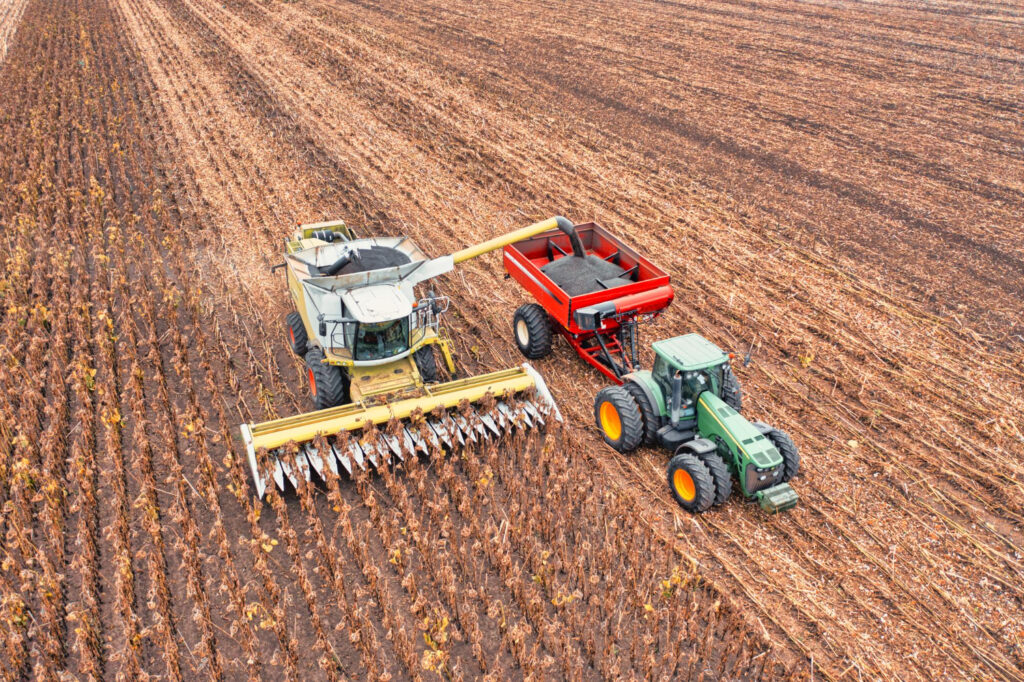
Later, the development of the threshing machine enabled simultaneous harvesting and processing. Crops were cut, grain separated from stalks, and cleaned in a continuous system. These innovations supported large-scale agriculture, particularly in regions with extensive farmland.
Fertilization and nitrogen cycles
Plant growth depends on key nutrients, especially nitrogen. Although abundant in the atmosphere, nitrogen must be converted into forms usable by plants through soil processes. By the late nineteenth century, the application of Nitrogen fertilizers significantly increased yields.
Combined with other practices—such as weed control—fertilizers can lead to surplus production. This has created contrasting outcomes: overproduction in industrialized regions and dependency in areas lacking technological access.
Refrigeration and global distribution
Technological advances also transformed food distribution. In livestock systems, such as sheep farming in Australia, meat could not initially be exported due to its perishability. The development of refrigeration in the late nineteenth century enabled long-distance transport of perishable goods, integrating global food markets.
Harvesting systems and data integration
Modern harvesting machines combine cutting, threshing, and cleaning processes. Grain is separated from plant material and transferred directly into transport systems, while byproducts such as straw are stored for later use. Advanced models incorporate satellite systems and onboard computers to analyze field performance, optimizing yield and resource use.
Food preservation and sensory systems
Taste and smell function as biological mechanisms to detect spoilage and environmental conditions. Decomposition produces odors due to microbial activity. Preservation techniques such as salting and pickling inhibit bacterial growth but alter flavor. Technologies like canning and freezing extend shelf life while maintaining original characteristics.
Food in extreme environments
Supplying food in space requires adapting to the absence of gravity. Loose particles cannot be controlled, so food is packaged for direct consumption. To reduce weight, products undergo freeze-drying, which removes water while preserving nutrients, flavor, and texture. The process involves freezing food and then creating a vacuum, allowing water to evaporate as vapor. Rehydration restores edibility during consumption.
Technology as an agricultural system
Agriculture has evolved from manual subsistence to a technologically integrated system. Each stage—soil preparation, planting, growth, harvesting, preservation, and distribution—relies on scientific and engineering advances. This transformation has increased productivity but also introduced new challenges related to sustainability, resource management, and global equity in food systems.