Classification of the Sciences
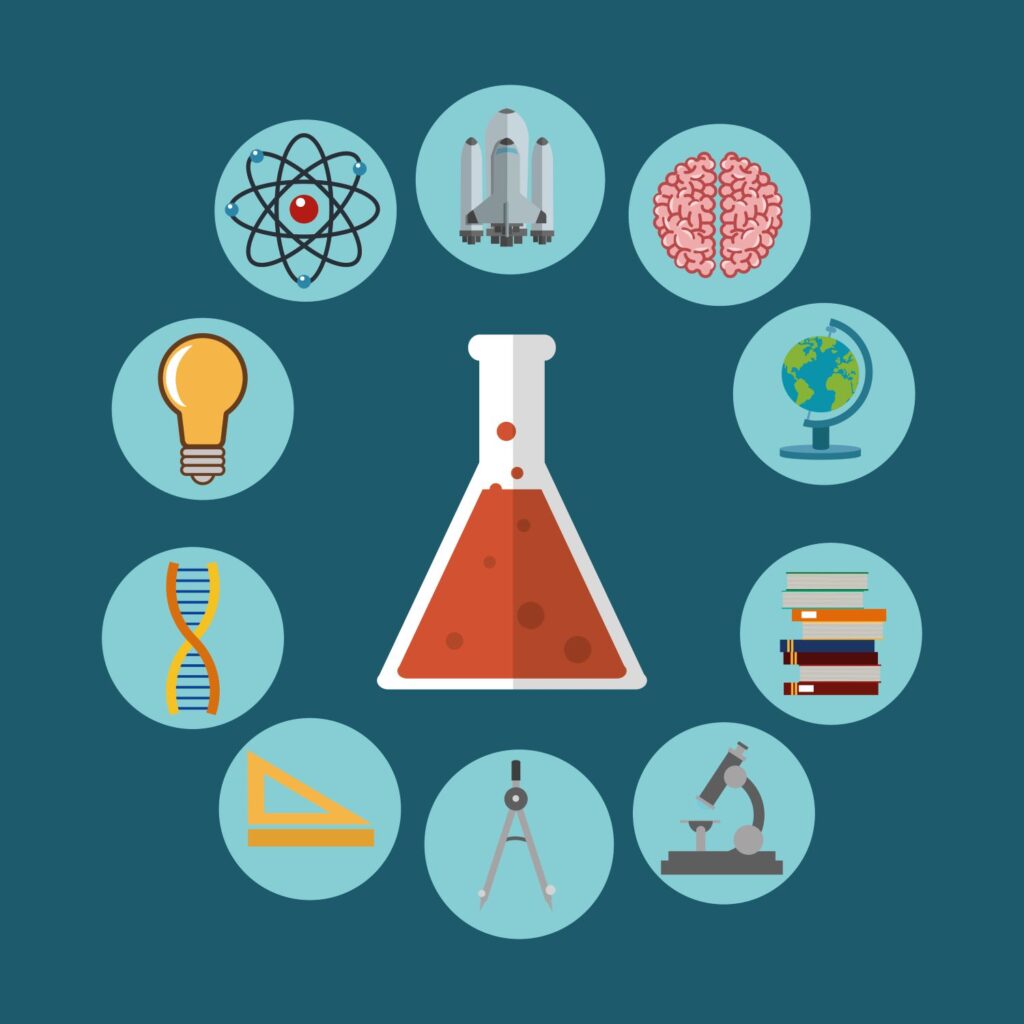
Las ciencias se organizan en distintas ramas según sus objetivos, métodos y campos de estudio, integrando disciplinas naturales, sociales y formales.
In the great philosophical schools of antiquity, the almost mythical figure of the sage encompassed the totality of knowledge of the time and its cultural environment, often applying unified principles without delving deeply into details. Over the centuries, a distinction emerged in the appreciation of knowledge, divided into two complementary roles: the philosopher and the scientist. These qualitative distinctions, arising from the empirical nature of scientific studies, led to successive divisions of knowledge into specialized domains. The organization of scientific disciplines within the broader framework of knowledge involves three key aspects: defining their characteristics and research objectives, establishing classification principles to hierarchically group them, and acknowledging the diversification and specialization that shape their development.
The issue of classifying the sciences from this perspective has been addressed in various ways throughout history. The legacy of medieval European universities led to a division between two major areas of knowledge, traditionally known as sciences and humanities, alongside other disciplines grouped under techniques or applied sciences. This division, based on the literary character of fields such as history versus the positivist orientation of the natural sciences, gradually lost relevance from the nineteenth century onward, when the social sciences emerged and historical studies began to adopt methodological frameworks similar to those of the natural sciences.
Other attempts at classification distinguished between descriptive sciences, primarily concerned with enumerating the functional characteristics of their objects of study, and deductive sciences, which derive results from hypotheses through observation and reasoning processes. However, no scientific discipline fully conforms to either category, although many display tendencies toward one or the other.
Another widely accepted classification is based on the objectives pursued by different disciplines, leading to the distinction between natural sciences and social sciences as two major branches of knowledge. Mathematics, due to its role as a fundamental tool in the theoretical considerations of most sciences, occupies a somewhat independent position, serving as a foundational pillar in both the linguistic and methodological formulation of principles and axioms across scientific fields.
The historical problem of interpreting the nature of light, which gave rise to the field of optics, became linked with discoveries in electricity and magnetism when these disciplines converged into a unified framework analyzing electromagnetic radiation, of which visible light is a part. This development did not immediately resolve the debate between the corpuscular and wave nature of light. Quantum mechanics, in the first half of the twentieth century, offered a conciliatory solution by proposing that every material particle is associated with an intrinsic wave, and vice versa.
This equivalence hypothesis connected with earlier conclusions from the theory of relativity, which also revealed mechanisms for the transformation of mass into energy. Subsequent research on elementary and subatomic particles led to the identification of new forms of interaction among physical entities, described through complex mathematical models. In modern physics, four fundamental types of interactions are distinguished: gravitational, studied within mechanics and dynamics; electromagnetic, analyzed through electricity, magnetism, and optics; and the strong and weak interactions, which operate at the scale of atomic nuclei and are addressed within nuclear, atomic, and quantum physics.
Thermodynamics, of exceptional importance, focuses on analyzing the effects of these phenomena, particularly energy exchanges within physical systems. The increasing similarity in mathematical treatments of physical phenomena has encouraged efforts to unify descriptions under field theory, which seeks to integrate weak, strong, and electromagnetic interactions, and potentially include gravitation.
Chemistry originated from alchemical attempts to control the transformation of elements and gradually established its independence from mystical traditions. By the early twentieth century, its level of rigor became comparable to that of physics, consolidating its role as a central scientific discipline.