The science and its historical process
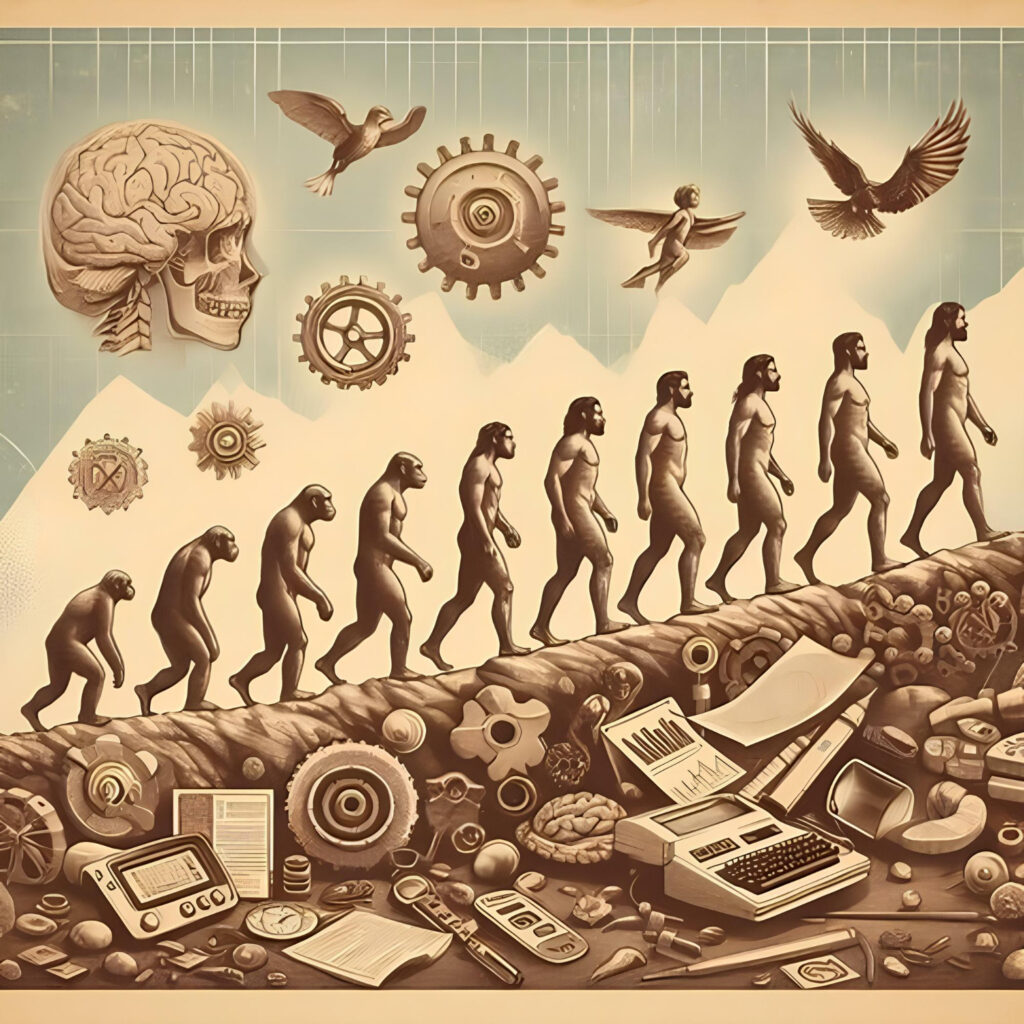
De las explicaciones míticas al método científico, la humanidad construyó un sistema de conocimiento basado en observación, razonamiento y transmisión acumulativa.
As soon as human beings became aware of their existence on Earth, they developed an inquisitive spirit that led them to question their surroundings and the ultimate purpose of life. Answers to such questions were pursued through different paths throughout history. Primitive explanations based on animistic beliefs and magical rituals gradually gave way, with the evolution of cultures, to theological and philosophical doctrines. From these systems of reasoning—interpreted in their most secular form—emerged the essential foundations of science.
Science has generally remained compatible with a metaphysical sense of life. Understood as the accumulation and synthesis of human experience since the origins of culture, it represents, in its positive dimensions, the culmination of a collective effort transmitted across generations. This process enabled progressively higher levels of social well-being and a growing sense of control over the conditions shaping civilizations. Since the late Middle Ages, science has experienced continuous expansion alongside an ongoing process of diversification and specialization. In recent decades, the number of professional scientists has become comparable to the total of scholars and researchers from all previous eras. Despite this intense activity, science still confronts phenomena whose causes remain unknown or insufficiently determined. Consequently, its explanations of natural and human events often open new questions, reflecting an intellectual trajectory that mirrors the unfolding of human existence within the realm of thought.
Historical Approach
The origins of scientific reasoning, whether more or less structured, can be traced back to the earliest stages of humanity. Prehistoric remains uncovered through archaeological excavations reveal forms of knowledge about certain aspects of nature, transmitted orally and embedded within the fabric of primitive societies.
The first major centers of scientific knowledge emerged in Eastern and Middle Eastern cultures. From there, knowledge spread along trade routes to regions of the Mediterranean. Geometry, arithmetic, and astronomy reached notable levels of development in Mesopotamian and Egyptian civilizations. The distinctive geopolitical situation of Greek city-states between the 8th and 3rd centuries BCE enabled them to act as both recipients and developers of philosophical schools of thought. These traditions crystallized into a rational and universal approach to knowledge. As a result, the first purely scientific methods for analyzing natural phenomena were established. The Ionian school founded by Thales of Miletus, Plato’s Academy, and Aristotle’s Peripatetic school stand as prominent examples of a rich intellectual tradition characterized by the synthesis of prior knowledge. Their work led to significant advances in mathematics, medicine, logic, and natural history throughout the Mediterranean world.
The fall of the Western Roman Empire, which had preserved Hellenistic philosophical doctrines, caused a disruption in the transmission of knowledge. The role of preserving and advancing classical learning was then assumed by the emerging Islamic civilization. It not only compiled Greek texts and ideas but also integrated them with Indian scientific traditions and introduced important innovations, such as algebraic symbolism.
Until the Middle Ages, philosophical ideals from the Greco-Roman tradition had endured more robustly than scientific ones. During this period, both domains were reunited through translations from Arabic, which were incorporated into a Christian worldview without major conflict. The vitality of the late Middle Ages fostered the creation of libraries and universities where all branches of known knowledge were studied, paving the way for the European Renaissance through new techniques and geographic discoveries. Although the Renaissance itself did not introduce major scientific breakthroughs, it established a humanistic perspective on the cosmos. From this foundation emerged the revolutionary ideas of the 16th century that dramatically transformed the scientific landscape.
Astronomy, mechanics, and mathematics became the central fields of change during this scientific revolution. A heliocentric view of the universe, in contrast to the earlier Earth-centered model; the development of powerful techniques of infinitesimal calculus as an abstraction of geometric concepts; and the formulation of precise laws governing motion based on mass and gravitation constituted some of the most significant milestones in the history of knowledge during the 16th and 17th centuries. Closely associated with these advances are figures such as Nicolaus Copernicus, Galileo Galilei, and Isaac Newton.