From Gutenberg to IBM
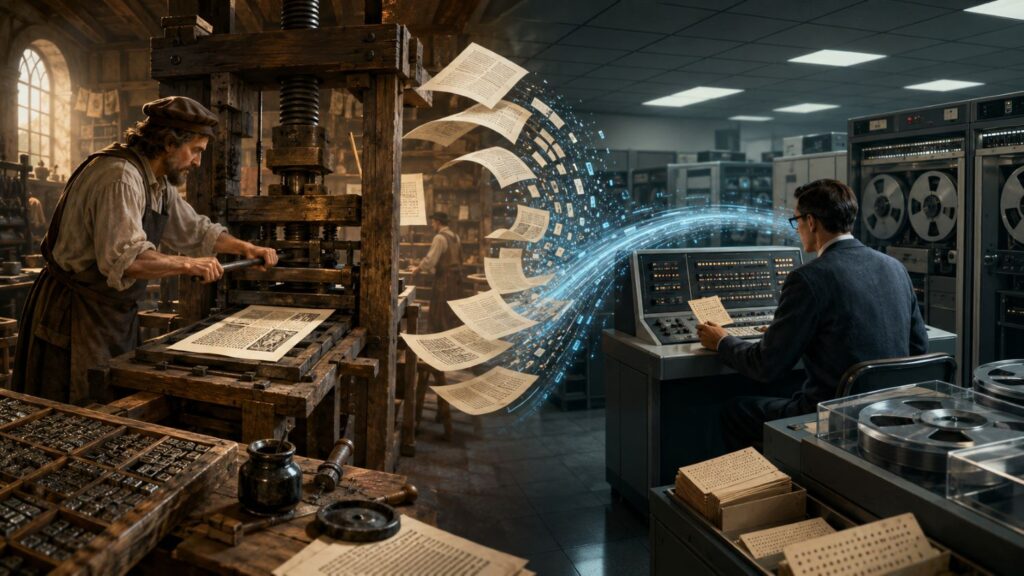
La imprenta y la computadora cambiaron la forma de producir, almacenar y compartir información, aunque también pusieron en crisis a quienes dominaron cada etapa.
The role played by technology in the Renaissance is well known. One curious example was the influence of the invention of eyeglasses, the lenses through which we see—those that inspired two affectionate metaphors from the poet Antonio Machado on an occasion when he lost them: “the lost scaffolding of my eyes” and “the projecting balcony of my gaze.” Before their invention, intellectuals were forced to abandon reading while they were still relatively young, when their eyesight, damaged by poor nighttime lighting, the difficult handwriting of texts and the effects of age itself, no longer allowed them to read and write. The invention of eyeglasses at the end of the Middle Ages extended the possibility of an active cultural life by several decades for thousands of people, and this became an indirect cause of the cultural revival known as the Renaissance. The most significant invention, however, came in the fifteenth century: the printing press. Before it, when manuscripts were scarce and rare, the usual vehicles of philosophy, scholarship, rhetoric and science were memory and oral language; technical knowledge was transmitted through gestures and words. The popularisation of the Bible had an impact on religion, breaking the Church’s monopoly over the sacred word, and it also affected technology itself by directing attention towards it. “Treatises” on agriculture, metallurgy, mechanics, fortifications, architecture, energy, military arts, mining and other subjects encouraged a cultural and productive explosion. The scientific revolution also followed: texts spread everywhere and inspired Copernicus and Galileo. Scientists began exchanging knowledge. Maps and atlases mobilised explorers, colonisers and merchants. The printing press competed directly with the copyists’ trade, and printed books competed with manuscripts. Yet it soon justified its title as the “art that preserves all the arts.” Its prophets went even further, calling it the “art capable of revolutionising all the arts.” Three centuries after Gutenberg, Carlyle wrote that the invention had “dissolved armies, dethroned kings and created a new democratic world.”
There is a tragic aspect to the vicissitudes of the first printing press: the conflicts its standard-bearer had to face with competitors, financiers and courts. Little is known about the mysterious Johann Gutenberg—whose surname was not actually Gutenberg but Gensfleisch—and even his essential contribution is not fully understood. It consisted of special moulds for rapidly producing large quantities of typographic pieces, effectively a “machine tool”: a tool for manufacturing the machines used in printing, namely the movable types, within a system that also included paper, ink, design, engraving and presses. The best historical repository for learning about him is found in the court archives of several German cities. There we can discover his Homeric legal battles to protect his secrets and the ownership rights to his invention. Yet the stubborn inventor did not abandon his efforts and safeguarded his most valuable secrets against competitors, judges and litigants. Years later, he succeeded in convincing others to finance new printing equipment and resumed the task of bringing his art to completion. At the end of his life, once again ruined and almost blind, he received a modest pension from the Archbishop of Mainz that included “a fixed quantity of grain, wine and one gentleman’s suit per year.”
How could anyone fail to notice that the role of the computer in the current revolution is analogous to that of the printing press during the Renaissance, and that the two periods share important similarities? To illustrate this, one need only consider developments such as the challenge posed to established authorities and the universal need for people to update their knowledge and skills. One example among hundreds is the decisive phenomenon of the internationalisation of banking and commerce, which we are witnessing as though on a stage of shifting sands. The massive expansion experienced by global trade and markets would not have been possible without the computerised management of data through a worldwide electronic communications network. Although this does not allow us to predict the future of the computer revolution, it would not be inappropriate for someone qualified for the task to examine the similarities between the two periods. Taking advantage of our knowledge of what happened in the earlier one could help us better understand the revolution now under way.
More interesting and simpler, however, is to consider the difficulties faced by the powerful.
No one would imagine that IBM could end up like Gutenberg. Even so, when one reads in La Nación, for example, that “its emblematic skyscraper, located in the heart of Manhattan, has been sold by the American multinational as part of a drastic cost-cutting policy,” it is tempting to continue the analogy. IBM’s romance with computing began when Remington Rand won the contract for the 1951 Census with its UNIVAC computer. The company, which dominated the office machinery market, recognised the trend and entered the arena. It soon became the undisputed king. For many years, it dominated not only the domestic market but also the international one. What happened to it? Some speak of bureaucratic heaviness, others of strategic errors in assessing the business, such as the initial underestimation of the personal computer, or of problems with the Department of Justice concerning antitrust laws. There is no shortage of imaginative observers who evoke the dinosaurs, which supposedly perished because of their enormous size, or lovers of historical metaphors who recall Gibbon’s account of the fall of the Roman Empire. What is certain is that the giant’s misfortunes have been dramatic. It is said that IBM also chose the wrong partner when it entered the personal computer business belatedly, around 1980. It passed up the opportunity to reach an agreement with Digital, a leader in PC systems, and instead entered into a partnership with Bill Gates’s Microsoft, which from then on became its dark shadow, helping the master of icons become a multimillionaire. Some attribute IBM’s passivity to its underestimation of the personal computer, but also to its fear that making these machines too powerful and effective would reduce the advantages of its core mainframe business. Others supplement this argument by pointing to IBM’s clashes with the United States government over antitrust issues, which began in 1969 with a Department of Justice action alleging market monopolisation. Yet it is also true that the scandalously prosperous Microsoft now appears to be facing its own dark hour of legal disputes. Ferguson and Morris therefore announce that, “judging by what has happened historically, the Department of Justice will prosecute Bill Gates throughout the next decade without ever reaching a conclusion, to the detriment of everyone except the lawyers.”
Something similar to what happened to IBM not long ago and, of course, much earlier to the unfortunate Gutenberg.