The hardware of the Eniac
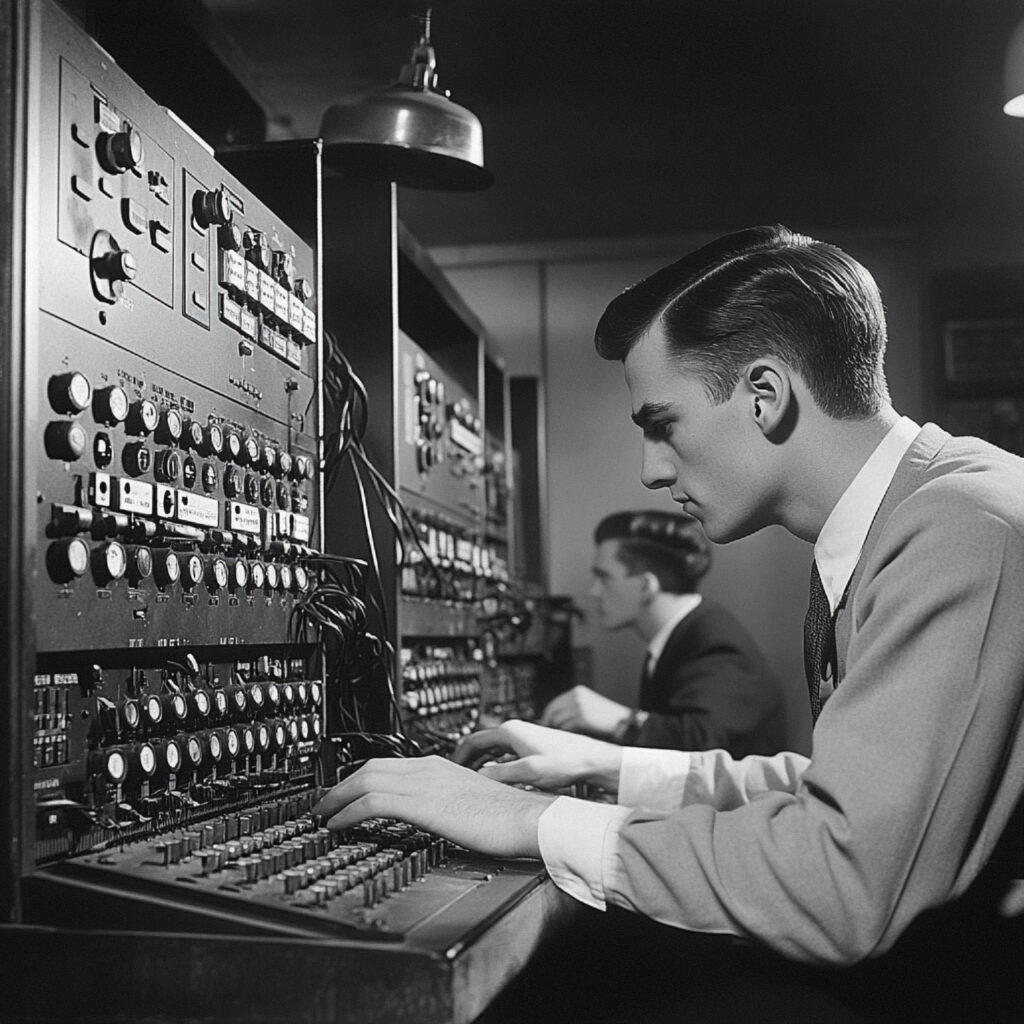
Imagen ilustrativa inspirada en los laboratorios de computación electrónica de mediados del siglo XX. La ENIAC utilizaba grandes paneles, tubos de vacío, interruptores y conexiones manuales para realizar cálculos científicos y militares.
The physical configuration of the computer was impressive. It weighed about 30 tons. It incorporated more than 17,000 tubes, of sixteen different types. It consumed an excessive amount of energy, between 100 and 140 kW, the same as a broadcasting station of the time, or a block of houses, or almost a thousand washing machines. In addition, it required an air-conditioning installation to prevent the room from overheating. It measured 30 meters long, three meters high and one meter wide. And, if it had been laid out entirely on a surface, it would have occupied 1,600 m². To have a complete idea of the hardware, it must be added that it also consisted of 70,000 resistors, 7,500 switches and more than half a million connections. Regarding operating capacity, the Eniac computer could receive three function tables with which to perform more powerful calculations. It had no central memory unit. The accumulators fulfilled that function, with a capacity of ten digits each. At the same time, they performed multiple tasks, such as controlling the development of the program and transferring data to other units. Data input and output were carried out by means of punched cards. The computer also presented the interesting particularity of integrating “and” circuits, “or” circuits and flip-flop circuits, which later became generalized in high-speed computers. As an example of the Eniac’s operability, there is an anecdote. The device was subjected to the test of a nuclear physics problem, after the appropriate programming had been carried out. If a single person had had to calculate it by traditional means, it would have taken one hundred years. The Eniac computer needed two hours to issue its answer, which consisted of a collection of punched cards. Later, the effectiveness of the computer was fully verified in artillery firing fields. The Eniac was installed in Aberdeen, Maryland, where the army had a testing ground. It had a long and diverse application. It remained in operation for ten years, which is a long time if we bear in mind the rapid evolution that was beginning to take place and that made previous innovations age quickly. It was used in tasks as different as calculating ballistic tables, making weather forecasts, preparing computations related to the hydrogen bomb, designing a wind tunnel and investigating the characteristics of cosmic rays.
An agreement with the army
The Moore School was carrying out work to improve a differential analyzer for army use. The objective was to speed up calculation times in order to complete firing tables for ballistics. Mauchly and Eckert managed to improve the speed and effectiveness of the analog device by a ratio of 1 to 10. But even so, the table required a month’s work. And the machine had reached its technical ceiling. In reports in which these researchers presented their own ideas together with Atanasoff’s, military experts glimpsed great possibilities for radical innovations. Among these ideas, the use of vacuum tubes to encode numbers by means of impulses and perform operations stood out. The Department of Ordnance openly welcomed the two scientists’ proposal to develop a non-specialized computer with which ballistic calculations and calculations of all kinds could be carried out.
The decision to incorporate vacuum tubes or electric valves was a novelty, considering that Atanasoff’s device was not known for patent reasons. These electronic devices had existed since the end of the previous century and were used for various purposes, but not in automatic calculation. Tubes have the property of connecting and disconnecting an electric current with great speed. As the two collaborators from the Moore School stated, the use of vacuum tubes to obtain current in discrete quantities would make it possible to produce electrical impulses for numerical encoding. None of this was a secret. Aiken himself knew of such possibilities, but preferred to opt for the more modest and safer model of electromechanical relays, which did not consume as much energy or burn out like valves or vacuum tubes. Eckert and Mauchly’s option was riskier, but no less carefully developed.
In the spring of 1943, the project was approved, with an initial budget of 150,000 dollars. At the beginning of 1946, it was finally completed and the Eniac was presented, the abbreviation of the project’s name, Electronic Numerical Integrator and Computer. The final cost reached half a million dollars, an investment similar to that of the Mark I, which was not an excessive amount given the experimentation time, the personnel, about 40 people, and the abundant material. The Eniac’s calculation capacity was the greatest that had been achieved. It performed the four basic operations, extracted square roots and, in addition, could discern the sign of a number and compare two numbers to determine which was greater. Its calculation speed exceeded that of the Mark I by one hundred times, which was possible because of the general design and the high clock frequency, 100,000 Hz. And more importantly, it offered the possibility of combining the different types of operation to solve problems that mechanical computers could not solve.