The dream of immortality

Desde los inmortales imaginados por Jonathan Swift hasta la inteligencia artificial, la humanidad ha buscado distintas formas de escapar de la muerte.
In 1726, Jonathan Swift, an irreverent critic of modern science, published a satire on humanity’s fear of death and its desire for immortality. In Gulliver’s Travels—a book he wrote “not to entertain but to vex the world,” and which, ironically, has seen its first adventure, in which the European is a giant and the islanders are tiny, transformed into compulsory reading for children—the hero arrives in Luggnagg, an island where immortality exists in the form of a rare lineage within the population: beings born with a red mark on their foreheads who never die, the “Struldbrugs.” On learning of them, Gulliver begins to imagine what it would have been like if he had been fortunate enough to be born as one of them. He would have studied and saved from the beginning and, by the age of two hundred, immensely wealthy, would know enough about humanity and nature to advise kings and ministers on how to achieve happiness for all. A living treasure of prudence and wisdom, together with his kindly immortal companions, he would become a benevolent guide, preventing human ambition from disturbing the natural order.
The people at court, however, soon revealed that this race of immortals was nothing to envy. They did not enjoy eternal youth, but continued ageing forever. Repulsive and stripped of every human quality, they were not only stubborn, ill-tempered and greedy, but also incapable of friendship and affection. Envy and powerless desires were their ruling passions; what they envied most were the vices of the young and the deaths of the old. Senile by the age of ninety, toothless and bald, from the age of two hundred onward they were unable to speak and constantly drooled. “Even the king of the island jokingly asked whether I wanted to take a pair of immortals back to Europe to fortify my fellow countrymen against the fear of death. After what I saw and heard, my appetite for a long life diminished considerably.”
A century before Swift’s book, Descartes had flourished, a mathematician and father of the modern science that Swift satirised. He certainly did not share the Irishman’s aversion to immortality. On one occasion, while corresponding with Huygens, he agreed with a curious wish expressed by him: “One day this tiresome habit of dying must come to an end.” Both men were repelled by the inevitability of death, and particularly by the thought that powerful minds such as their own, containing so much accumulated human knowledge, would one day cease thinking and become nothing.
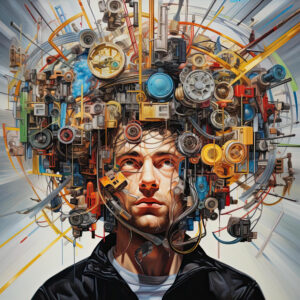
Descartes is often cited precisely because he was the first to formulate the separation between body and mind and the supremacy of intellect within that duality, making him a precursor of current utopias concerning the creation of cybernetic beings endowed with immortality. His idea of “thought without the body” is now identified with that of an “immortal mind,” a product of mathematics and the computer. There is an entire literature of metaphors of this kind in the world of artificial intelligence, or AI, which flourishes in university and corporate laboratories. The imitation of the human mind by a “thinking machine,” or more ambitiously, “a machine capable of learning,” had already reached a high point as a project in 1956 at the famous Dartmouth College conference, organised with the participation of figures such as Marvin Minsky, John McCarthy, Herbert Simon and Claude Shannon. Some of them described the brain as “a machine” and the body as “a bloody mess of organic matter” or merely a “teleoperator of the brain,” entirely dispensable. Minsky announced there that human-machine symbiosis would become the greatest manifestation of artificial intelligence long before the arrival of autonomous thinking machines capable of making evolutionary advances on their own.
Let us concentrate on the question of death. The leading prophet of computer-based post-biological immortality is Hans Moravec, who recently wrote a book entitled Mind Children: The Future of Robot and Human Intelligence. In it, he describes the surgical procedures required to transfer intelligence from the mind to a computer. The arrival of intelligent machines, he says, will provide “personal immortality through mind transplantation,” a secure defence against the regrettable loss of knowledge and function that constitutes the worst aspect of individual death, as in the understandable revulsion felt by Huygens and Descartes that we mentioned earlier.
That is one side of the matter. On the other, during the 1980s, artificial intelligence gave rise to a related enterprise known as “Artificial Life,” or “AL,” a bottom-up approach to the subject, different from but related to the top-down approach of AI. Its recognised father was John von Neumann, the mathematical genius idolised at the Pentagon until his early death in 1957, who developed the theory of self-reproducing cellular automata. The Mecca of Artificial Life is Los Alamos, the birthplace of the Hiroshima bomb. The apostles of AL explained that the enterprise consists of studying artificial systems that display behavioural characteristics associated with living systems. They predicted that computer science and genetic engineering would soon provide the technology needed to create new forms of life, both in silico and in vitro. “With the advent of artificial life, within fifty or one hundred years we may become the first species to create its own successors.”
One such “Dr Frankenstein,” reflecting on the consequences that the evolution of super-intelligent, self-reproducing cybernetic organisms might have for human beings within only one or two generations, concluded: “What the hell! I won’t be around then.” It is an exclamation—whether regretful or relieved—that most of us might perhaps share.