Great Inventions I
Desde los diseños mecánicos de Leonardo da Vinci hasta las primeras máquinas de vapor de Papin y Newcomen, estas ideas sentaron las bases de la ingeniería moderna y de la futura revolución industrial.
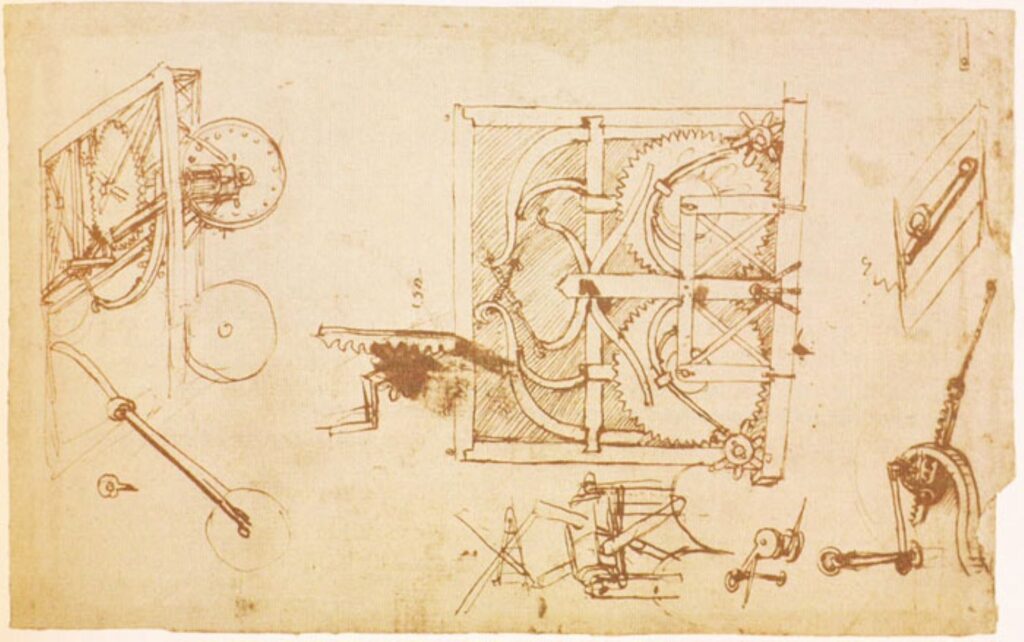
Leonardo da Vinci designed a mechanical vehicle. He believed that its source of energy could consist of powerful springs tightly compressed. The extension of those springs would set a horizontal wheel in motion, and the rotation of that wheel would then be transferred to the wheels of the vehicle. Two men, from inside the carriage, at regular intervals, would have the task of winding the springs. Aware that the movement produced in this way would not be uniform, Leonardo da Vinci, more than a hundred years before the pendulum investigations of Galileo and Huygens, planned to use a pendular regulator that would ensure the regularity of the vehicle’s motion. This makes Leonardo one of the earliest precursors of the inventors of the automobile.
Leonardo intended to apply a similar idea to naval locomotion. He proposed replacing oars with wheels fitted with paddles, driven by an ingenious clockwork mechanism. These would have drawn their energy, as in the case of the mechanical vehicle, from springs.
The problem of mechanical flight particularly attracted Leonardo’s interest. For many years he devoted himself to studying the flight of birds, as shown by several of his drawings. One of the first models he devised consisted of a wooden framework on which the pilot would lie in a horizontal position. The pilot’s hands would move two handles that, in turn, operated a pair of wings, while the feet moved a set of pedals. Leonardo soon reached the conclusion that this model was insufficient when he realized that muscular strength alone was not enough to lift a body into the air. He therefore considered replacing muscular power with clockwork mechanisms similar to those he had designed for his mechanical vehicle and boat.
Papin, Newcomen and Watt. First Boilers and Steam Engines
In the year 1707 the boatmen of Minden, Germany, destroyed a barge intended to be propelled by an “infernal amalgam of fire and water,” instead of the traditional means of wind and oars. Denis Papin, its owner and inventor, had been born in France in 1647. He studied medicine at the University of Angers and later worked with the physicist Christiaan Huygens (1629–1695). He taught for several years in England and produced numerous inventions related to mining work, before dying at an unknown date and place. The last trace of him that remains is a letter dated 1712.
Established in England with Robert Boyle, following Huygens’ recommendation, Papin improved the pneumatic machine and even built a device capable of launching projectiles by means of vacuum and atmospheric pressure. Yet these inventions did not bring him the fame he first achieved with his Digester, a distant ancestor of autoclaves and pressure cookers. Papin knew that the effect of a vacuum is to lower the boiling temperature, and this observation led him to discover the opposite effect produced by pressure higher than that of the atmosphere. To prevent the explosion of the device and keep the pressure at a constant level, he devised an ingenious safety valve equipped with a lever arm and counterweights. This principle is still used in boilers of all kinds.
Papin’s success was complete and earned him admission in 1680 to the Royal Society. There, however, the enthusiasm aroused by his invention stopped, as many refused to accept applications beyond simple cooking. Papin nevertheless remained encouraged by the idea of transforming his Digester into a machine capable of using steam power.
In 1690, in Kassel, Germany, where he had moved to perfect his invention after finding refuge with a Protestant family, Papin continued his experiments. Later, in England, Thomas Savery built a machine designed to pump water from mines. Soon afterward, Thomas Newcomen (1663–1729) constructed another machine that attracted considerable attention.
Newcomen’s engine applied all the physical principles discovered by Papin and introduced improvements that ensured its practical effectiveness. Newcomen connected the boiler to the cylinder through a tube fitted with a valve that opened during the rise of the piston and closed during its descent. The cylinder was cooled by an intermittent flow of cold water. Finally, he introduced the idea of condensing the steam by injecting a small amount of cold water into the lower part of the cylinder.
The Newcomen engine represented an ingenious combination of elements known before his time: cylinder and piston, steam produced at atmospheric pressure in a boiler separate from the cylinder, and the condensation of steam by cold water. One of the first machines installed was used to pump water from the coal mine of Griff, near Coventry, where it replaced the work of fifty horses. Soon it was applied in mines throughout the region and marked the beginning of modern industry.