Toward the computer of our time
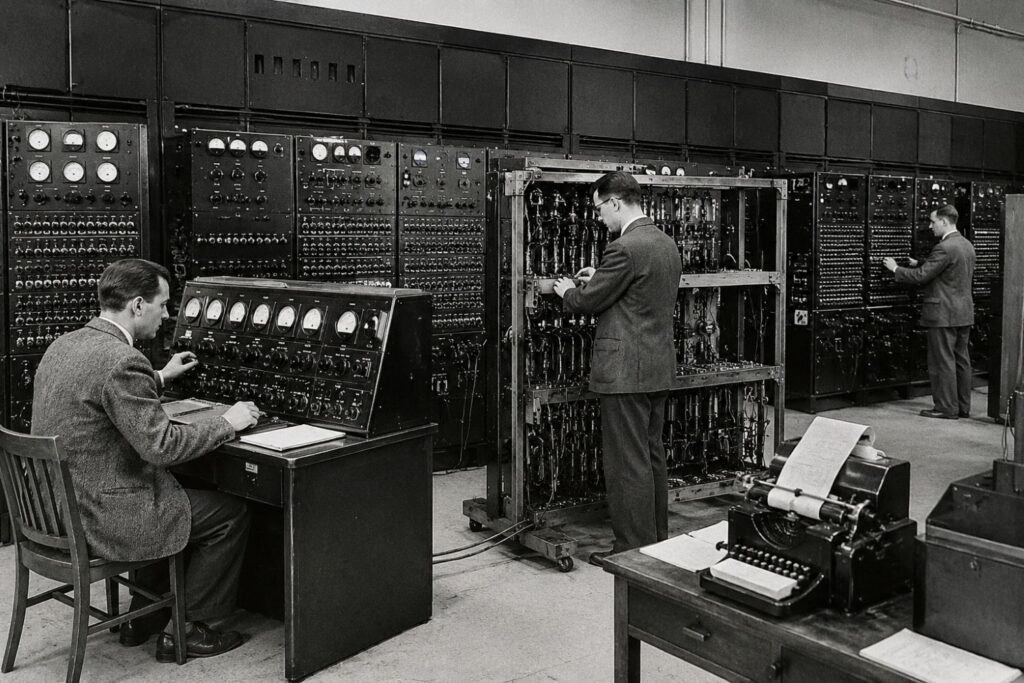
Los primeros desarrollos de la computación surgieron en laboratorios donde el cálculo automático dependía de grandes máquinas, paneles de control, circuitos eléctricos y programación manual.
The first computer
In the 20th century, automation processes began to be introduced in many fields. A paradigmatic example is automobile manufacturing, which from the second quarter of the century became automated through assembly lines, where workers were deprofessionalized and became personnel who could be assigned indistinctly to any point in the manufacturing process. Even earlier and more general was the Taylorist organization of labor, based on the systematic division of tasks. It was within this technological environment of the time that research for the creation of the first computer took place. There was not a single group, nor was work carried out in only one direction; rather, in the 1930s several groups appeared. The first team that managed to give concrete form to its attempt was the one led by Vannevar Bush.
They built the differential analyzer. At last it could be stated that the first computer had been manufactured, although other, more complete ones would follow. After so many attempts, the time of the computer had arrived, because three factors that until then had been separate had just converged:
the perfect design of the inventor; technological resources;
the social need for the creation of these devices.
The first factor had been present in history for a long time and offered the necessary formal consistency, but neither the second nor the third provided a response. The maturity of engineering was not adequate for what was being proposed and demanded of it. Nor were political and economic interests sufficient to justify large investments.
Bush and the differential analyzer
Vannevar Bush (Everett, Massachusetts, 1890–Belmont, Massachusetts, 1974) was the inventor of the analog computer. An engineer and professor of electronics at the Massachusetts Institute of Technology (MIT), he began in the late 1920s to study the possibilities of applying electronics to calculation. His objective was to manufacture a device capable of integrating ordinary differential equations. He achieved this with the construction of the computer he would call the differential analyzer, which was indebted to the postulates of the 19th-century researcher Lord Kelvin.
Between 1930 and 1932, his team of collaborators at MIT introduced improvements until the device was perfected. Then the work of application began. To the surprise of those who had taken part in the project, it was gladly discovered that the field of use of the differential analyzer was broader than expected, and satisfactorily covered immediate applications in acoustics, atomic physics, mathematics, etc., despite the diversity among them. The computer developed by Bush belongs to the family of analog computers. And it has a double merit. First, because it broke the barrier that held back projects and prevented their materialization. And second, because it opened the breach that would later allow the creation of the first digital computer. This is as fundamental as the previous point, if we take into account that most current computers are digital.
The useful effects of the differential analyzer could be seen ten years later, when the Mark I computer was presented and, almost immediately afterward, the Eniac computer. Bush’s work was the first step and an indispensable aid for Aiken and for Eckert and Mauchly, responsible for the Mark I and the Eniac, respectively. In another area, Bush dealt with forms of information organization. He devised a device capable of quickly finding required information in a database. The rapid selector, as the device was called, operated in a large bibliographic bank arranged on microfilmed supports. A binary code, invented by Bush, was printed on the edge of the film and was located by a photoelectric cell. The search for information was carried out rapidly. The rapid selector was used in some libraries and, although its use was not widespread, it helped pave the way toward information processing and database management.
Bush also developed an automatic text-editing system, although a rudimentary one. By means of a typewriter prepared for that purpose, it was possible to compose a perfectly aligned page. When the text corresponding to each line was entered, the special machine spaced the words conveniently and achieved perfect alignment of the left and right margins. Word processing and editing have evolved very significantly since then, but Bush’s device is an interesting precedent for these applications, which account for a large percentage of the work currently carried out by computers in the field of management.
Claude Shannon
The study of Bush’s advances provided his successors with firm theoretical principles. One of his disciples, Claude Shannon, contributed new theoretical advances. Shannon, who would later become known for his highly important mathematical theory of communication, in which he mathematically quantified information, applied his theses to computing fields. In particular, he outlined the theory of the circuits needed to provide binary arithmetic, while also linking arithmetic and logic. In 1937 Shannon established these principles in a brief paper entitled A Symbolic Analysis of Relay and Switching Circuits. Following his indications, it soon became possible to build machines with true logical capacity, which meant a notable expansion of the computer’s capabilities. Shannon made another important contribution as well. With his “switching theory,” he outlined new systems for the design and production of circuits, which would lead, in practice, to their simplification and versatility. Shannon’s work drew attention to the necessary fit between the material component, circuits, and the immaterial component, or programming. And it pointed out the importance of considering logical programming as a close and determining relationship between instructions and the physical organization of circuits.