Automotive technology
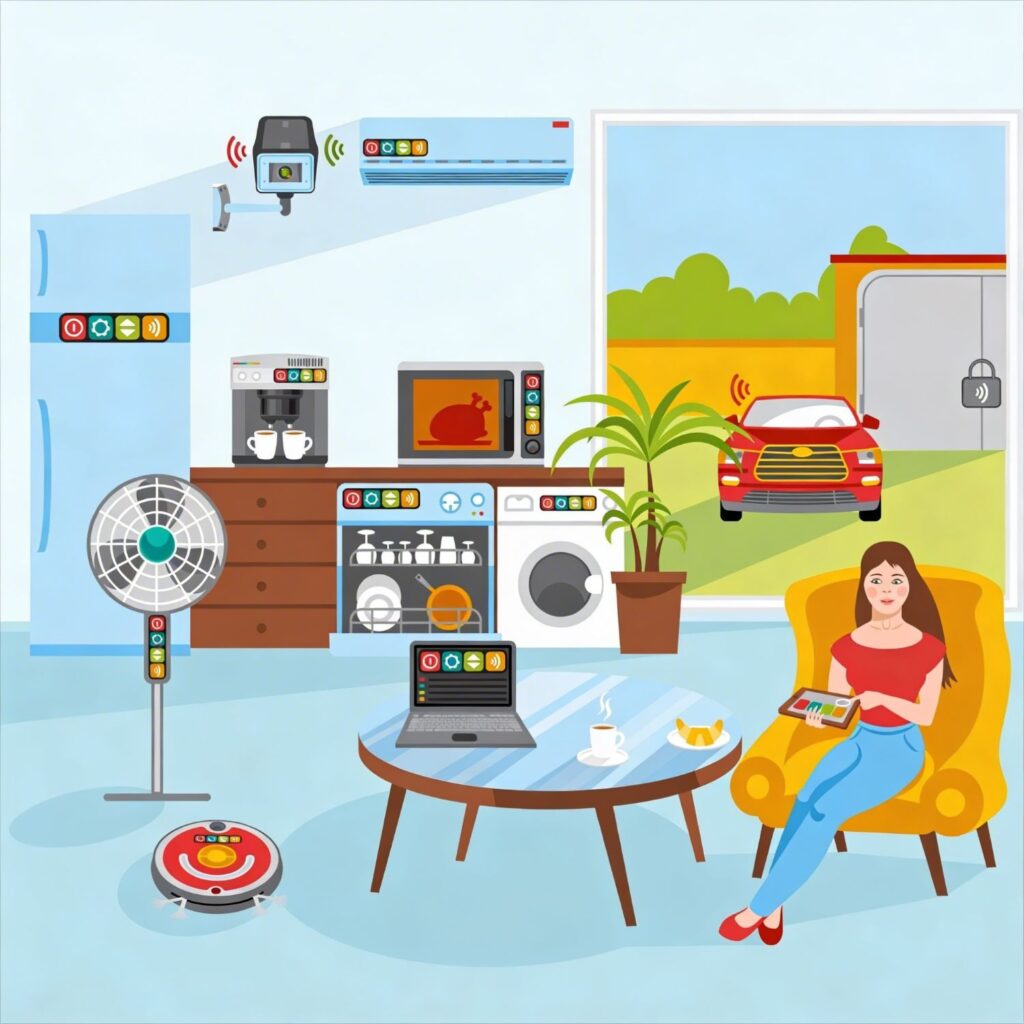
Del desarrollo automotriz a los sistemas domésticos y sensoriales, la tecnología redefine la experiencia cotidiana.
In its overall form, the automobile has changed little in the past 100 years. Since the first “horseless carriages” powered by petroleum appeared, they introduced uncertainty on roads originally designed for horse-drawn vehicles. Mechanically, however, the automobile has constantly evolved. Early designs used steam and electric engines, but both had limitations: steam engines were heavy and slow to start, while electric vehicles relied on large batteries. The internal combustion engine, which burns fuel inside the engine rather than externally like steam systems, enabled the automotive revolution. Since then, development has been gradual but continuous. Today, densely populated countries face space limitations, fuel sources are diminishing, and safety remains a concern, as road accidents cause tens of thousands of deaths each year.
The modern saloon car
The Japanese manufacturer Toyota introduced the luxury Lexus model, based on a design structure established decades earlier. The core layout—engine, transmission, passenger, and luggage compartments—remains consistent. The main differences lie in detail improvements and the increasing integration of electronics. Engine management and multiple systems are electronically controlled, and automatic transmissions simplify driving.
The wooden model
Automobile designers have experimented with variations in engines, wheels, and seating since the earliest vehicles. Scale models have always been used during the planning stage, often made from clay over a wooden frame, allowing design evaluation and refinement. The French architect Le Corbusier created experimental automotive models in the 1920s, reflecting early explorations of form and function.
Safety standards
Although accidents cannot be eliminated, engineering aims to reduce their impact. After the introduction of seat belts, the next objective has been to slow down the deceleration during collisions. Front and rear crumple zones are designed to absorb energy by deforming on impact. These systems are tested under controlled conditions to measure performance and improve safety outcomes.
Robots in car manufacturing
Early automobiles were built on heavy chassis structures. By the late 1920s, the self-supporting steel monocoque body was developed. Pressed steel panels are joined to form a rigid and lightweight structure that supports the engine, wheels, and passenger space. Robots now perform repetitive and precise assembly tasks, such as welding panels together using electrical currents that fuse metal sheets.
Traffic demands
Automobiles provide fast and comfortable transportation, replacing earlier modes of travel. However, their widespread use has generated significant challenges. Pollution and accidents affect public health, while the growing demand for infrastructure often leads to the displacement of communities to make way for highways and urban road systems.
Pasta machine
Bacteria cannot multiply without water, so drying is an effective method of food preservation. Pasta, made from high-protein durum wheat, originated in Italy, possibly during the Middle Ages. The wheat is ground into semolina, mixed with water, and then dried. In this form, it can be stored for long periods and later cooked by boiling. Pasta can be shaped in various forms and filled with ingredients such as cheese, meat, or vegetables.
The sense of smell
The sense of smell influences preferences, memories, and emotions. Technology now interacts with this sensory system. Chemists can produce synthetic fragrances that replicate natural scents, while instruments can analyze and measure odors to reproduce desirable ones and eliminate unpleasant ones.
Aromatherapy
Certain scents produce positive effects, while others generate discomfort. Aromatherapy studies these responses and applies natural aromas to support well-being. Essential oils used in this practice are extracted from plants such as herbs and flowers.
Gas chromatography
Industries that depend on scent—such as food and fragrance production—use advanced analytical tools to study odors. Gas chromatography functions as a scientific “nose.” A small sample is injected into a flowing gas stream inside a long tube filled with a material that separates its components. As each compound passes through a detector, it is identified and measured, allowing precise analysis of complex aromas.
Clean aromas
Many aromatic substances are oils derived from plants, such as mint species. Scents associated with cleanliness are often artificially reproduced and used in products like cleaning agents and retail environments. Synthetic aromas are designed to create consistent sensory experiences and can be monitored and adjusted using computerized systems.