Diagnosing Low-Tech Institutions in a High-Tech Social Reality
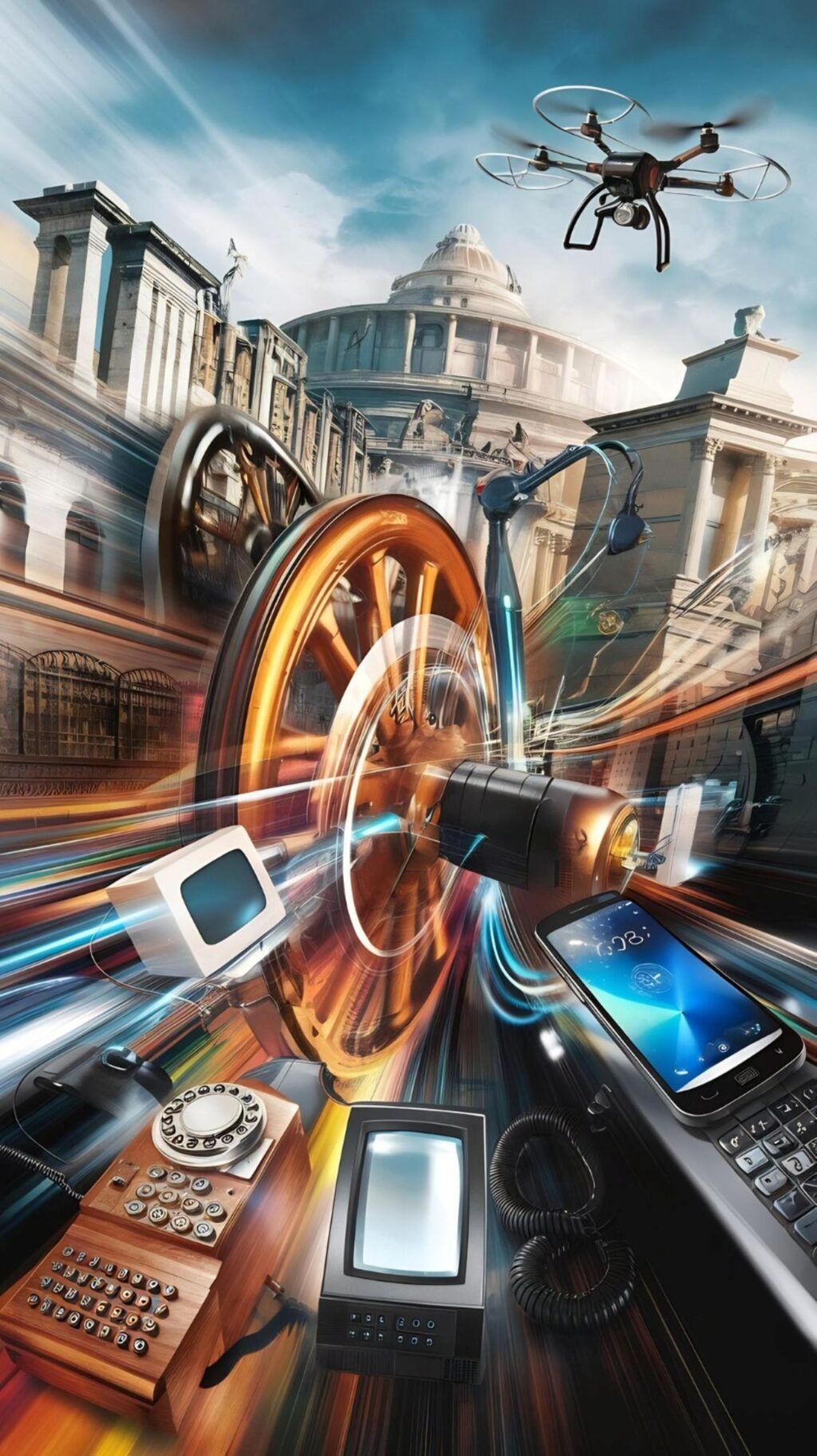
La imagen reúne dispositivos de distintas épocas para representar el avance tecnológico y su impacto sobre las instituciones, la educación y las formas de organización social.
Several decades ago, innovations in teaching machines began to attract greater public interest in the United States after the Cold War. Although historians indicate that the development of mechanical teaching devices dates back at least to the late nineteenth century, when patented devices for educational use began to appear, it was not until the mid-twentieth century that innovations in “teaching machines” began to gain broader public visibility. The historian of education Benjamin indicates that, in the 1960s, wider public debates could be observed in different forums: “National and international conferences were held to discuss the new technologies, and popular magazines and scientific publications reported on new research and applications […]. Interest came not only from educational institutions, but also from industry and the armed forces, which were especially interested in training applications.” Commentary in the popular press, Benjamin noted, was generally cautious, with articles emphasizing fears about the dehumanization of education, the moral and cultural implications of having children educated by machines, the prospect of people being “instructed like pigeons,” and whether machines could truly teach. Indeed, with headlines such as “Can Machines Replace Teachers?” and “Will Robots Teach Your Children?”, all advocates and innovators of the different teaching machines were required to address one of the most frequent and important fears: the impact that machines would have on teacher retention and workload; that is, how a future of mechanized education could produce an educational workforce based on modules.
Despite those fears surrounding labor and the mechanization of teaching, the promise that such devices could amplify the potential of education had clearly generated a new “movement” to promote the use and invention of teaching machines. Educational organizations such as the American Educational Research Association, the National Education Association and the American Psychological Association knew they had to intervene, so they collaborated on a joint statement on “self-instructional materials and devices” in 1961, emphasizing the importance of guidelines and materials to ensure quality teaching and assessment (Benjamin, 1988). However, the mid-century “boom” also revealed the barriers to computerizing classrooms. The main barriers were the persistent lack of guidelines and support materials for programs that were ultimately not “user-friendly and helpful,” in addition to their high and coveted cost. Testimonies began to emerge from schools that had invested thousands of dollars and obtained few pedagogical results, such as the report of a school district that spent $5,000 on machines and discovered that no support programs were available for them. Other machines, lacking curricular support for teaching, came to be seen almost as toys with limited educational benefits. Indeed, the decline in publications about teaching machines reflected an even deeper loss of interest. New developments in microprocessors and other components at the end of the 1970s, which made fully assembled personal computers more accessible, had to take place before the general public could move beyond those serious outcomes.
These historical traces remind us that the developments, as well as the debates, surrounding teaching machines have histories that predate by many years the emergence of today’s highly visible teaching devices. Ambitious digital education initiatives, which explicitly seek to cover the entire planet and take advantage of the growing global accessibility of personal and mobile devices, such as the MIT-launched One Laptop Per Child program, credited with driving global movements to provide one laptop for each student, or various MOOC platforms, Massive Open Online Courses, are clear heirs to those intricate histories surrounding the teaching machines of the previous generation. Now designed for deployment across entire national territories, these contemporary teaching-machine initiatives tend to emphasize that their virtual learning environments come already prepared for mass adoption and can overcome the spatial, geographical, economic or technical limitations of standard classrooms and institutional facilities. However, something rarely mentioned in their definitions and representations is their relationship with previous debates, frequently revived, about the costs of such transformations for students, teachers, existing institutions and organizational infrastructures. It is as if those debates had never existed, or as if they had appeared only recently, without earlier histories, without any record of their development or prior use.