Integrated-Circuit Memories
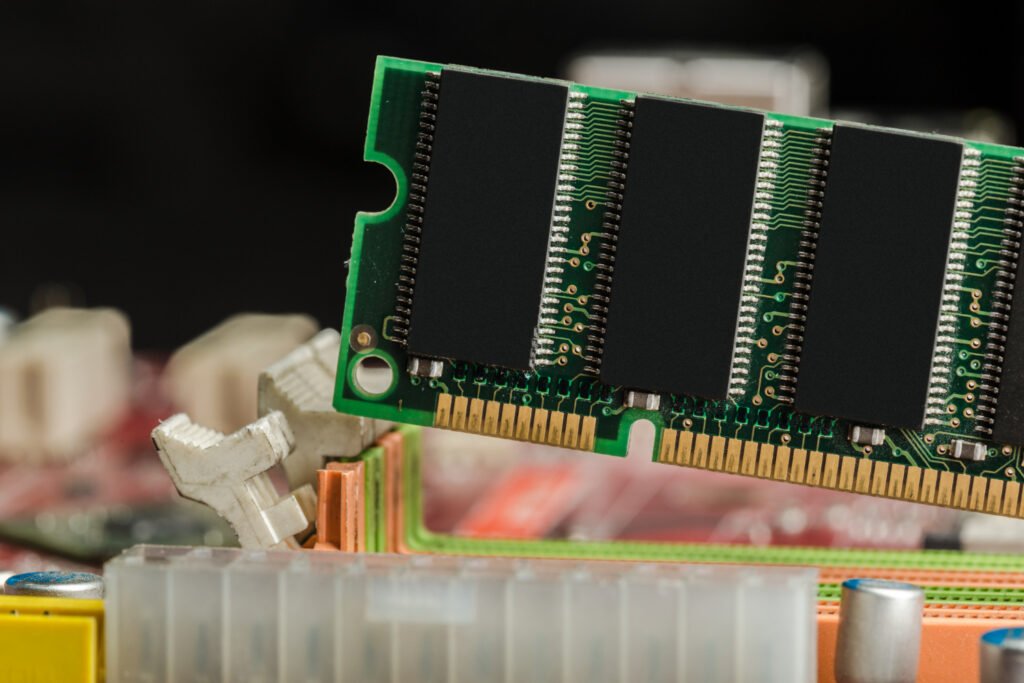
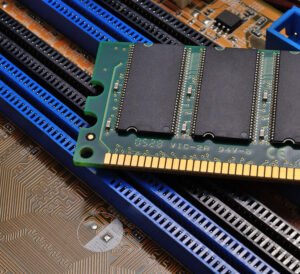
Módulo de memoria RAM junto a las ranuras de una placa base.
These are the memories currently in use. They are fast and provide direct access. They are divided into several classes according to their durability and whether they can be rewritten. The most important are:
RAM
These memories, whose name stands for Random Access Memory, allow data to be written and read. They can be compared to an appointment book. In an appointment book, you can record a meeting, check the schedule for a particular day or cancel an appointment. If you want to find a customer’s or supplier’s address, you do not begin searching at A and continue until you find it; instead, you go directly to the page corresponding to the first letter of the surname. However, RAM is volatile memory: its contents are erased when the power supply is interrupted.
ROM
These memories, whose name stands for Read Only Memory, can only be read. No data can be written to ROM. They are nonvolatile memories. Their contents are recorded during manufacture and cannot be changed. They are ideal for storing microprograms, operating systems, conversion tables, character-generation data and so on. Following the comparison used earlier to illustrate RAM, ROM can be compared to a published book. In a printed book, whether a dictionary, novel or technical work, the contents cannot be changed; it is only possible to read and obtain information, never to add information or modify the text.
PROM
As their name, Programmable ROM, indicates, these memories are programmable and are supplied blank to the programmer. Using a special device, the programmer records the data considered relevant to the work.
Programming is a destructive process: once programmed, the memory behaves like ordinary ROM.
EPROM
This is a PROM whose information can be erased using ultraviolet light, hence the name Erasable PROM. For this operation, the integrated circuit must have a quartz window transparent to ultraviolet light. Exposure time must be short and varies according to the manufacturer. Once the EPROM’s data has been erased, a special programmer is required to enter new data. EPROM memories use a particular transistor called FAMOS, short for Floating Avalanche Injection MOS.
RPROM
This is a PROM whose information can be erased electrically by applying suitable voltage levels to its inputs and then programmed again, hence Reprogrammable ROM. A special programmer is needed both to erase and to reprogram an RPROM. RPROM memories use MNOS-type transistors, whose main characteristic is that they can be erased and programmed electrically.
Upper, Expanded, Extended and High Memory
Although random-access memory, or RAM, is the same within a computer, different types are distinguished according to their position in the memory map: upper memory, expanded memory, extended memory and high memory. A computer’s conventional memory, ranging from 0 to 1024 K, is where all DOS operating-system programs execute.
Upper memory is the area of conventional memory between 640 K and 1024 K. Its 384 K are used to store basic computer-system routines, such as those that control the computer from the moment it is switched on, those associated with data input and output, and video memory. Video memory stores the characters displayed on the monitor and the numerical information indicating how they should appear: character and background colors, color intensity and so on.
Expanded memory, or EMS memory, from Expanded Memory Specification, is a technique that allows DOS to work with memory beyond the 1024 K of conventional memory. It uses a method based on a 64 K block within upper memory that both DOS and DOS applications can access.
Extended memory is memory above 1024 K, characteristic of processors in the [incomplete reference in the original] range and above. In computers using 386 processors and above, for example, this memory can reach up to 4096 MB. Although this memory region is not accessible to DOS itself, it is accessible to most modern applications running under it and to interfaces such as Windows. Operating systems such as UNIX and OS/2 can access extended memory.
Finally, high memory is the memory between 1024 and 1088 K. Like extended memory, it is found in computers equipped with 286 processors and above. However, these 64 K are accessible to DOS from version 5.0 onward. Consequently, when high memory is available, extended memory begins at 1088 K rather than 1024 K.
Other Types of Memory
Special types of memory include CMOS RAM: 64 bytes that can be written to, for example, to store computer configuration information such as RAM, date and time, installed drives and so on, but whose contents disappear when the computer is switched off. Another special type is shadow memory, which stores a copy of the computer’s basic input/output routines, or BIOS. This copy allows input/output routines to execute more quickly. Cache memory is a fast type of RAM that allows information to be exchanged more quickly between the processor and main memory.