Justicialism and scientists
El proyecto nuclear de la isla Huemul y la relación entre el gobierno de Juan Domingo Perón y la comunidad científica argentina forman el eje de este análisis histórico.
The electoral platform of the party that had been in government since 1989 stated: “There will be no national liberation without national science and technology. Although today no one fails to recognize that scientific and technological knowledge is a fundamental factor of power, social well-being, and the economic and cultural transformation of the Nation, 40 years ago this was not the case. Nevertheless, even then Justicialism embraced it as an essential part of its policy. The development of jet aircraft, automobiles and nuclear research using self-generated technology became a reality before 1955.” This quotation contains elements of a political party’s historical memory that belong to a persistent mythology. Nevertheless, none of the assertions contained in the paragraph is correct. It is not true that scientific and technological knowledge was an essential part of the party’s policy during that government. Nor did it develop jet aircraft, automobiles and nuclear research with its own technology. These are nationalist appeals of the kind that excite young people, defenseless in the face of public forgetfulness, but harmful because they create confusion. We would therefore like to recall some facts that clarify what happened with nuclear energy five decades ago and what “self-generation,” what participation Argentine scientists and technologists actually had. We will draw on three particularly relevant works: one by Jorge Sábato (1981), another by Regis Cabral (1988), and especially a third by M. Mariscotti (1987) on the historical origins of the issue.
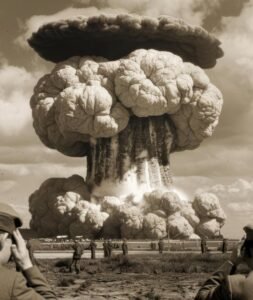
On March 24, 1951, General Perón read a statement announcing urbi et orbi that “on February 16, 1951, at the atomic energy pilot plant on Huemul Island in San Carlos de Bariloche, thermonuclear reactions were carried out under controlled conditions on a technical scale.” The country was then suffering a serious energy crisis. Huemul’s energy, once brought to production scale “for peanuts,” “could be sold in one-liter and half-liter bottles for industrial or domestic use, for cooking or ironing.” He concluded his exchange with journalists with another memorable phrase: “In half an hour Richter explained all the secrets of nuclear physics to me and now I master the subject.” The newspapers worked wonders with their headlines. We had control of nuclear fusion (a technology that remains today a research program of the major powers for the twenty-first century at a cost of billions per year), we had the definitive answer to the universal energy problem; it was one of the most momentous announcements in the history of Humanity. On March 28, in a packed White Hall, Ronald Richter received an honorary doctorate from the University and the Peronist Medal. It was an apotheosis.
What, meanwhile, did Argentine physicists say about the Austrian’s scientific and technical enterprise? Certainly none of them was at Government House for the celebration. Colonel Enrique González, responsible for Huemul, said: “There are no Peronist physicists in this country.” Enrique Gaviola had sent his opinion to the journal Ciencia e Investigación. He wrote: “The greatest crime a scientist can commit is to simulate or falsify a result. Secrecy is a powerful corrupter. It is so easy to hide behind it to conceal flaws, failures, deception, fraud, shady dealings, embezzlement and misconduct!” The journal’s editors refused to publish it.
Gaviola, Galloni, Bunge, Balseiro and the masters Gans and Beck knew how to recognize scientific seriousness. They needed only to examine a curriculum vitae. But they were not consulted. To the government, scientists were “opponents” unless they proved otherwise. (For Richter, in the end, when he felt he had lost, Argentina was “a country full of monkeys with long tails sitting in palm trees.”) Some time ago, a researcher at Lund University wrote that throughout the government, until 1955, there was only one group which, with few exceptions, remained consistently opposed to Perón: the Academy. “The Perón-Academy conflict became particularly serious when the government embarked on a nuclear program designed by foreign scientists.” As can be seen, this is far removed from the “self-generated technology” mentioned in the political platform under discussion. It would take too long to recount the twists and turns of that delusional project. They can be read about in El secreto de Huemul, Mariscotti’s entertaining book. It cost the country an embarrassment on a worldwide scale and an enormous sum of millions. But there was one circumstance that left consequences of importance to history.
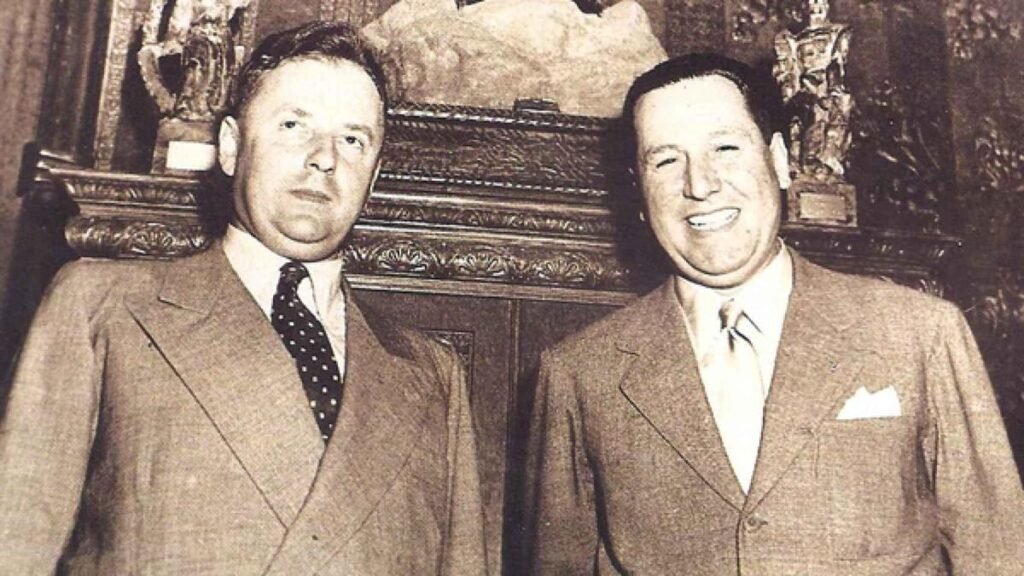
At one point, already in 1952, after Richter repeatedly refused to allow his laboratories to be inspected or anyone to see what he was doing, the authorities began to have doubts. The President asked his friend Prince Bernhard of the Netherlands to send him a technician who could verify the Austrian’s claims. Bernhard, without hesitation, sent Dr. Bakker. He too was unable to enter the island, but he understood everything: what was needed was to complete the equipment with devices manufactured by Philips. [The following fragment is corrupted in the source: “Después el príncipe Bernardo fue investigado en su país se hizo, por muchos millones de guildes. Cuando integró la llamada ‘conexión holandesa’.”] Eventually, when a responsible administration took charge of nuclear affairs, a commission of Argentine physicists was able to enter the island and dismiss the project. Unexpectedly, a positive use was then found for part of the equipment Richter had acquired. Argentine physicists inherited the material and were able to begin serious work. It was material truly “worthy of a novel.” The way events unfolded had two consequences. On the one hand, among CNEA scientists there were certain confused feelings regarding the Richter episode, somewhat as if perhaps smallpox should be thanked for having produced Jenner. On the other, there was the Justicialist fallacy (“after this, therefore because of this”) that Argentina’s nuclear development was owed to Perón and that this development was somehow inseparable from the “national essence.” Government deputy Rumbo initiated this logic in 1954 when he publicly acknowledged in the Chamber the failure of the Huemul atomic project.
The story of the jet aircraft is told through other accounts involving Germans discarded by the Allies (see the article “Distinguished Immigrants in the 1930s”) and brought into the country by the government after the war. Kurt Tank, associated with the also unsuccessful Pulqui II, was with Richter in Villa del Lago and recommended him to the President. He was accompanied, among others, by Jazzquer, Rudel, Behrens, Mildebrath, Kalembach and Siebrecht. These are surnames that hardly suggest “self-generated technology.” The path followed by Argentine scientists was always different. They had brought Gans, Guido Beck and Seelman Eggebert to the universities. All were figures of the highest international standing. Jorge Sábato said of the latter, a disciple of Otto Hahn, that he later became the most valuable figure for the nuclear program that ultimately emerged. Before the Richter affair, Gaviola wanted to establish a private university financed by industrialists in order to train the scientific elite required for the country’s development. In 1946 he estimated that 5,000 people would need to be trained, including those who would have to be sent abroad. He even went so far as to pre-contract none other than Werner Heisenberg. Another great scientist, Eduardo Braun Menéndez, accompanied him in the project. But the political and economic upheaval of those years swept away his dreams of an autonomous development of Argentina’s scientific capacity. The idea of a private university was vetoed “from above.” The government’s policy of trusting its Germans while distrusting Argentines frustrated one of the many opportunities that the postwar period offered the country.