The conceptual conquest of number
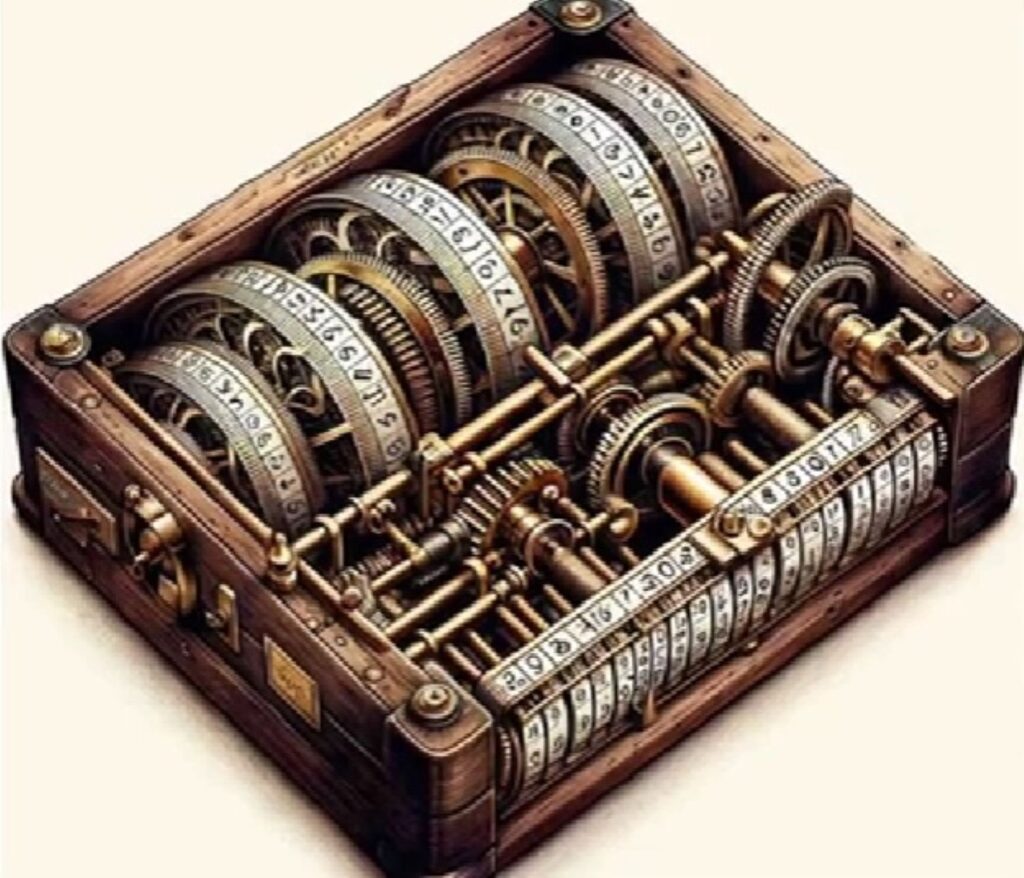
La evolución del número permitió pasar del cálculo manual con ábacos a las primeras máquinas mecánicas de procesamiento de información.
The revealing step in the human being’s capacity for abstraction is number. The words that primitive man had previously coined responded to a much more material and immediate expressive function: he pronounced them driven by need or desire. With number, he reached a higher conceptual conquest. It can be said that this is the first properly rational expression of his thought. And number becomes the instrument that will allow him to develop abstract, mathematical and rigorously rational concepts. Its history, revealed to us through anthropological research carried out among peoples who still remain in primitive stages, shows that the concept of abstract number is reached after an indeterminate stage in which number is conceived as a concrete characteristic inseparable from things. To quantify things, different numerals exist according to the types of material elements into which reality is divided. And, also, prior to the creation of numbers, practical methods of numeration are acquired. The use of fingers, stones, knotted cords and so on constitutes a set of diverse calculation systems known in remote times. It is not necessary to know how to name numbers in order to know them.
Calculation opens new paths of inquiry for understanding the material world that surrounds the human being and also for understanding the distant world, the celestial world. The conquest of numeration is made up of many attempts with unequal success. The history of the different systems of numerical notation is fascinating. One monumental milestone is the invention of the number that designates emptiness or nothingness, zero. Another milestone is the consolidation of the positional notation of numerals. Finally, the Indo-Arabic numeral system represents the achievement of solid maturity. The abacus is a cathedral of calculation. It is the oldest calculating device. Its origins date back to 3000 BC. And it is still in use in many places in Asia. This name comes from the earliest known form of the abacus, which consisted of a board covered with sand on which grooves were marked. Stones or counters were placed in these grooves. The next stage of evolution is the invention of the mechanical calculator. This device is made up of toothed wheels and cranks. And calculation processes are made lighter. The mechanical calculator is the mother of electric and electronic calculators, and the antecedent of the computer. Despite this evolution, new techniques are not always more efficient than those they theoretically surpass. With sufficient skill, it is possible to perform calculations with the abacus more quickly than with the calculator. On various occasions, calculation contests have been organized in which the abacus competed against electric and electronic calculators, and the abacus managed to defeat its opponents in many operations, including complex calculations.
Mechanical calculators
The 17th century anticipated some elements of the contemporary era. Cartesian rationalism and Lockean empiricism began a solid path in the study of the foundations of knowledge. Empiricism, without neglecting mathematics, began the study of nature and the development of the sciences applied to it. Among universalist ambitions, a breach opened for the creation of calculating devices. It is no coincidence that, in the century in which the theoretical foundations of the future Industrial Revolution were generated, the first calculating machines appeared. Symbolically, they anticipated technological change. They are a symbol because they did not achieve widespread or productive application. Of course, their creators did not intend such a thing either. Although the greatest value of these calculators lies in their technological symbolism, they are not without material value or immediate usefulness. They mechanize operations and mark a substantial break with the abacus, where the human being must manually move the counters and carry out the operations. This is a conquest that begins the process of automating the treatment of information. And it is consolidated with the creation of some truly ingenious prototypes, whose excellent formal conception is limited by the technical difficulties of their realization.
Pascal and the pascaline
Pascal is commonly spoken of as the first builder of a calculating machine. This is not exact. That honor belongs to Wilhelm Schickard (1592–1635), a German based in Tübingen. The event, which occurred around 1623, remained ignored until almost our own time. Interest in the beginnings of computing has brought this fact to light, as well as another even more spectacular one. It refers to a calculator project dated between the 15th and 16th centuries. The signature belongs to Leonardo da Vinci. Despite Schickard’s chronological priority, the true protagonist is Blaise Pascal, the illustrious French philosopher (1623–1662). His device was completed in 1642. It should be noted that the time difference between the German’s invention and the Frenchman’s was barely twenty years, which represents hardly any distance at all if we consider the pace of scientific advances at the time. This reduces the importance of the question of who was first and demonstrates parallel research. In both cases, the conception is very similar, without Pascal owing any tribute to Schickard. The appreciable difference lies in the fact that Pascal’s machine positively demonstrated its operability. And, in honor of its creator, this mechanical calculator was baptized with the name pascaline.