Dialogues with science
Las conversaciones entre científicos alemanes detenidos después de la Segunda Guerra Mundial revelaron qué sabían sobre la bomba atómica y por qué el régimen nazi nunca llegó a construirla.
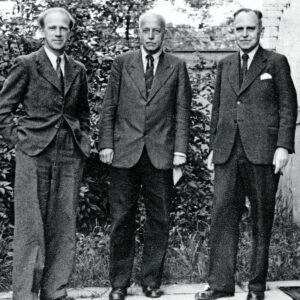
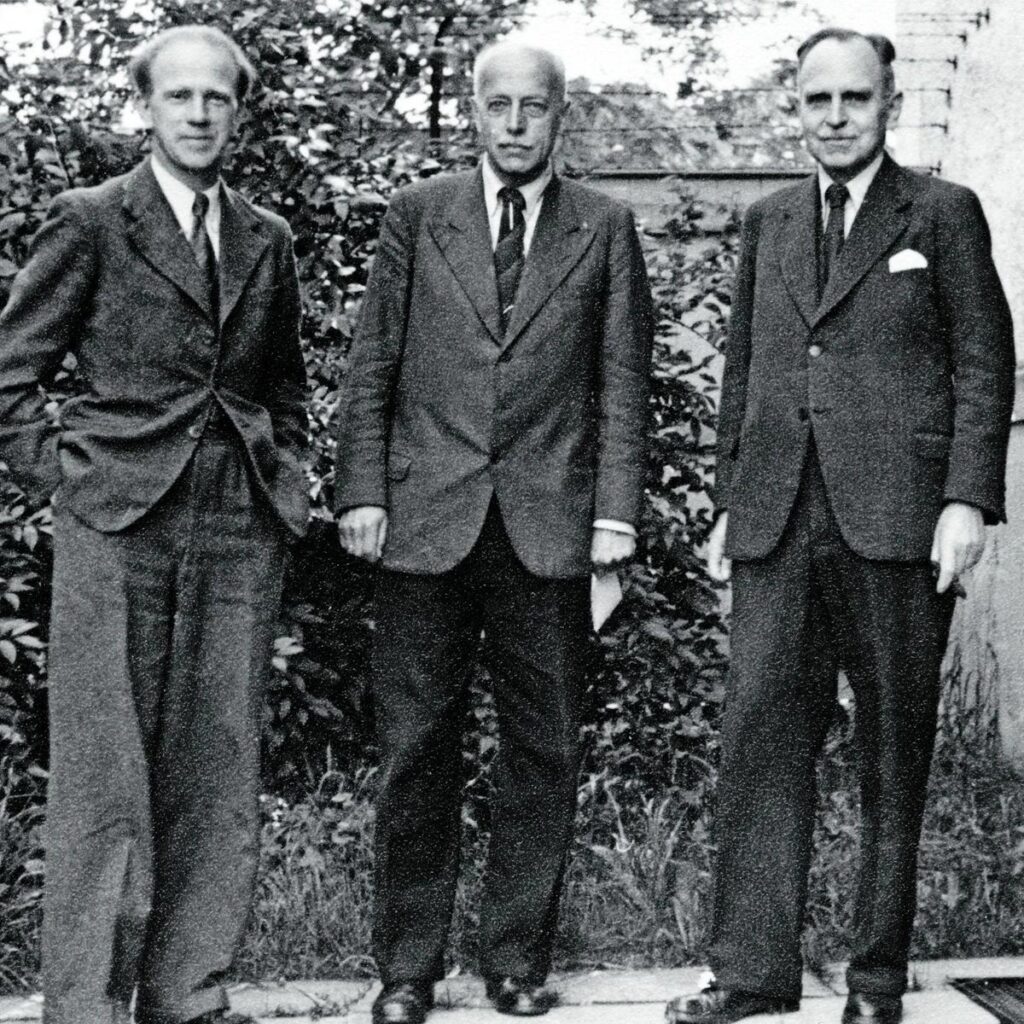
The conversations among Hahn, Heisenberg and Weizsäcker are the most revealing.
“Poor Heisenberg. If the Americans have the uranium bomb, all of you are second-rate.”
Heisenberg replied: “One could also say that this is the quickest way to end the war.”
Weizsäcker, whose brother later became president of West Germany, said: “I think it was madness for the Americans to build it.”
Hahn, who had attempted suicide in 1939 after his discovery of nuclear fission, added: “I thank God that we did not build it.”
Heisenberg and the German bomb
Werner Heisenberg is the central figure in this story.
In 1942, Albert Speer, Hitler’s minister of armaments, summoned him to assess whether an atomic bomb could be developed. The physicist’s pessimism convinced the Nazi minister that such a weapon could not be completed in time.
Heisenberg spoke about reactors and cyclotrons and argued that atomic bombs might become possible in the future, but not during that war. Hitler then placed his hopes in Wernher von Braun’s flying bombs.
In the report produced by the Alsos mission—the name was the Greek translation of the surname of General Leslie Groves, head of the Manhattan Project—Heisenberg appears far more outspoken in private conversations with his German colleagues than he would be later.
He rejected the suggestion that Germany’s decision not to build the bomb resulted from incompetence or ignorance. The country’s circumstances, he argued, made such an effort unsuitable.
“The physicists would have succeeded if all of them had wanted Germany to win the war.”
They worked only on a reactor, not on a bomb, because the regime was Hitler’s.
Almost immediately after learning that an atomic bomb had been dropped on Hiroshima, Heisenberg reconstructed the process that had made it possible. A week later, he delivered a lecture on the subject to the other scientists being held with him.
Hans Bethe, one of the leaders of the Manhattan Project, later examined what Heisenberg had said and had no doubts about how much the German physicist truly understood about fission and atomic explosives.
Patriotism and defeat
Two comments made by the detained scientists deserve particular attention.
When a colleague spoke to Otto Hahn about patriotism, Hahn replied that he also loved his country and that this was precisely why, however strange it might seem, he had hoped Germany would lose the war.
Weizsäcker offered a similar explanation for why German scientists never produced the bomb:
“I think the reason was that we did not want it because we did not want the war to be won. If all of us had wanted Germany to win, we would have succeeded.”
The mystery of the missing German bomb thus appears to resolve itself through a kind of hall of mirrors.
In 1942, the Anglo-American and German teams possessed roughly comparable knowledge of nuclear physics. But knowledge alone is not enough to build a bomb. It must be organised within an enormous industrial complex.
The United States government created that complex, initially encouraged by Jewish scientists who had fled Europe and feared that Hitler might get there first.
The Nazis never made the same effort. Partly, they did not believe the Allies would do so. Partly, they received negative advice—perhaps deliberately—from Heisenberg and some of his colleagues.
Those scientists also retained control over Germany’s uranium research.
Heisenberg and his group never later claimed recognition for having taken a morally superior position. Yet, accepting their explanation—which not everyone does—they could be viewed as a significant example of the possible connection between scientific values and humanism.
Vannevar Bush and the linear model
Although he was an engineer, Vannevar Bush formulated for the United States one of the most influential scientific ideologies of the decades following the Second World War.
Science was granted almost absolute primacy within the supposedly magical pairing of research and development, which came to be treated as synonymous with economic growth.
Knowledge, according to the universal chorus of economists and communicators still heard today, is the basis of innovation, and scientific research plays a central role within it.
Bush, a former dean of the Massachusetts Institute of Technology, had played a leading role in the Manhattan Project and became the dominant figure in post-war American science.
He stated:
“Basic research leads to new knowledge. It provides scientific capital. It creates the fund from which practical applications must be drawn.”
The sequence appeared perfect and simple:
Basic science, applied science, development and technology.
In 1950, Bush became the architect of the National Science Foundation, the institution that came to symbolise support for the basic sciences.
The model in Argentina
Not long afterward, Argentina created the National Scientific and Technical Research Council following a similar belief in the priority of basic science.
The idea was that technological applications would emerge from it almost naturally.
It proved to be an expensive and frustrating illusion, although perhaps an inevitable one given the cultural characteristics of Argentine society.
Only a few voices challenged an ideology that eventually became deeply rooted in public opinion and continues to be defended by many people.
Bush’s correction
Vannevar Bush himself later became concerned about the undesirable consequences of the ideology he had helped establish.
In his memoir Pieces of the Action, published in 1971, he revised what he had written in Science, the Endless Frontier in 1945.
He observed:
“The business of placing scientists on a pedestal probably began with that statement, and it is something that has persisted and misled many young people. Even recently, when we sent the first astronaut to the Moon, the press hailed it as a great scientific achievement. Of course, it was nothing of the sort: it was the work of wonderfully competent engineers.”