The analytical engine
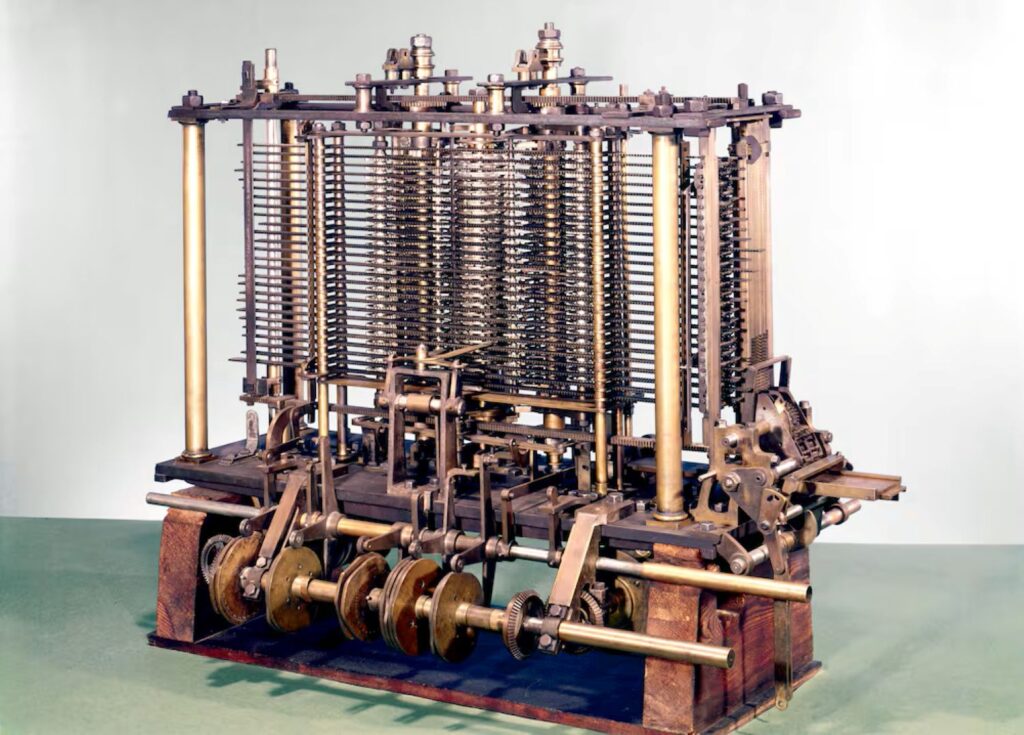
La máquina analítica de Babbage anticipó conceptos centrales de la computadora, como memoria, instrucciones, entrada de datos y unidad de cálculo.
When the possibility of building the difference engine disappeared, Babbage went further. He devised a machine that responded to absolutely new characteristics. He devoted his efforts to it from 1833 until his death. It was the analytical engine, the precursor of the 20th-century computer.
What was its functionality? Stated briefly, it consisted of a multipurpose calculating machine, with the capacity to operate in different ways according to the type of problem posed. This definition uses the concept of a general-purpose machine and applies equally to Babbage’s device and to the modern computer. In both cases, the structure of the machine makes it possible to alter the sequence of operations according to the result of the immediately preceding calculations.
The material elements of its structure were similar to those of the difference engine, that is, gears and shafts, but with the novelty that the energy to move the whole machinery would not be generated by an operator, but by a steam engine. This change was due to a very significant increase in the size of the projected device and to the application of regulating controls. The vast differences with the calculating machines known until then were the following. Since the analytical engine allowed multiple uses, its control had to be carried out through the introduction of instructions encoded on punched cards. In addition, the device had to have a memory in which to store the instructions that would intervene at the appropriate moments to regulate the calculations.
Input mechanisms
Punched cards supplied the machine with information. A distinction was made between two types of cards, with different inputs into the machine:
- cards related to data;
- cards related to instructions or programs.
Memory
The projected maximum storage capacity was one thousand numbers of fifty digits. Its realization would consist of a set of one thousand columns of fifty wheels each. The memory corresponded to the machine’s store.
Control unit
Arithmetic logic unit
This unit performs numerical calculation operations and logical discriminations. Babbage referred to this mechanism as the “mill.”
Output mechanisms
Where the results of the calculations were read.
Babbage’s legacy
Babbage never saw his project completed. With an almost obsessive devotion, he dedicated the rest of his life and his resources to designing parts and diagrams for the analytical engine, hoping to involve capital partners in the project. He was so much a prophet of his extraordinary invention that his behavior was considered eccentric, if not deranged. After his death, which occurred in 1871, he left behind a remarkable technological legacy that was not valued until much later, despite the existence of some continuators of his work. Among them was the very active Spanish researcher Leonardo Torres Quevedo (1852–1936), a mathematician, engineer and inventor, who built a calculating machine that he named the arithmometer.
Ada Augusta Byron
Ada Augusta Byron (1815–1852), countess of Lovelace and daughter of the Romantic poet Byron, was one of the main sources of information on the work of the father of the computer. Ada’s outstanding intellectual gifts and her friendship with Babbage led her to take an interest in experiments in the mechanics of calculation. She also took part in the publication of the master’s ideas through an article that became famous.
This is the history of that article. At the Congress of Italian Scientists, held in Turin in 1840, news was given of Babbage’s discoveries. Following what was presented at that forum, an Italian military engineer, L. F. Menabrea, wrote a popularizing article on the analytical engine. The article was published in French in the Bibliothèque Universelle of Geneva in 1842. Lady Lovelace then translated it into English and doubled its length with her own notes, which were highly clarifying and deepened the information. She published it in 1843 in Scientific Memoirs. Ada was then twenty-eight years old and was a solid collaborator of Babbage. She took charge of developing the instructions that were to govern the first operations of the analytical engine.
Hollerith, the first professional of computing
The first steps of computing were taken at the end of the 19th century. The person responsible was the American statistical technician Herman Hollerith. With a device of his own invention, he partially mechanized the processing of his country’s census, using programming techniques through punched cards. His work made him the first professional of computing. In addition to counting inhabitants, they had to be classified into groups and subgroups according to criteria such as age, sex, marital status and others. The census was completed seven years after it began.