The Steam Engine
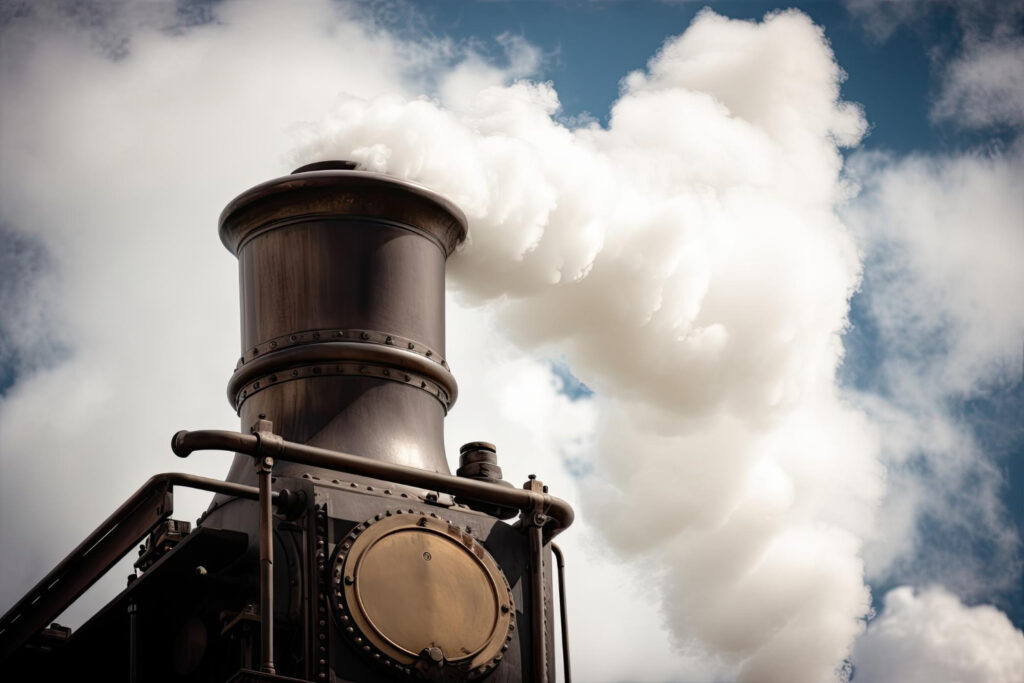
La máquina de vapor transformó la producción, el transporte y la energía industrial, desde las minas y fábricas hasta las locomotoras y los barcos.
The force generated by steam has fascinated people for hundreds of years. In the first century AD, Greek scientists discovered that steam contained force or energy that could be used. But the ancient Greeks did not use steam to move machinery.
The first steam engines were designed in the late seventeenth century by engineers such as the Marquis of Worcester and Thomas Savery. Savery’s engine was intended to pump water out of mines. The first truly practical steam engine was designed by Thomas Newcomen, who presented the first of them in 1712.
The Scottish instrument maker James Watt improved the steam engine. His machines condensed steam outside the main cylinder, which saved heat. They also used steam to force the piston downward, increasing efficiency. The new machines soon became the main source of power in factories and mines. Later improvements included the more compact, high-pressure engine used in locomotives and ships.
Navigation and Measurement
As more people traveled by ship, navigation skills became increasingly important. Navigation probably originated on the Nile and the Euphrates 5,000 years ago, when Egyptians and Babylonians established trade routes. The Egyptians were also pioneers in measurement, which was essential for creating large buildings such as the pyramids.
Navigation and measurement are related, since both involve measuring angles and calculating distances. From 500 BC onward, first the Greeks, then the Arabs and Indians, established astronomy, geometry and trigonometry as sciences and created instruments such as the astrolabe and the compass.
By understanding the movements of celestial bodies and the relationship between angles and distance, medieval sailors were able to create a system of longitude and latitude to find routes without using land as a reference. The Romans pioneered the use of accurate measuring instruments, and Renaissance architects added the theodolite, a device that remains one of the most important instruments.
Spinning and Weaving
Early humans used animal skins to keep warm, but about 10,000 years ago people learned to make clothing. Wool, cotton, linen and hemp were first turned into thin threads with a spindle. The thread was then woven to make cloth.
The first weaving machines probably consisted of a pair of sticks that held a group of parallel threads, called the warp, into which the crosswise thread, the weft, was inserted. Later machines, the looms, had rods that separated the threads to make it easier to insert the weft. A piece of wood, the shuttle, carrying a spool of thread, was passed between the separated threads.
The basic principles of spinning and weaving remain the same today, although during the Industrial Revolution of the eighteenth century many ways of automating the process were invented. With new machines, many threads could be spun at the same time and, with the help of devices such as the flying shuttle, large pieces of cloth could be made at great speed.
Batteries
Two thousand years ago, the Greek scientist Thales produced small electric sparks by rubbing a cloth against amber, the yellow resin formed from the sap of dead trees. A long time passed before this force could be controlled to produce a battery: an object that generates a steady flow of electricity.
In 1800, Alessandro Volta (1745–1827) published details of the first battery. Volta’s battery produced electricity from the chemical reaction between certain solutions and metal electrodes. Other scientists, such as John Frederic Daniell (1790–1845), improved Volta’s design by using different materials for the electrodes. Today’s batteries still follow Volta’s basic design, but use modern materials.
Photography
The invention of photography produced, for the first time, exact images of any object quickly. It emerged from the combination of optics and chemistry. The projection of the Sun’s image onto a screen had been studied by Arab astronomers in the ninth century AD, and by the Chinese before them.
In the sixteenth century, Italian artists such as Canaletto used lenses and a “camera obscura” to create accurate drawings. In 1725, the German Johann Heinrich Schulze demonstrated that the darkening of a silver nitrate solution when exposed to the sun was caused by light and not by heat. In 1827, a metal plate was covered with light-sensitive material, and a permanent visual record of an object was made.
Medical Inventions
Humans have always practiced some form of medicine. Primitive peoples used herbs to cure illnesses, and prehistoric skulls have been found with holes in them, probably made with a trephine, a surgeon’s circular saw. The ancient Greeks performed this operation to reduce pressure on the brain after head injuries.
The Chinese practiced acupuncture by inserting needles into the body to relieve pain or symptoms of disease. But until well into the nineteenth century, a surgeon’s instruments were not very different from ancient scalpels, forceps, hooks, saws and other tools used for amputations or tooth extraction.
The first instruments used to determine the cause of diseases appeared during the European Renaissance, thanks to the pioneering anatomical work of scientists such as Leonardo da Vinci and Andreas Vesalius. In the nineteenth century, medicine advanced; many instruments used in medicine and dentistry, from stethoscopes to dental drills, were developed during this period.