The finished plant
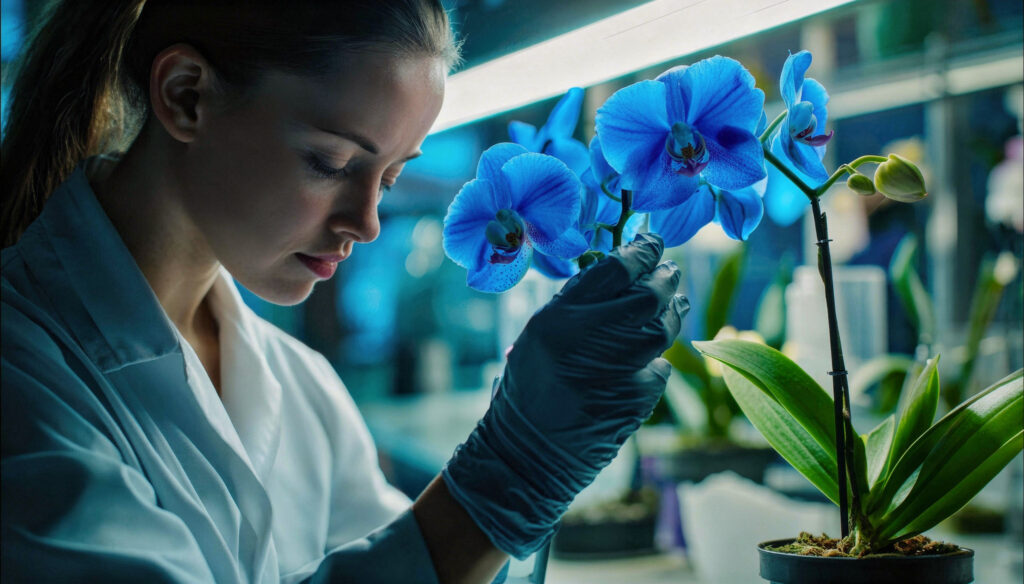
La biotecnología vegetal, el reciclaje y las energías limpias redefinen la relación entre desarrollo tecnológico y medio ambiente.
This blue orchid, native to tropical regions of Southeast Asia, represents a case where technology intervenes to preserve biodiversity. Through in vitro cultivation, almost invisible seeds can be developed into viable plants under controlled laboratory conditions. This method enables the conservation and propagation of species whose natural habitats are under threat, maintaining genetic continuity beyond environmental limitations.
A look toward the future
For most of history, technology addressed basic needs through simple means. Over the last two centuries, however, the emergence of industrial systems—driven by fossil fuels—transformed technology into a dominant force shaping economies and societies. While these systems increased productivity and material well-being, they also introduced environmental degradation and resource dependency.
Current research trends indicate a transition toward cleaner and more efficient systems. Governments, engineers, and scientists are working on alternative energy sources, material recycling, and technologies adapted to different economic contexts. However, technological change alone is insufficient without adjustments in consumption patterns and societal expectations.
Recycling materials
Extracting raw materials requires significant energy. Resources such as timber, water, and petroleum are either slow to regenerate or non-renewable. Recycling reduces pressure on these systems by reusing existing materials. For example, producing aluminum from recycled cans consumes far less energy than extracting it from ore.
The recycling process involves collection, compression, fragmentation, and purification. Metals are separated, melted, and reformed into new products. This closed-loop system reduces energy demand and environmental impact while supporting industrial production.
Efficient collection systems
The effectiveness of recycling depends on logistics. If collection requires excessive transportation, the energy cost can outweigh the benefits. Efficient systems integrate disposal into daily routines, allowing consumers to deposit materials at accessible points. Centralized collection reduces fuel consumption and increases overall system efficiency.
Hydrogen energy
One of the most researched alternatives is nuclear fusion using hydrogen isotopes such as deuterium and tritium. This process aims to replicate the reactions that occur in stars, releasing large amounts of energy from minimal material input. Experimental systems use high-energy lasers to initiate fusion under extreme temperatures. If controlled, this technology could provide a nearly inexhaustible energy source derived from water.
Harvesting wind energy
Solar radiation drives atmospheric movements, generating wind as a secondary energy source. wind energy converts this kinetic energy into electricity through turbines. Modern wind farms are large-scale systems that contribute to energy supply without producing chemical pollution.
However, wind energy has limitations: variable output, landscape impact, and relatively low contribution compared to total demand. These constraints highlight the importance of energy efficiency alongside generation.
Appropriate technology and resource use
In many regions, limited access to industrial infrastructure has led to the development of low-cost, functional technologies. Devices built from reused materials—such as manual water pumps constructed from scrap components—demonstrate how engineering principles can be applied with minimal resources.
These systems rely on human energy and simple mechanics, offering practical solutions for irrigation and daily needs. Such approaches illustrate a model of “appropriate technology,” where design is adapted to local conditions, resource availability, and sustainability requirements.
Technology and environmental balance
The evolution of technology now faces a central constraint: environmental sustainability. The capacity to transform natural systems must be balanced with resource limits and ecological stability. Future development depends on integrating innovation with efficiency, reducing waste, and aligning technological systems with long-term environmental conditions.