Pascal and his contribution
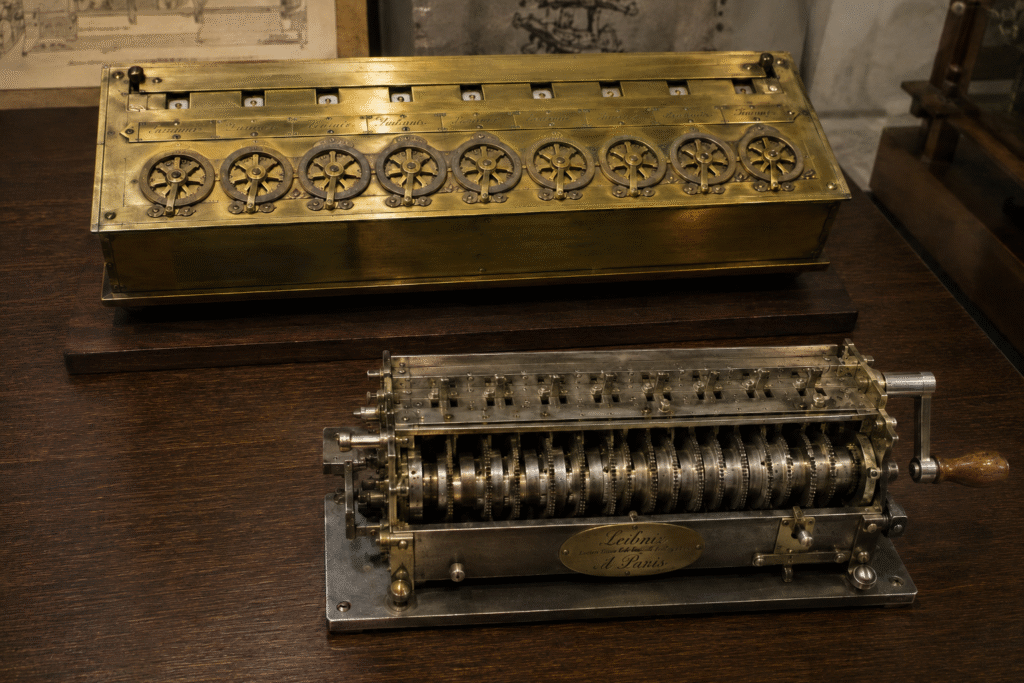
La Pascalina de Blaise Pascal y la calculadora de Leibniz abrieron el camino hacia la automatización de las operaciones matemáticas.
The precocity that Pascal showed in mathematics and essay writing also extended to calculation. At the age of eighteen, he addressed the problem of how to avoid the burden of lengthy operations. His father was a tax-collection official, and Blaise occasionally helped him draft official reports. The gifted son realized how tedious it was to add endless lists of numbers. And he concluded that it was not proper for man to perform these routine calculations. Hence his idea of manufacturing a truly useful machine and the origin of the invaluable gift he gave his father. He would be able to calculate more comfortably, no doubt, but he would also do so with greater speed and precision. The “Pascaline” was somewhat smaller than a shoebox. It looked like a low, elongated box. The total number of wheels amounted to eight, distributed as follows: six wheels to represent whole numbers and two more wheels, at the far left, to indicate decimals. With this arrangement, numbers between 000 000.01 and 999,999.99 could be handled. By means of a crank, the toothed wheels were made to turn. To add or subtract, it was only necessary to operate the crank in the appropriate direction, causing the wheels to move the necessary steps. The French philosopher and physicist persevered in perfecting it and generously applied his inventiveness. He built around fifty models in his search for a satisfactory calculator. Despite this, his effort had no repercussions in the royal offices, nor did it gain acceptance among his father’s colleagues. The technical quality of Pascal’s invention was not enough to overcome social obstacles. Clerks and accountants preferred to continue with their habits, partly out of routine, partly out of fear of being displaced by the efficient machine. And employers or business owners saw no benefit in buying expensive machines when the work was being done for them at a very low cost.
Leibniz’s calculator
Pascal’s illustrious successor in this inventive race was another genius, the philosopher and mathematician Gottfried W. Leibniz (1646–1716). This German scholar stood out for his precocity and depth of thought, more brilliant and influential than Pascal’s. He learned mathematics on his own and advanced beyond what was known. He devoted himself to theoretical problems of calculus and also demonstrated his skill in designing a calculating machine. From a very young age, he showed his sensitivity toward mathematical operations. This led him to study the calculating machines that had been built up to that point, those of Pascal and the Englishman Samuel Morland, and to improve them. He devised a calculator that not only added and subtracted, but could also multiply and divide. This marked a very notable milestone, whose functional principles continued to be used until the middle of the 20th century. From the conception to the final material realization of the idea, there was a long effort. His universal calculator, the name he gave it, was a rudimentary prototype in 1671. It benefited from later improvements until 1694, the year in which Leibniz considered it perfected. We previously mentioned Leibniz’s precocity. One fact justifies this obvious point: he built his first prototype at the age of twenty-five. To mechanize multiplication and division, Leibniz devised a brilliant method. It consisted of a device that allowed repeated additions and subtractions to be carried out, which is equivalent to multiplying or dividing. The mechanism that made these operations possible was based on a step counter, consisting of a long cylindrical toothed wheel with nine teeth or rods of variable length. The invention is known as Leibniz’s stepped wheel. This toothed wheel in the shape of a cylindrical drum drove the calculation machinery through another smaller wheel. The small toothed wheel could move along its axis, and a dial associated with it marked the number to be multiplied or divided. Each revolution of the cylindrical drum made it turn a number of teeth identical to the one selected. If, for example, the aim was to multiply by 4, the cylindrical drum had to be turned four times, and it added the given quantity four times.
The calculators of Pascal and Leibniz encountered a major technical obstacle. The technological development of the 17th and 18th centuries was not equal to their designs. Artisanal production did not reach the degree of precision required to achieve the proper functioning of the machinery. The various models attributed to each of these “engineers” of thought and mechanics constituted a search for techniques that would ensure greater reliability. The Industrial Revolution would take more than a century to arrive and, with it, the possibility of serial production of precise machinery. Nevertheless, there were the prototypes of what would become a long tradition of mechanical calculators. During the 18th and 19th centuries, only variants of Leibniz’s model were introduced. From the 19th century onward, the gap between theory and practice was overcome, and precise and economically affordable calculators were built, thanks to better technologies. But the break with the solutions advanced by Pascal and Leibniz was not seen in small shops and small businesses until well into the second half of the 20th century.