Technology vs. the human brain
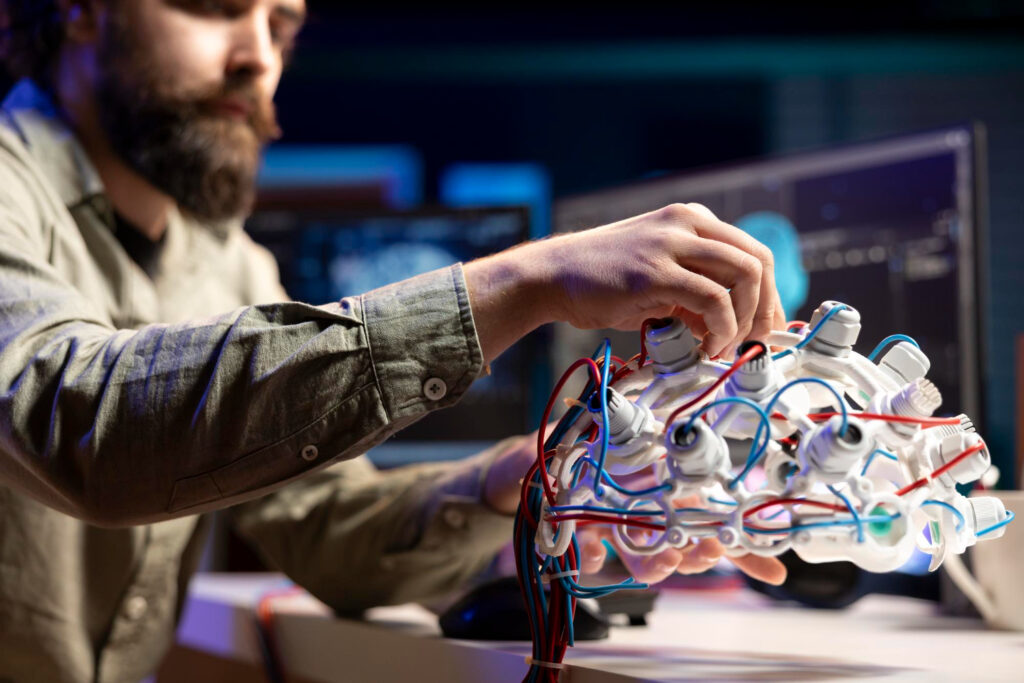
La técnica electrónica aparece como una herramienta capaz de liberar al cerebro humano de tareas rutinarias y ampliar su función analítica, creativa y científica.
With electronic technology, the aim is to imitate, replace and surpass much of the heavy work performed by the human brain, which has around 10 billion nerve cells concentrated in the basal nuclei and the cerebral cortex. That attempt by electronic technology will succeed. Those 10 billion cells will benefit from being relieved of the overload imposed today by an outdated system that forces memory to retain more than is pleasant or useful. Writing was a remarkable advance for the mind. No brain is capable of recording all the knowledge contained in books. The brain becomes uselessly fatigued by the function of storage, which becomes more difficult to maintain every day; its main function should be analysis, synthesis and creation.
Human life is characterized by a constant and progressive technical control of its environment. Each human advance corresponds to an advance in the technique of control. The more that technique evolves, the more humanity evolves. The technologization of the world will coincide with its most complete domination by man. That domination is the oldest and most ambitious of human dreams. The new era opened by the disintegration of the atom and the use of its energy for peaceful purposes, consolidated and expanded by electronic technology, places humanity in a position to turn that dream into reality. Our time is a transition between two worlds. Man must prepare to face that transition properly and benefit his evolutionary process. A poorly used transition, instead of favoring evolution, could lead to mere hypertrophy, as happened to the reindeer with its oversized antlers. But man is showing that he knows how to take advantage of every change by placing it at the service of his evolutionary process.
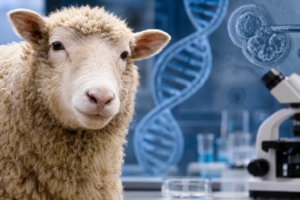
We are at the beginning of the greatest transformations of what is called “matter”; chemistry will achieve technical advances as transcendental and spectacular as the disintegration of the atomic nucleus in physics. Genetics, in turn, will manage to control inheritance to an extent that still cannot be predicted. Life is entering a deep and long period of mutations. Modern man is more sensitive to this than primitive man; therefore, he is subject to more diverse, frequent and profound changes. His capacity to evolve is increasing. He will change greatly. If we could come back to life a few centuries from now, we would find it difficult to recognize the descendants of today’s man as such. It is not reckless to say that our history will be prehistory, and that the man of the future will regard the man who lived before the disintegration of the atom as “his ancestor”.
It is estimated that within 10 years, in the major countries, nuclear energy will be equivalent to 20 percent of the energy obtained through traditional means; in three decades, it will represent half; and in half a century, nine tenths. It is impossible to imagine what such a change will mean in the supply of energy, not counting many other sources that are yet to be discovered, or that will emerge as new techniques open the way to new scientific research. The energy problem, which seemed to place a barrier before the expansion of human power in the universe, may be considered solved. Without the light and heat of the sun, the type of life to which we belong would be deeply damaged. But if the sun were to go out, in the strict sense in which this can be thought, long before that man, as a source of energy, would either have changed his dwelling place by choosing another planet. Technology would make that work possible.
If the type of world in which we are living had to be defined, it would be progressively technological. For such a world, humanity must also be progressively prepared technologically; otherwise, there would not be an adequate articulation between man and his environment, which would damage the evolution of both. It has taken man a great deal of time and effort to reach the point he has reached in his systems of relation with the environment. If, for the expansion and development of his new technological world, he had to face the same or similar difficulties as in the past, his life would continue to be, in large part, a frustration.
Most of the world’s population is insufficiently prepared for the new technological era. This preparation is vital for man. If he did not learn to govern the stages of the new technological process, it would become chaos instead of a process of order and harmony, because changes will follow one another as in a chain reaction.
Technology, as a possibility, has always been ahead of man. The average man today, despite the wonders achieved by his species, is a rustic figure compared with what he could already be. He gives the impression of believing that no other species can surpass him in the domination of the world. But he is mistaken: he will be surpassed by men with a new attitude of creation; even more, by a new type of men emerging from the same species, this time without the need for transcendental genetic mutations, since a broader and more varied use of their brain, their technology and their environment will be enough.
The man who adapts to interplanetary travel, who is exposed to the influences of a new flora and a new fauna, a new atmosphere, a new way of eating, resting and living, will be, in short, a man physically, psychically and historically different from the man of today. This transformation is inevitable. Man must evolve if he wants to continue living as a species.