Scientific and Technological Literacy
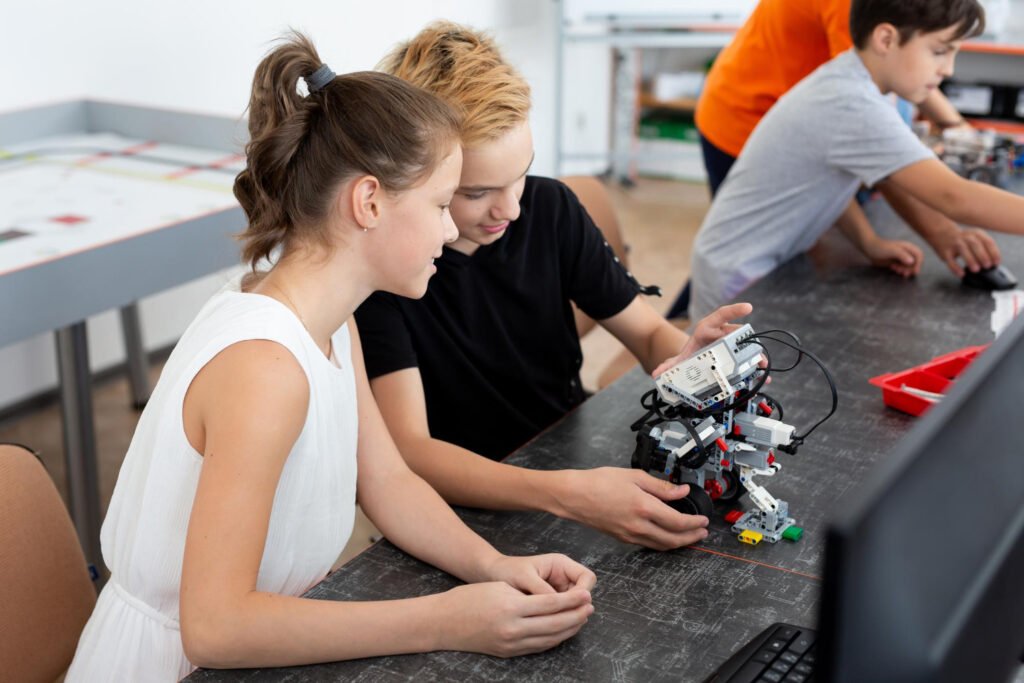
La alfabetización científico-tecnológica propone vincular los conocimientos con situaciones cotidianas y fortalecer la autonomía, la comunicación y la responsabilidad.
In the last century, amid the Second Industrial Revolution (transportation, electricity and the telegraph), forward-looking societies understood the need for the masses to learn to read and write so they could participate in both the effort and the benefits of progress. Nothing more and nothing less, surely, than scientific and technological literacy for Argentines. Familiarizing those who can be educated with the patterns of the transformation humanity is experiencing. Enabling them to understand the cultural dynamics of the twenty-first century and become responsible agents in its processes.
There is a genuine worldwide social movement in favor of this kind of literacy. Initiatives to renew science education are emerging everywhere. A crisis is acknowledged, stemming from the exhaustion of traditional models, the lack of relevance of pedagogical methods and a disciplinary style of teaching. We note initiatives from organizations such as UNESCO (“Project 2000+ Forum”), the European Commission (“Teaching and Learning Towards the Learning Society”), the OECD (“Innovation in Science, Mathematics and Technology Education”) and the AAAS. And among developed countries: England, the pioneer; France, following the Haby Reform; and Belgium, which began renewing secondary education as early as the 1970s… In our country, some signs of political concern can be noted. They are reflected in provisions of the Federal Education Law and in isolated initiatives within the relevant sector concerning common content for general education. Yet it is clear that errors typical of our battered pedagogical culture are being repeated: authoritarian or manipulative conceptions, haste and opportunism.
It is clear that there are no grounds for feeling reassured. Fundamentally, moreover, because there can be little confidence in the governmental gestures of a political faction whose tradition is characterized—as teachers’ electoral antipathy clearly reflects—by little enthusiasm for education. Furthermore, when the Ministry speaks of “scientific literacy,” it is probably thinking exclusively in economic terms (more precisely, about the theoretical demands of the “model” and the talk of “competitiveness” and “globalization”), above the other two requirements of a serious scientific literacy program: the humanist perspective (individual autonomy) and the democratic standpoint (communication with others). The most important signs come from a particular sector: dedicated educators who are modest, persistent, followers of Sarmiento and probably socialists. The best can be expected from them.
Around April of last year, at the San Martín Cultural Center in Buenos Aires, the “Science for Everyone” Mutual Association held a meeting under the slogan “Scientific and technological literacy, a commitment to the new century.” With around 1,500 participants, it was an extraordinary public demonstration of the interest and desire for change animating the country’s mutual association teaching community. Central to the meeting, the participation of Gérard Fourez—who holds a doctorate in Physics from Maryland (U.S.), degrees in Philosophy and Mathematics from Louvain, and is director of the Department of “Sciences, Philosophies, Societies” at the University of Namur, standing at the forefront of the European educational renewal project—became an event in itself. We wish to introduce his book Scientific and Technological Literacy, translated especially for the occasion (Editorial Colihue, 1997), to the readers of Río Negro (and, in particular, to the many teachers who some time ago in Neuquén shared with us their bewilderment at the unexpected ministerial requirement to teach “Technology”), now that another visit by the educator in May and several lectures in different parts of the country have been announced.
Professor Fourez recounts that, on one occasion, a goddaughter of his, a secondary school student, expressed her intense dislike of science. He explained why knowledge is useful; physics, for example, enables her to understand electricity and thus become more autonomous in her experiences of life. The girl answered firmly: “That is not what they teach us in our science courses; we learn only things that interest scientists, not us.” Her godfather thought it was important to reflect on whether she was right. Should we teach young people physics, chemistry, biology and mathematics, or should we teach them how to confront their own world? Despite our familiarity with traditional ways of teaching science by discipline, it is clear that the second alternative is the appropriate one. To fulfill it, we must strive to teach scientific theories through the mediation of a context of human projects. The book abounds in examples of concrete situations in which scientific concepts, as well as the educational process and its rewards, become clear. They are examples from everyday life. Blood circulation, but in order to understand (and be able to respond to) a hemorrhage or fainting episode; knowing why meat should not be put back in the freezer once it has thawed; understanding how a soufflé puffs up or what alcoholism or drug addiction means. Concrete situations require an interdisciplinary model adapted to each context, a conceptualization (“island of rationality”) that answers the questions “What is this about?” and “How should we represent the situations in which we find ourselves?”
There is much to nourish the interest of good teachers, who, fortunately and despite everything, abound in our country. The aims of scientific and technological literacy, competing epistemological conceptions, ideologies, the distinction between sciences and technologies (he always refers to them in the plural, a significant and correct detail); contexts, scientific models seen as “intellectual technologies,” what is needed to develop scientific and technological literacy—that is, simple and interdisciplinary models—the construction of “islands of rationality,” the proper use of metaphors and standardized knowledge, the uncovering of projects, and the opening of technologies’ “black boxes.” Fourez writes: “I would consider someone scientifically and technologically literate when their knowledge afforded them a certain autonomy (the possibility of negotiating their decisions in the face of natural or social pressures), a certain ability to communicate (finding a way to ‘say’), and a certain mastery and responsibility in concrete situations.” A basic question: what training does a teacher need to teach science? A solid grounding in epistemology that enables them to appreciate the contextual origins of knowledge. The ability to construct interdisciplinary projects integrated around real and complex phenomena. The ability to think technologically (in the manner of a doctor, engineer or architect). Finally, they need to know how to participate in the current debate about the purpose of science education—for example, the question of deciding whose interests it should primarily serve: elitist science or science for everyone.