Clones, genetics and technology
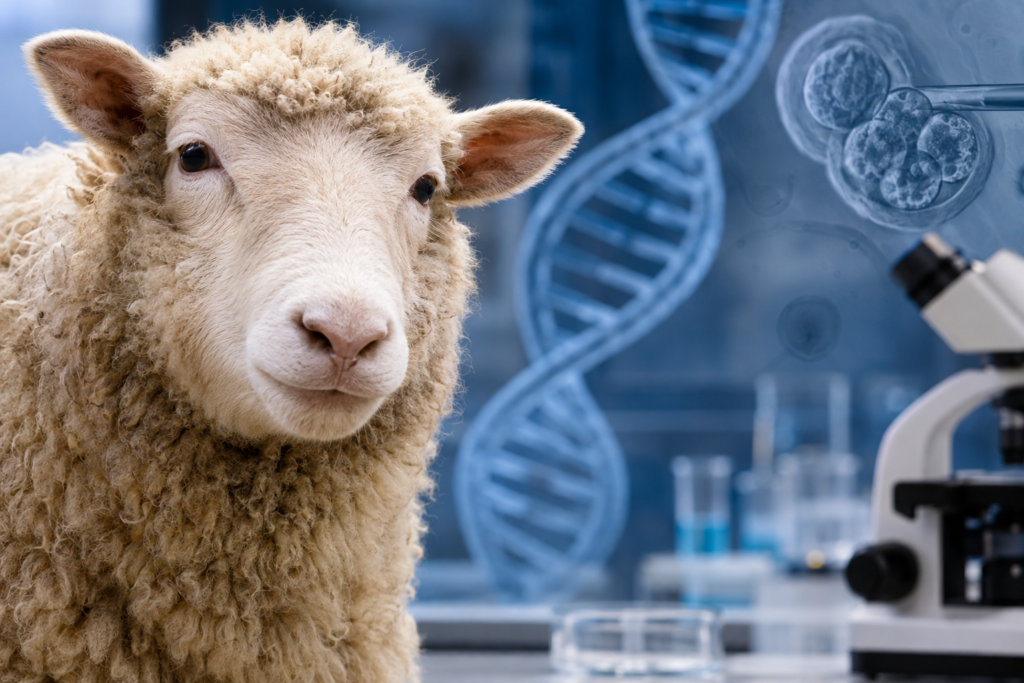
La clonación de Dolly abrió un amplio debate científico, ético y moral sobre los alcances de la genética y las nuevas tecnologías reproductivas.
The announcement that a sheep had been successfully cloned in Scotland and that “Dolly” was healthy sparked heated debates and anxiety about its meaning and significance. Some denounced the technological achievement as an attempt to “play God”; they even fantasized about cloning Hitlers and Einsteins. Man was usurping the place of the Creator and risking unpredictable, perhaps monstrous, results. Biblical exclusivity (Jehovah and His cloning of Eve using one of Adam’s ribs) had been challenged by technoscientific arrogance. The President of the United States took no more than a single day to request an urgent opinion from the National Bioethics Advisory Commission. The Senate, with a Republican majority, did not want to be left behind: three weeks after the announcement of the cloning, it held its public debate on the ethical and moral concerns it raised. Representatives of the biotechnology industry assured the senators there that they were far from dreaming of manufacturing children and that they were only interested in developing laboratory methods to produce cells and tissues that could be used in transplant therapies.
That Presidential Commission produced its Report one hundred days after the announcement about Dolly. Now, several months later, it has prompted a critical analysis by Richard Lewontin, professor of Biology at Harvard University. As a more general point, he finds that the reservations it raises about the cloning of human embryos fall into the error of “confusing the genetic state of an organism with its total physical and psychological nature as a human being.” This is not, in particular, a new position of his; in fact, for quite some time he has been denouncing (in his 1992 book The Dreams of Human Genome and several times in controversial articles against “genomania”) the fallacy of “genetic determinism,” the assumption that genes “make” the organism. It is a basic principle of biology, he recalls, that the organism undergoes continuous development from conception to death, a development that is the unique consequence of interactions between genes and their cells, the temporal sequence of environments through which the organism passes, and random cellular processes that determine the life, death, and transformation of cells. As a result, even the fingerprints of identical twins are not identical. Their temperaments, mental processes, abilities, life choices, histories of illness, and deaths quite clearly differ.
This is what some parents of twins fail to understand when they try to make them identical beyond their natural similarities, dressing them alike, giving them names that begin with the same letter, giving them the same haircut, etc. The professor draws from his childhood memories a famous case of efforts to transform “genetic clones” into “human clones”: that of the Dionne quintuplets, those Canadian babies born in 1934 who became the object of intense publicity and even a tourist attraction, identically dressed and groomed by Dr. Dafoe and the province of Ontario until their adolescence. Returned to their home, each had her own adulthood and her own mixture of happiness and unhappiness. They resembled one another in health and professions no more than any group of five girls of the same age raised in a rural town like theirs. Three married and had children. Two trained as nurses; two went to university. Three of them were drawn to the religious profession, but only one entered it. One died in the convent at the age of twenty, suffering from epilepsy; another at thirty-six; three are still alive, now in their sixties. This is a case that demonstrates that genetic identity (which is even greater when it occurs naturally, as in the case described, than in the case of cloning) does not mean personal identity.
There is no need to prohibit cloning, says the biologist. What is needed is to demystify the genomania spread by some science communicators and the media in general, producing a false understanding of the control that genes have over our lives. We must embark on a serious educational campaign to correct the error. There are several examples of behaviors or purposes misdirected by the erroneous synecdoche that substitutes “gene” for “person.” For example, the exaggerated estimation of what is understood as “family genetic heritage.” These stories respond to the same force that leads people who were “adopted” as children into a futile search for their “real,” that is, biological, parents in order to discover their “real” identity. They are modern continuations of an earlier concern with “blood” as the bearer of an individual essence and as a mark of legitimacy. It is not the possibility of producing a human being with a copy of someone else’s genes that has created the problem of public anxiety or that adds a unique element to it. It is the fetishism of “blood” which, once accepted, generates an immense series of apparent moral and ethical questions. “If it were not for the belief in blood as essence, much of the concern about the cloning of human embryos would disappear.” The key to successful cloning is to make sure that the donor’s chromosomes are in good condition. However, no one knows how to achieve this. The case of the Scottish sheep clearly demonstrates the difficulties of this technology. Dr. Wilmut and his colleagues learned this through multiple failures: 276 embryos inexorably died at various stages of development until case number 277 became Dolly. And they only made it public when the sheep had reached a state of biological maturity that allowed them to be certain that the operation had been successful. This indicates how difficult it would be to improve the methods so that they would work in humans. How many embryos would have to be sacrificed, and at what stage of their development? Clinton’s Bioethics Commission listed four ethical problems to be considered: individuality and autonomy, family integrity, treating children as objects, and the problem of safety regarding the outcome.
The Harvard professor analyzes the first three and quickly dismisses them for different reasons. Only the issue of safety seems serious to him. Suppose, he says, that we have a high success rate in the cloning of human embryos; what kinds of developmental abnormalities could be acceptable? And acceptable to whom? Once again, the moral problems that emerge from cloning are not exclusive to this technology. They are common to a series of new reproductive technologies: in vitro fertilization, embryo implantation, and surrogate mothers, for example; the possibility of cloning adds nothing to those problems. This is the position of a scientist. It will not fail to draw objections, particularly strong ones from religious perspectives that also challenge the other reproductive technologies that have emerged as a consequence of the revolution in contemporary biology.