The Manhattan Project
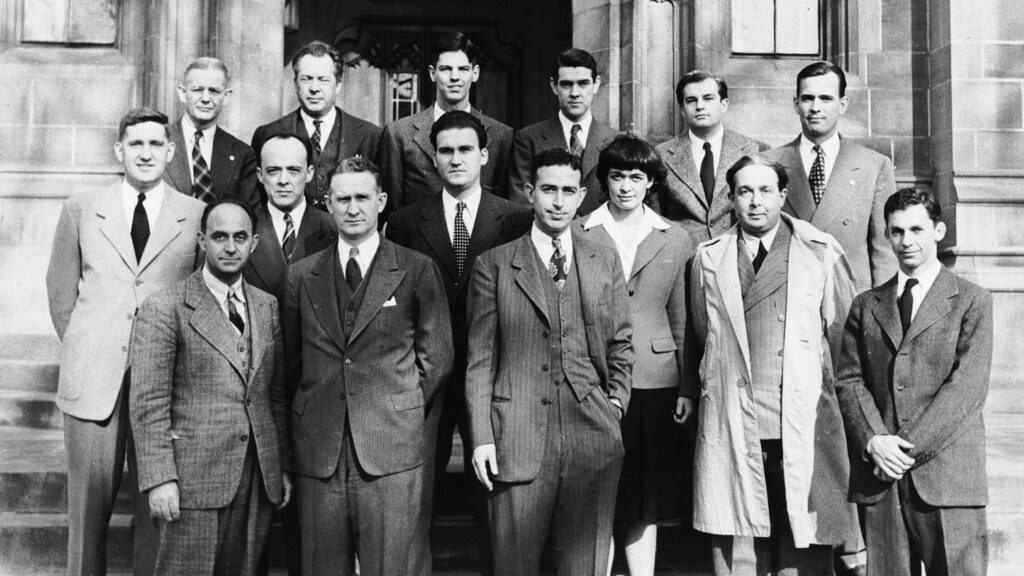
La primera reacción nuclear en cadena controlada, lograda en Chicago en 1942, marcó uno de los pasos decisivos hacia el desarrollo de la bomba atómica.
There are several preliminaries and three milestones that mark the project that led to the bomb: the first, on December 2, 1942, was the achievement in Chicago of the first controlled nuclear chain reaction; the second, on July 16, 1945, came when the first nuclear device was detonated in New Mexico; the third, on August 6 of that same year, was the catastrophe of Hiroshima. More than half a century has now passed since that last event.
There are also scientific precedents worth reviewing, including those presented in the following passage, which should be supplemented by reference to Chadwick’s discovery of the neutron in 1932 and the discovery of nuclear fission by Hahn, Meitner, and Strassmann in 1938.
One of those precedents came from Leo Szilard, who, while standing at a traffic light in London in 1933, reflected:
“If I could find an element that is split by neutrons and emits two after absorbing one, such an element, assembled in sufficient mass, could sustain a nuclear chain reaction.
First: if a neutron struck the nucleus of an atom with enough force to cause it to emit two neutrons, then with each collision the number of released neutrons would double. One would release two, which would strike nuclei and release four. Each of those would strike another nucleus, releasing eight; then 16, 32, 64, 128, and so on. Within millionths of a second, billions of atoms would split and, as they did, the energy holding them together would be released.
Second: if Einstein had been correct in 1905 when he established that energy equals mass multiplied by the speed of light squared (E = mc²), the amount of energy released would be enormous. The mass involved is small, but the speed of light is immense and, at least in theory, the amount of energy latent in matter is therefore gigantic.”
He had conceived the chain reaction.
The history of the Project has been told countless times, but it contains so much substance that it is always possible to tell it again in an interesting way. Two Hungarian refugees living in the United States, Leo Szilard and Eugene Wigner, feared that Germany’s scientific capabilities might give Hitler access to the nuclear bomb—at the time still only a theoretical possibility. In mid-1939, they asked Albert Einstein to draw President Roosevelt’s attention to that overwhelming possibility.
Einstein, a pacifist and widely recognized as the world’s most famous scientist, did not hesitate to convey to the President his belief that it was “conceivable” that an extremely powerful new type of device could be built using uranium.
When banker Alexander Sachs, a friend of Roosevelt, presented him with the letter signed by Einstein—although actually written by Szilard—Roosevelt asked:
“Alex, do you think the Nazis could blow us up?”
“Certainly,” Sachs replied.
Once Vannevar Bush, who came from MIT, where he had worked on radar and would later become the dominant figure in postwar American science policy, took charge of the matter, events began to move rapidly. His first task was to convince reluctant generals and admirals, after first convincing himself that a bomb could be built within two or three years. But he realized that a project of such magnitude required an energetic leader. His choice would be Leslie Groves.
Stagg Field, Chicago
The reports from US Military Intelligence were categorical. The first read:
“Enrico Fermi left Italy because his wife is Jewish. He is undoubtedly a Fascist. His employment is not recommended.”
The second stated:
“Mr. Szilard, Hungarian Jew, refugee. Reported as pro-German. His employment on secret work is not recommended.”
History would eventually provide the finishing touch to those intelligence assessments. Not only would it establish the civic integrity of both men, but it would also summarize the scientific achievement they accomplished together at the University of Chicago with a concise division of credit:
“Ideas, by Szilard; physics, by Fermi.”
They began working together at Columbia University in 1939 to explore the properties of uranium-235. In 1942, they were transferred to Chicago. The Italian scientist, who had received the Nobel Prize in 1938, possessed a brilliant intellect and an extraordinary memory. He could, for example, recite entire cantos of The Divine Comedy.
He was also a physicist who had no objection to manual work. Step by step, thinking and sweating, he constructed the first pile capable of sustaining a controlled nuclear chain reaction. A later biography of Szilard would bear the title Genius in the Shadows.
When the breakthrough came on December 2, 1942, one of the scientists opened a bottle of Chianti, an appropriate tribute to the Italian physicist. After the others had left, Szilard and Fermi remained behind, alone and contemplative.
“I shook his hand,” the Hungarian later recalled, “and told him that I thought that day would be remembered as a black day in the history of mankind.”