Distinguished Immigrants in the 1930s and Their Technological Legacies
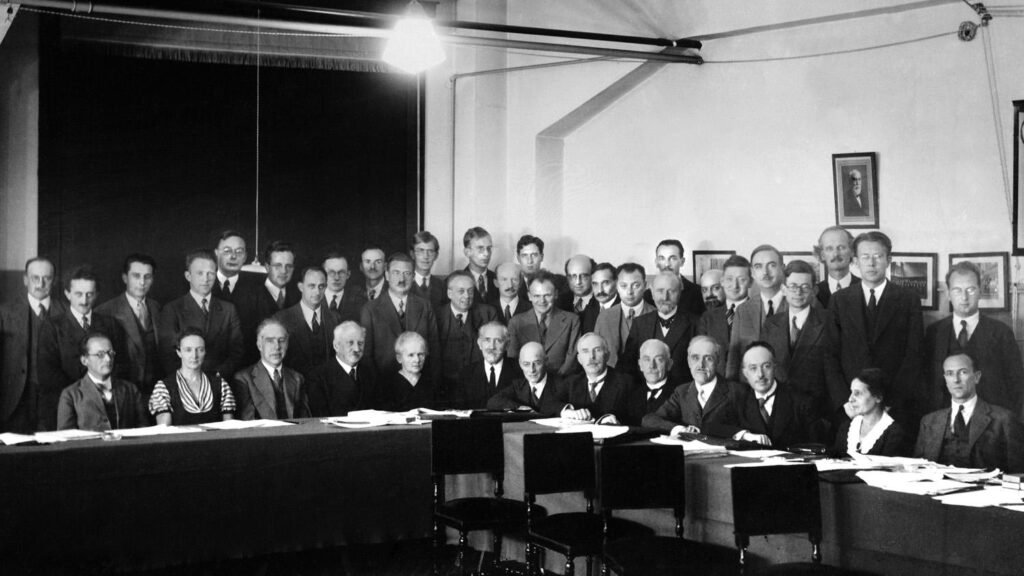
Participantes de la séptima Conferencia Solvay, dedicada a la estructura del núcleo atómico, celebrada en Bruselas en octubre de 1933.
The number and caliber of foreign intellectuals received by the United States during the 1930s were extraordinary. In 1933, Hitler began purging Germany of Jews working at its universities and research institutes. “Only the Aryan can organize states; the Jew cannot. He feels the need to spread as the plague does.” The American Alvin Johnson, one of those who worked hardest to welcome refugees of high intellectual standing and the driving force behind what became known as the “University in Exile,” would later offer an ironic reply: “Hitler is my best friend. He shakes the tree and I collect the apples.” Jewish intellectualism was once examined by Stefan Zweig, the distinguished writer who had taken refuge in Brazil. He found that Jews were genuinely inclined to rise to the world’s highest intellectual plane. This was true even within Eastern Orthodox Judaism, where both the virtues and the defects of the race were more intensely expressed. The community valued the scholar above the wealthy man. All social classes shared this tendency. Even the most destitute would try to ensure that at least one of his children studied. “Subconsciously, something in the Jew shuns the morally ambiguous, the thankless, the petty, the anti-spiritual that is inherent in all trade and everything merely commercial, to rise to the disinterested sphere of the intellect, as if, in a Wagnerian sense, he wished to redeem himself and his entire race from the curse of money.”
The consequences were profound. The country’s entire cultural and scientific system received a shock of revitalization and creativity reflected in its remarkable national performance over recent decades. Art, literature, philosophy, the social sciences, mathematics, physics and chemistry made a prodigious leap, turning the country into the cultural center of the world. Germans accounted for nearly half the total; a transfer took place from Göttingen to the United States like that from Byzantium to Italy in the ancient world. Why did so many distinguished refugees choose the United States? Some reasons are obvious, such as democracy, its immigration tradition, the language and material opportunities. But one reason may have been decisive and is less often noticed: the flexibility of educational institutions, which gave thousands of professors and researchers the opportunity to resume their cultural activities. Nor were universities alone in being flexible. Public administration and even the armed forces were as well: some refugees were able to influence political and military affairs. Einstein himself influenced President Roosevelt regarding the atomic undertaking; Fermi served on the five-member committee responsible for recommending the use of the bomb after Germany had already been defeated; von Neumann played vital roles in aeronautics and nuclear policy; Teller headed the thermonuclear project at Livermore; Kistiakowsky, a Russian physicist, headed Truman’s scientific advisory staff.
In the previous century, when it ranked second in the world in the number of immigrants, our country had gained some modest experience with political refugees. The European socialist revolution of 1848 had brought several Frenchmen to Argentine shores. Names included Alexis Peyret, an economist who helped with Urquiza’s agricultural settlement efforts; Amadeo Jacques, the headmaster of the Colegio Nacional recalled in Juvenilia; Larroque, of the Colegio de Concepción del Uruguay; and the Lavernis, also distinguished educators. Sarmiento publicly argued that accepting and encouraging the arrival of political refugees served the national interest. He knew from personal experience: a country’s most capable and creative people are those affected by poor institutions or bad governments. Therefore, they are the best candidates for a country of immigration.
Argentina in the 1930s restricted immigration in general. Since Uriburu’s coup, the doors had been closed on the grounds of the economic situation and unemployment. The ideological rise of nationalism also played a role. The public writings of Maurras’s disciples and admirers of the Italian “Duce” exalted the abstract values of nationality, praised Hispanic identity, opposed political liberalism and were hostile to cosmopolitanism. Foreigners, it was said, distorted and endangered native values and the national essence. There had also been a dangerous change in the composition of immigration during the preceding decade: an increase in the proportion of Slavs compared with Latins, the trusted immigrants. Yugoslavs, Czechs, Poles and Germans, possibly mostly Jews, accounted for nearly 50 percent of the total. Restrictive measures were enacted in 1932, 1936 and 1938.
As for political refugees, the Argentine government had no doubts. In 1938, an international meeting on refugees was held in Évian. The United States proposed facilitating the immigration of Germans and Austrians by treating them as political refugees; these were mainly Jews expelled from Eastern Europe who could find no countries willing to receive them. The proposal fell on deaf ears. At that time, Argentina signed a migration agreement with Czechoslovakia that expressly excluded Jews. At the Lima Conference of 1938, which discussed how to accommodate people persecuted on political and racial grounds, our country’s position was to accept only “genuine immigration”; refugees were not stable, had no immigrant intent and were acting under pressure.
[A passage contains transcription errors and requires comparison with the original: “Se debatió después el tema en Dipupeto, Solari y Dickman, por los socialistas tuvieron posición tados. Leónidas Anastasi y Bernardino Horne”.]
The former said, echoing Sarmiento’s words: “Why fear the refugee? The political exile is not a person of vice, nor an inferior. He is a man of exceptional energy, who knows how to face anything in defense of his convictions.” But Vicente Solano Lima, the interior minister, replied on behalf of the conservative government: “We don’t want the ghetto here!” The comparison between Argentine and American attitudes and opportunities regarding the use of foreign talent can also be extended to postwar policy.
Argentina was not among the victors. Its attempt to join their side when the military government belatedly realized that the Germans would not win the war earned it no place among the victorious nations. It did, however, have substantial foreign currency reserves that could have enabled it to negotiate favorable contracts with foreign professionals of the highest scientific caliber. Yet its performance in this respect was also mediocre. Important ideas, such as the new private university of high scientific standing proposed to the government by enlightened figures such as the physicist Gaviola and the biologist Braun Menéndez, were rejected. Missions abroad devoted their efforts to a handful of second-rate military technicians.