A lighthouse beneath the sea
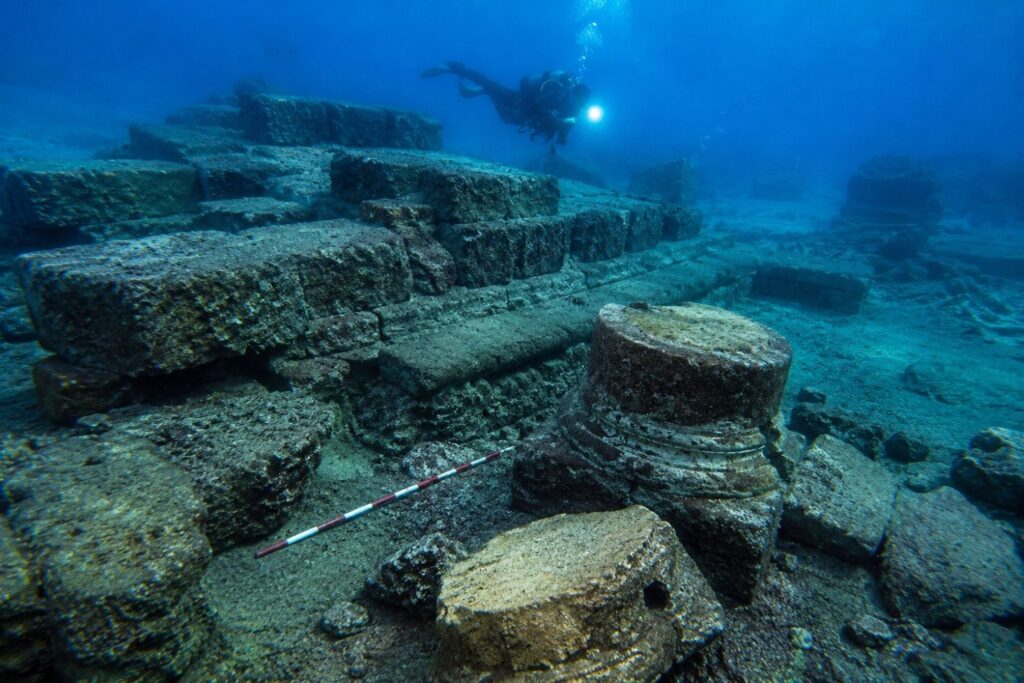
El hallazgo submarino del Faro de Alejandría permite reconstruir el legado científico y tecnológico de una de las grandes capitales culturales de la Antigüedad.
When we were children, we lost ourselves in the magazine Billiken and in trading-card albums illustrated with paintings of “The Seven Wonders of the World.” Being able to recite them from memory at school later earned us smiles from the teacher. Now the newspapers have carried sensational news concerning one of those seven legendary wonders: French archaeologists have discovered, beneath the waters off the Egyptian port of Alexandria, the remains of the lighthouse erected in 280 BC and submerged by the sea around the year 1200 of our era. The news offers us an opportunity to escape for a moment from the leaden routine of information that overwhelms us. It is soothing to revisit the splendours of that civilisation which flourished, like an original and final offshoot of the Greek springtime of the human spirit, on the opposite shore of that navel of the world that was the Mediterranean. Everything began with the imperial enterprise of Alexander the Great. One of his officers, Ptolemy, founded the dynasty that bore his name and, at the same time, the city named after the conqueror. For three centuries, a lighthouse 135 metres high marked the place where those monarchs, anticipating what the patron princes of the Renaissance would later do, gathered brilliant minds in an intellectual cosmopolis without equal in the ancient world.
Alexandria’s stature as a cultural centre could be demonstrated merely by noting that, between the third and first centuries BC, Greek philosophy, literature and science were refounded there. Yet there was still more: the first scientific and technological development of the Western world was created there, one that Europe would resume only fifteen centuries later. It is significant to recall that the freedom and prosperity enjoyed by the city attracted, in a way that evokes what would occur centuries later in Amsterdam, Paris and New York, a constellation of immigrant geniuses: Demetrius, Strato, Apollonius, Erasistratus, Herophilus, Euclid, Philo, Ctesibius, Hero and Archimedes. The Ptolemies succeeded in bringing together, in that centre of economic trade and circulation of ideas, around the Museum and the Library, everything the Hellenistic world possessed that was most advanced in every field of culture. The Library, where Aristarchus worked, eventually housed 700,000 scrolls containing the treasures of the Greek literary miracle. It is said that the Muslims burned it in AD 641 because Caliph Omar reasoned that no book other than the Qur’an was necessary, but the truth is that they could at most have burned its ruins. The Romans, in the days when Caesar surrendered himself in Cleopatra’s bed, had already taken care of looting it.
There were differences between the Alexandrian spirit and the one expressed in the Athens of Aristotle. Whereas Athens had pursued a philosophical system, Alexandria sought the possibility of both a scientific system and a technological system. Four names and their works are enough to convey an idea of its originality and scope. Aristarchus wrote a treatise on the dimensions of the Sun and the Moon and their distances from the Earth, using measurements that were nearly exact, and eighteen centuries before Copernicus he conceived a heliocentric cosmos. Euclid, the father of geometry, wrote the Elements, thirteen books that have been described, because of their clarity, symmetry and inner beauty, as a monument to human intelligence. Hero, who crowned four centuries of development in mechanics, constructed ingenious devices, particularly automata, in which he employed almost all the kinematic mechanisms known today: pulleys, gears, counterweights, multiplying systems, valves and programming. Finally, Archimedes, who embodied the scientific and technical ideal of the school, formulated the laws of the lever, determined the centre of gravity of plane figures and developed the theory of floating bodies and hydrostatics. He was the first rational mechanician; no one comparable to him appeared until Galileo in the sixteenth century.
Several stories about Archimedes, some true and others less so, were told by Plutarch. One concerns his discovery of the principle of hydrostatic pressure while taking a bath, his cry of “Eureka”—Greek for “I have found it”—and his naked dash through the city to tell his disciples. Another tells of the effectiveness of his catapults and concave mirrors in sinking and setting fire to ships belonging to Marcellus’s besieging fleet. A third recounts the astonishment of King Hiero when Archimedes told him: “Give me a place to stand, and I will move the world.” Finally, there is the story of his death by the sword of a Roman soldier, whom he ignored when ordered to accompany him to meet his commander because he was absorbed in demonstrating a mathematical problem. An Alexandrian story that deserves to be better known is that of the beautiful Hypatia, who lived from AD 370 to 415 and became a female symbol of scientific thought. The first woman mathematician in history, as well as an astronomer and leader of the Neoplatonic school of philosophy, she became the target of hatred among monks who followed Bishop Cyril. At a time when tensions between Christians and non-Christians reached a crisis in the city, she was brutally murdered and mutilated by a fanatical mob. This marked the beginning of Alexandria’s final decline as a cultural centre of the Mediterranean. “Her great enemy, Bishop Cyril,” Carl Sagan, author of Cosmos, pointedly observed, “was later declared a saint by the Church.”
The discovery of the remains of the Lighthouse of Alexandria by French divers also brings to mind, because of its connection with Alexandrian technology, the case of an enigmatic underwater relic found in 1900 during an archaeological expedition near the island of Antikythera, south of the Peloponnese. A strange device was recovered there, and its identification was difficult because of the corrosion it had suffered during the nearly two thousand years since the shipwreck, which was dated to 65 BC.
In 1959, Derek Price, the historian of technology, learned at Princeton about certain features revealed by new studies of the artefact carried out at the Archaeological Museum of Athens. The American Philosophical Society sent him to Greece to investigate further, and together with a team of museum specialists and epigraphers he was finally able to solve the mystery: the device, a decayed box containing various metal components—gears, toothed wheels, rings, dials, bronze plates and inscriptions explaining its use—was a mechanism resembling a computer, designed like a clock and capable of reproducing the movements of the Sun, the Moon and perhaps the planets. This Greek machine was the earliest known specimen in the lineage of mechanical clocks, which had always seemed to appear almost magically at the end of the Middle Ages, and an ancestor of the clocks and calculating machines of the modern world. The complex Antikythera mechanism demonstrates how Alexandrian mechanicians formed part of a technological tradition that emerged with Archimedes and extends into contemporary laboratories. Price published an initial account of the discovery in the June 1959 issue of Scientific American. His final report was entitled “The Antikythera Mechanism—A Calendar Computer from 80 BC” and was published in the December 1974 issue of Transactions of the American Philosophical Society. As a good historian, he could not resist pursuing his speculations. Several coincidences led him to suggest that the objects recovered at Antikythera may have formed part of the luggage that Marcus Tullius Cicero, the great Roman orator and politician, sent to Rome after his stay on the island of Rhodes, an event that chronologically coincided with the shipwreck.