Hundreds of thousands of applications
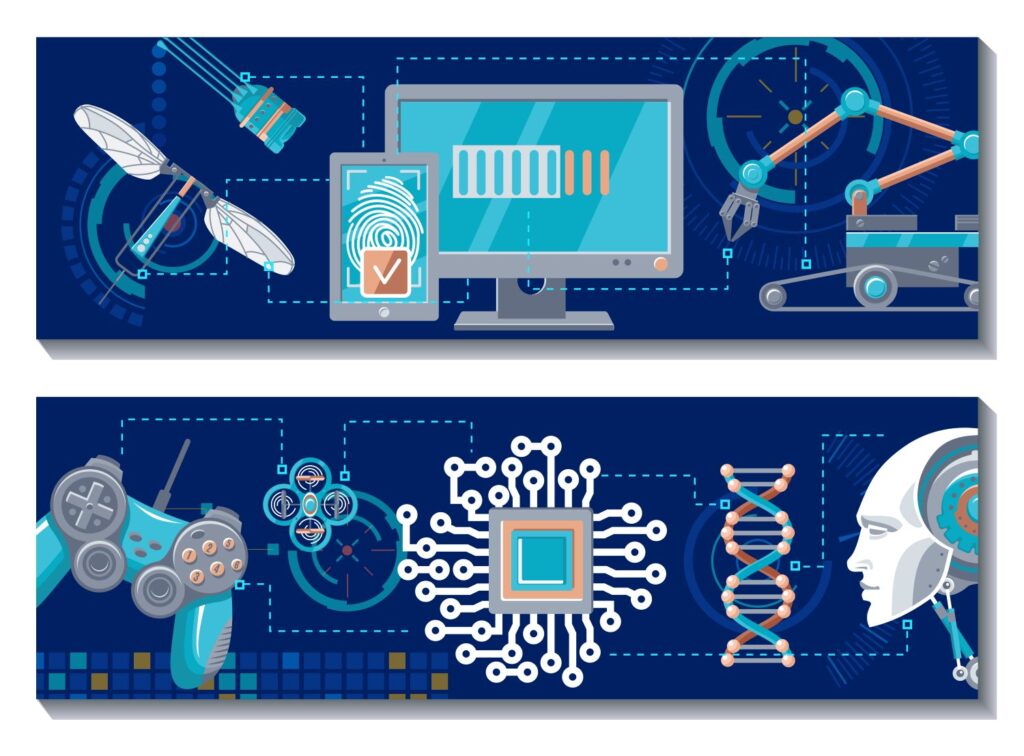
Las computadoras y los microprocesadores amplían su presencia en miles de sistemas, desde aparatos domésticos y equipos industriales hasta gestión municipal, medicina, telecomunicaciones y enseñanza.
Computers and microprocessors have already achieved countless applications. The expansion of this phenomenon has no foreseeable end. It is considered reasonable that, in the immediate future, domestic and industrial applications of chips or integrated circuits will be found in more than 200,000 different devices or systems. At the beginning of the 1980s, the approximate existence of 250 million units or systems related to microprocessors was estimated. Today, that figure has soared, and by the mythical threshold of the century, in the year 2000, experts estimate that there will be close to 10 billion units of this kind.
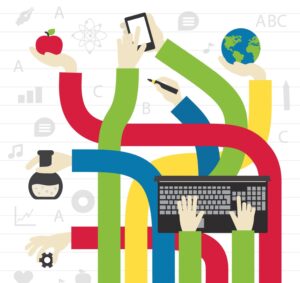
The above refers to concrete applications of developed logic circuits, which can now be found in a multitude of devices, from surgical instruments to low-cost digital watches. It is reasonable to expect that the revolution of this information era will expand across every area of reality. On the other hand, strictly computer-based applications are extremely vast. Let us imagine the keyboard of a computer and draw on its keys symbols representing possible fields of application. Of course, there are not enough keys to represent every general use of the computer on one specific key, as if counting a pile of things with one’s fingers. Not even a set of ten devices would be enough. Nor does it matter. What is fundamental is not to enumerate everything possible, like someone carrying all the objects of a house on their back, but to know that practically everything is possible, like someone who owns the key to the house and knows they can enter it and take any object they want.
On a symbolic keyboard such as the one described, many spheres of application would be represented. Business, home, industry, office, administration, education, leisure, meteorology, statistics, telecommunications, research, medicine, church, municipality, art, publishing, commerce, library, navigation, banking, air traffic, food, agriculture and a long etcetera. In many of these fields, computer applications are visible and well known. In others, they do not draw attention because their way of operating is less spectacular, but no less effective.
If we focus an imaginary magnifying glass on just one of these fields of action, we can imagine another symbolic keyboard full of activities and devices in which the full power of computing takes part. If, by way of example, the municipal sphere is chosen, we find applications for firefighters, traffic-light networks, traffic-control sensors and cameras, lighting, healthcare, schools, older adults, parking, road planning, public health, laboratories, administrative and tax management, urban guard services, green areas, cultural activities and festivities, fairs, teletext and more. Diversification and specialization can easily be expanded.
Balance between hardware and software
The computer is the conjunction of hardware and software. Hardware, also called the physical system, is the machine, the material, the tangible. That is why the choice of a computer does not depend only on the technical characteristics of the machine, nor independently on the quantity, quality and versatility of the software. An example can help us understand this. Suppose we own a modern digital record player with a laser reader. This device has extraordinary reproduction fidelity and great power, along with other added features such as automatic track search. But if nearby stores have almost no digital records available and we must settle for a limited repertoire of recordings, we will underuse the device and feel disappointed.
The computer would be equivalent to the music player, and programming to the records. The existence of one of the two elements without the other is useless, and an imbalance between them is not optimal either. The criterion for choosing a computer is the proper balance between hardware and software. Likewise, there is no computer that is absolutely better than another. There are personal computers, professional portable computers and large-scale systems. Depending on their characteristics, they have less or greater memory, and the speed at which they execute instructions also varies significantly.
It may be just as inconvenient to have a system with excessive capacity and speed as it is to have an insufficient one, because the relationship between work and processing capacity becomes disproportionate. The imbalance between hardware and software can explain why our computer equipment does not fully satisfy our requirements, or why we may have invested money in purchasing a device that we do not actually need.
Economic sectors and computing
Without the development of computing, this would not have been possible, and the development experienced by traditional sectors would also have been entirely impossible. The concept of information should not be confused with that of news, since it is much broader. The increase in information is dizzying: annual information growth is estimated at 12 percent. It requires new methods of organization, memorization, selection, interaction, search and editing. It also makes evident the important role of the generalization of the use of information technology and computers.