Don Quixote and the windmills
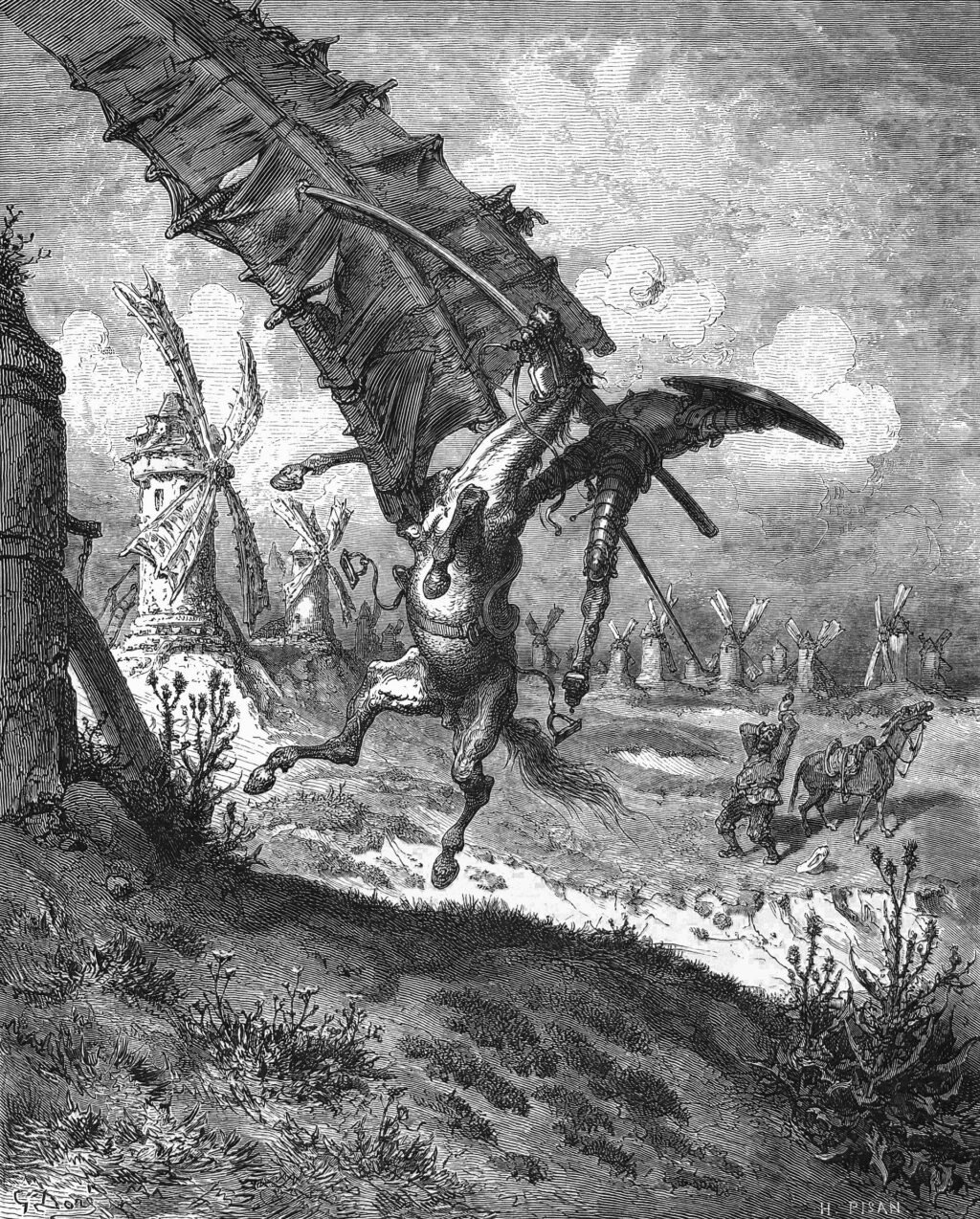
La escena de los molinos de viento puede leerse como algo más que una aventura delirante: también como una metáfora del rechazo a una tecnología nueva en la España de comienzos de la modernidad.
It is not an easy task to formulate a novel observation about the text of a classic. What is a classic? Borges defined it as a book that people have decided to read as if everything in its pages were profound and suited to endless questioning. In the Spanish language, our classic is, without doubt, Don Quixote de la Mancha. Contemporary with Shakespeare’s creatures, a mountain of publications has been written about it over almost four centuries. But if classics are, by definition, inexhaustible, why not allow ourselves, with the benefit of invention, a different view of one corner of that feast of Cervantine wit? There are mainly two passages from Don Quixote that everyone remembers: the introductory lines — “In a village of La Mancha, the name of which I have no desire to call to mind, there lived not long since a gentleman of the kind that keep a lance in the rack, an old shield, a lean hack and a greyhound for coursing…” — and one of the hero’s first adventures, that of the windmills which, in his delirium, he mistook for formidable giants. Let us recall that episode. The hero, already armed as a knight-errant and consecrated in his future exploits to Dulcinea, rides out into the countryside on Rocinante to “right wrongs.” Riding a donkey, his squire Sancho Panza flanks him. Little by little, they discover thirty or forty windmills in that field of Montiel. Don Quixote sees them as giants and turns a deaf ear to the prudent Sancho, who warns him that they are not such things but mills, and that what seem to him to be arms are sails turning. But he insists that they are giants with whom he wants to enter into fierce and unequal battle. He shouts at them: “Do not flee, cowardly and vile creatures, for it is a single knight who attacks you.” Commending himself to Dulcinea del Toboso, he charges the first mill, whose sails the wind had begun to move. And so the mill smashed the lance to pieces with the impact, carrying horse and rider with it. Once recovered, he did not give up his idea. He would not accept that it had been his mistake; he insisted that a magician had changed the giants into mills in order to deprive him of the glory of defeating them. Such was the fated hidalgo. In secondary school literature courses, this matter of the windmills has been a classic locus from which no student escapes and which no teacher resists. The coinciding interpretation of manuals and teachers is that it has a symbolism: the knight as standard-bearer of the ideal versus the mills as symbol of the material. In terms of appreciation, something valuable against something of little value. In that way, they made even the episode itself evanescent for us.
A spiritualist tradition dominates our Spanish literature classes. That is why they are generally so boring. That tradition comes from the Spaniards themselves. Even the most critical of their culture agree on the essential point. Ortega y Gasset himself, who very early, in 1914, published Meditations on Quixote, found in those flour mills that the hero sees transfigured into giants a sense of reality, the “ideal” sense, different from the concrete one and more suggestive than it. But there is another reading of the matter, more interesting and less conformist. It refers to the history of technique and to the cultural system that sustains techniques. The Middle Ages had watermills as their great energy innovation. In the year 1200, hydraulic energy reigned throughout Europe. The windmill became widespread only in the sixteenth century. It had appeared earlier in Holland — imitated from Iran and perhaps from China — but in Spain it spread around 1600, the period in which Cervantes wrote Don Quixote. They were built of wood — even the gears — on masonry and were used mainly to grind wheat. They emerged as a very new source of energy and therefore were surely viewed as an ordinary citizen today might contemplate the dome of a nuclear power plant: as the latest word in technology.
This is connected with the reading, different from that of our literary tradition, that some non-Spanish scholars make of the episode of the windmills. Bertrand Gille, a Frenchman, writes that “everyone evokes Don Quixote’s fight against the windmills, considered as novelties contrary to a certain traditional spirit.” Another, the Englishman Brian Stableford, recalls that the windmill was a true giant among machines, a new technology for Don Quixote, and that the knight alleged to Sancho that it was “a great service to God to remove such evil seed from the face of the Earth.” Let us agree — and this is one of our reasons for agreeing with the thesis — that “evil seed” is a highly suggestive description for an artifact that at the time represented mechanical progress in Europe.
What is the reason why, in our Hispanic cultural sphere, such a logical interpretation has been ignored, while the episode has always been seen instead as a mere individual madness or a heroic-spiritualist manifestation? I suspect that it considers culture to belong only to the spiritual realm, that we are dealing with an ideological vision of culture, in which its operational side and that of human labor are little less than absent. Perhaps this lies in the process of divorce between modern European culture and Iberian culture that took place in the seventeenth century. The meaning of the windmill episode is not perceived because the Spanish world of Philip II and his successors alienated itself from the main current of progress and ignored the world of production and science that emerged in the Europe of those times. Cervantes wrote precisely at the historical moment when progressive Europe was abandoning Aristotle and the medieval tradition in order to adopt Galileo’s modern paradigm. Spain, by contrast, was committed to a reactionary project: the Inquisition, the expulsion of the Jews — who were its commercial bourgeoisie — and of the Moors — its specialists in cultivation — and it withdrew into itself, into dogma and aristocratic-military stubbornness. What Cervantes, a man who knew Europe, would have wanted to allude to with his windmills were not giants of an inflamed imagination but, properly speaking, windmills as a creation of the practical science of men, of their mechanical ingenuity. The collision of the knight’s lance with the mill’s sails would thus be his metaphor for the drama of his Spain, determined to reject the world of modernity that was taking flight. Do the giants Don Quixote saw not resemble those which, already in our century, in the time of bitter Spanish introspection after the defeat of Cuba by Yankee technology, the Quixotic Miguel de Unamuno conjured with his wounded and proud cry: “Let others invent!”? The Spanish parable of three centuries is thus completed in the rector of Salamanca asking for his homeland: “Let them leave it to die and dream its slow, dark, monotonous dream, the dream of its good routine life! Let them not sacrifice it to progress, by God, let them not sacrifice it to progress.”