The History of ENIAC
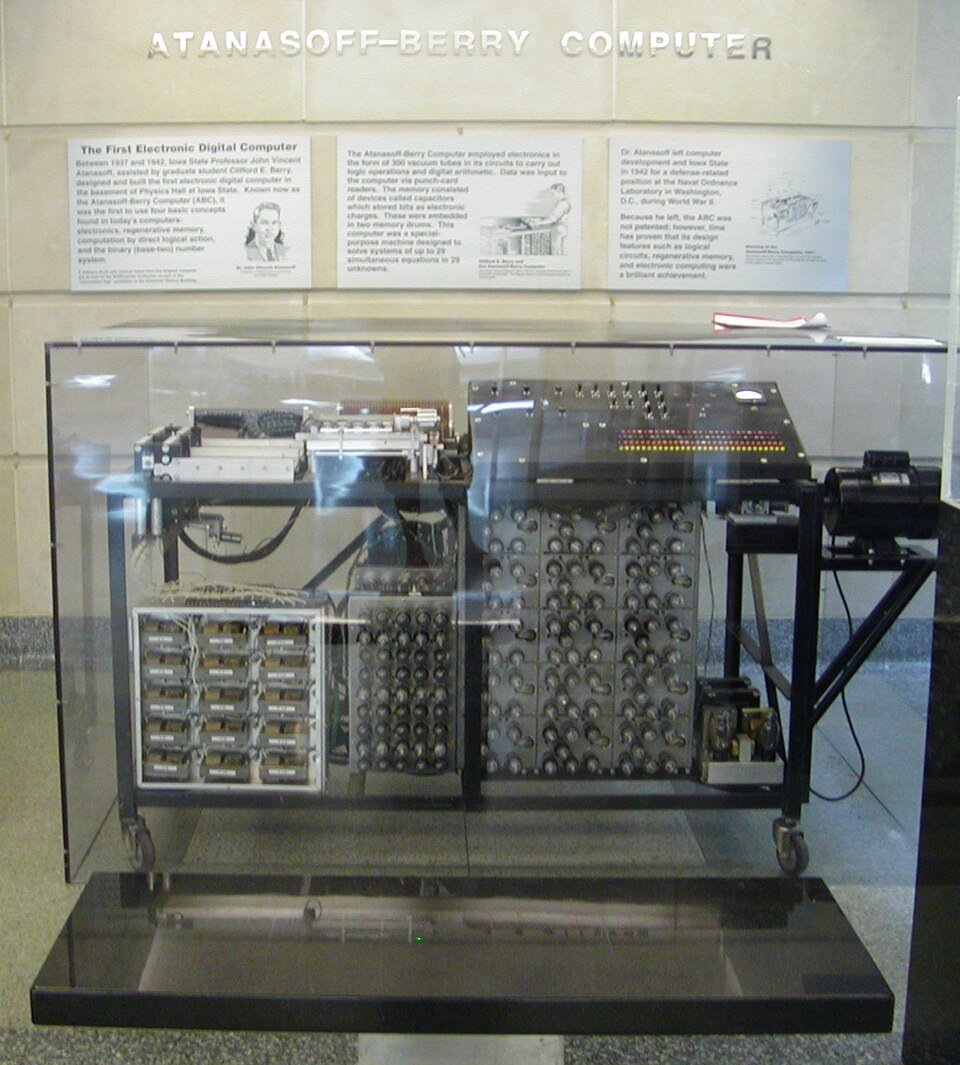
John Vincent Atanasoff, junto con Clifford Berry, construyó en 1939 la Atanasoff-Berry Computer, una máquina digital, binaria y electrónica que anticipó el desarrollo de computadoras posteriores como la ENIAC.
Another figure in this story is the American John Vincent Atanasoff. He was born in 1903 into a family that loved science and mathematics. His father was an electrical engineer who had emigrated from Bulgaria, and his mother, a schoolteacher, was an enthusiast of mathematics. Atanasoff played a prominent role in the innovations that took place in computing during the 1940s, building the first electronic computer.
After earning a doctorate in theoretical physics, he devoted himself to teaching and research. As had happened to Pascal, he ran into the frustrating reality of calculations that required a great deal of time and effort. He understood that solving problems was delayed excessively for mechanical reasons, rather than for substantive ones. He also regretted the waste of mental effort his students had to make in order to solve equations.
Starting With the ABC
Atanasoff was familiar with Pascal’s machine and Babbage’s theories. He was tempted by the idea of taking up the inventor’s torch. There had been few achievements, and the great technological revolution in the field of automatic information processing was just around the corner. The calculator project developed by this engineer can be summarized in four characteristics:
- digital;
- with electric-charge memory;
- based on the binary system, not the decimal system;
- non-mechanical in operation.
The set of characteristics in Atanasoff’s calculator project makes it possible to call it a computer. Unlike other contemporary attempts, it was not analog, nor was it digital with a decimal base. Its memory was to consist of a storage device using electric charge. And the operation of the machine was not to be purely mechanical.
To carry out the project, he obtained an initial grant of 650 dollars from Iowa State University, later adding other grants from private foundations until he reached 2,000 dollars. With that, he bought materials and hired a part-time assistant, Clifford Berry, an engineering student. That same year, 1939, he completed his computer, which was named with the initials ABC: Atanasoff-Berry Computer.
The economy of means and the ingenuity shown must be regarded as excellent, especially considering that the Mark I cost half a million dollars and involved the dedication of a large team. The ABC consisted of 300 vacuum tubes. It therefore lacked mechanical elements as its central structure, unlike the Mark I. No moving elements opened and closed, which made it faster, smaller and quieter.
The ABC could solve up to 29 equations with 29 variables. But it was not a complete general-purpose computer, because it was limited to solving certain types of mathematical problems. Even so, its anticipation in the research of a fully electronic system was a very notable achievement. The ABC computer became a model for those that followed, including ENIAC.
Atanasoff Meets Mauchly and Eckert
Experimental activity in the scientific world was intense. Of the hundreds of mathematicians, physicists and engineers who worked with intelligence and dedication in these early electronic beginnings, only a few can be mentioned here.
Atanasoff and Mauchly met in December 1940 at a conference organized by the AAAS, the American Association for the Advancement of Science, which, among its activities, publishes one of the world’s most important scientific journals, Science. This meeting between two researchers was highly fruitful, although years later they would engage in a bitter dispute, eventually brought before federal legal authorities, over who deserved the true paternity of the electronic computer.
John Mauchly had attended the scientific conference to present a paper on a small digital calculator of his own invention. He headed the physics department at a college in Philadelphia and had students who faced problems similar to those of Atanasoff’s students, with the same slowness in calculation work. These students had, at most, a slide rule and a table of logarithms, which today seems very rudimentary and of little help.
If they had had a pocket electronic calculator, such as the one that appeared in the 1970s, their professors might not have concerned themselves with calculating devices. Mauchly built the calculator mentioned above in order to fill an obvious gap. This professor did not know that his attempt would later lead him to build a 30-ton machine.
The year after meeting Atanasoff, Mauchly decided to expand his knowledge by studying electrical engineering at the Moore School of the University of Pennsylvania. J. Presper Eckert worked there as a laboratory technician. Their shared interests led them to collaborate and to decide to build an electronic calculator. Meanwhile, Eckert traveled to Iowa to visit Atanasoff and learn about the ABC computer. The three figures in this story had already begun their work.