Other works by Leibniz
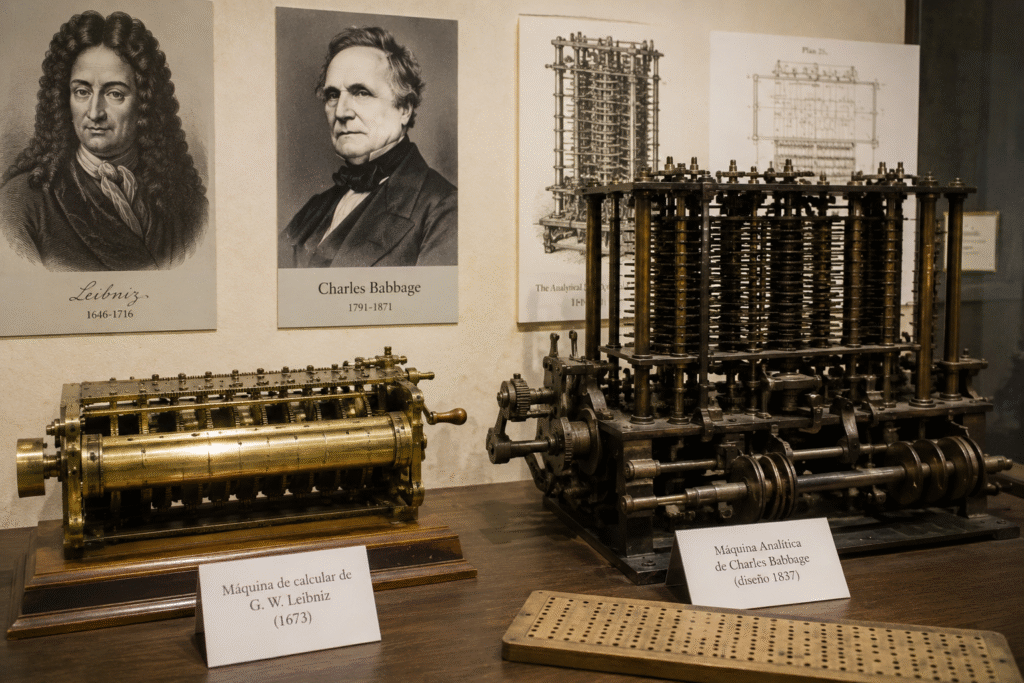
Leibniz, Babbage y Lord Kelvin anticiparon principios decisivos de la informática moderna: el cálculo automático, el sistema binario y la computación analógica.
Leibniz must be considered a precursor in two other subjects related to modern computing: the decomposition of reasoning and the binary numbering system. At the age of fourteen, Leibniz conceived the idea that all propositions could be arranged according to the order in which they had to contribute to a chain of syllogisms. With greater maturity he wrote his work De Arte Combinatoria, historically related to the Ars Magna of the medieval Ramon Llull, to Hobbes’s logic of computation and to contemporary calculations of probability. The decomposition of the logical operations that constitute a problem-solving process is a notable contribution to the future formulations of computational programming, as it is understood today. Leibniz’s second contribution is his work in the field of symbolization. The fundamental principle of his theory of symbolism is that our expressions must be able to reflect the structure of the world. For this purpose, he needed symbols for all notions that had to be taken as elementary or unanalyzable, as well as appropriate resources to express formal notions such as predication, conjunction, disjunction, conditional connection, universality and existence. He could hardly cover such a broad project, but, in mathematics, Leibniz achieved advances as important in the field of symbolization as infinitesimal calculus and the binary numbering system, later used in computing. Unlike the decimal system, binary numbering makes it possible to write any number with only two elements: 0 and 1. This makes it possible to establish a system of dichotomies: 0 or 1, that is, “no” or “yes,” “closed” or “open.” This simple opposition, perfectly implemented mechanically, offers a broad channel for symbolizing all kinds of numbers, letters and functions.
The saga of calculators
Leibniz’s machine inaugurated a saga of similar models, with appreciable variations and improvements that did not alter the basic structure. The number of devices in this family of mechanical calculators generously exceeded one thousand models. Many of these inventions have a rich history of commercial variants that followed one another throughout their useful life. One aspect of the evolution of mechanical calculators concerns the incorporation of new technical advances. The second is their adaptation to the use of electrical energy. These latter machines, generally equipped with a built-in printing device, could not withstand the impact of electronic calculators, which were preferable in many respects, including weight, size, operational capacity, reliability and speed.
Babbage, the father of the modern computer
If anyone deserves special distinction, it is Charles Babbage (1791–1871), who must be described as the father of the modern computer. To his excellent mathematical training, this Englishman added remarkable interest and inventive abilities. This great figure of the 19th century, mathematician and inventor, was ahead of his time. The original design of his revolutionary computer dates from the 1830s and was practically identical to the first computer built much later. The temporal separation between Babbage’s project and its definitive materialization is more than one hundred years. Until Babbage’s revolutionary innovations, calculating devices had limited operability. It must be taken into account that these were mechanical calculators and not computers, a concept that had not yet been defined. Such results were limited to simple arithmetic operations. For this purpose, the devices had calculation mechanisms. In the calculator we find elements comparable to the input, output and processing units of a computer. However, to reach the properly computational stage, substantial deficiencies had to be overcome. Mechanical calculators required the permanent intervention of an operator. This lack of automation undermined attempts at improvement, due to poor operating speed and an insufficient level of reliability. On the other hand, operational capacity had to go beyond mere arithmetic and open itself to the logical field, including relations of union, intersection and negation. Finally, it was also necessary to design a general-purpose computer, and not only one suitable for some specialized and invariable activity.
Lord Kelvin and the analog computer
In the 19th century, other significant advances were made. Among them were the works carried out around the analog computer. Babbage’s computer had the characteristic of being digital; that is, it arranged the solution, as well as the intermediate steps it had taken to obtain it, through a string of numbers or digits. The computers most widely used today are digital. Another British researcher, Lord Kelvin, produced the first analog machine: the tide-predicting machine. This occurred in 1872. The device predicted high and low tides and graphically represented their levels. If Kelvin’s machine had described the movements of the tides through numerical quantifications, in that case his invention would have been digital. Kelvin also conceived, although vaguely, a general-purpose analog computer that could solve all kinds of problems. His idea was an extraordinary anticipation, but one that could hardly be developed in his time. For this reason, he limited himself to postulating a device with such characteristics, without attempting to build it, although he gave it a name: differential analyzer. Once the thing had been named, only its structure remained to be invented, given form and set in motion. Half a century later, Kelvin’s prophecy became a reality. The American engineer Vannevar Bush created the differential analyzer in 1930. But this belongs to another chapter.