The Man Behind the Triangle: On Scientific and Technological Development
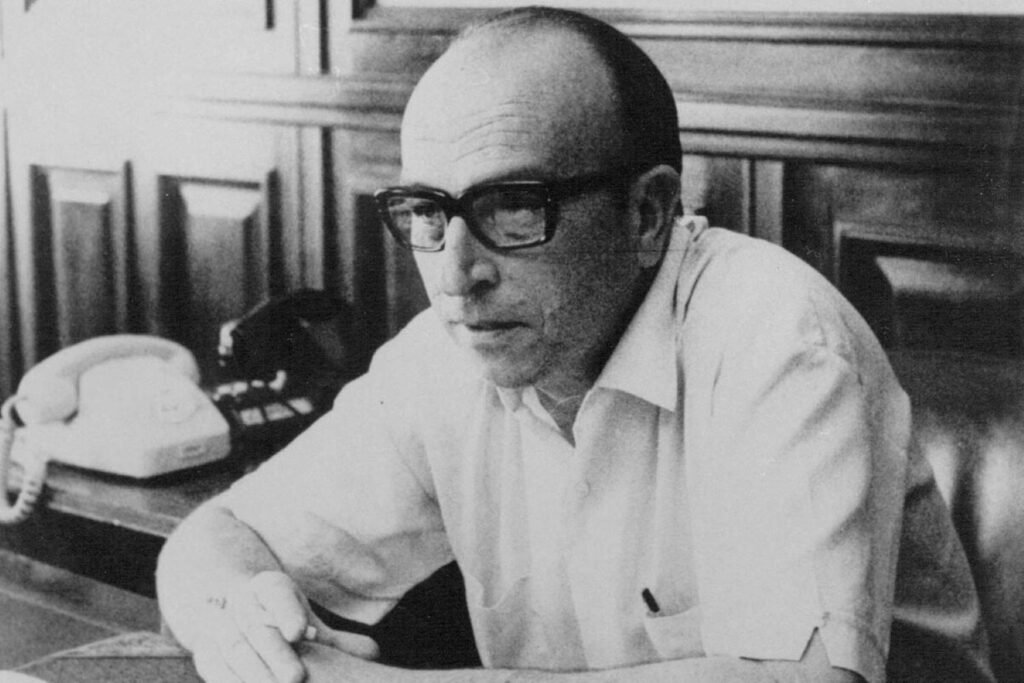
Jorge Alberto Sábato propuso el triángulo que vincula al Gobierno, la estructura productiva y la infraestructura científico-técnica.
Jorge Alberto Sábato’s thinking took shape during a distinctive historical period, that of “development economics” (Hirschman), which spanned the 1950s and 1960s and focused primarily on disadvantaged nations. At the time, wealthy countries themselves supported research and debate, mainly through international agencies. Raúl Prebisch and ECLAC formulated the overarching arguments concerning Latin America’s economic problems.
An important debate on scientific and technological policy took place in the region. A substantial body of thought emerged concerning the relationship between science, technology and society, within broader discussions of “dependence”/“liberation”/“autonomy” and amid political events such as the Cuban Revolution and the Alliance for Progress. Sábato’s personal reflections, his experience promoting Argentina’s nuclear program, and the exchange of ideas made possible by his frequent visits to the Northern Hemisphere laid the foundation for the ideological framework that shaped “Latin American thought” on scientific and technological development aimed at national autonomy.
He was an important driving force behind the development of nuclear technology in Argentina. Since many have wondered over the years why such a highly qualified group of civilian scientists and technologists became passionately involved in this undertaking from its beginnings in the 1950s, it is worth reviewing the reasons Sábato recorded concerning himself and his friends. During a talk, he recounted the history of that development in its foundational phase, from Richter to Atucha I—that is, up to 1974, the year he resigned from the CNEA—and, in particular, the reasons for undertaking it. He explained why the decision to “catch the train” of nuclear technology had been made at that particular moment and the steps that followed. It had not been a matter of linear rationality, but rather something idiosyncratic. The motives could be described in the same way: uranium appeared to offer an extraordinary energy opportunity; if humanity had entered into that pact with the devil, we needed to know how to manage its consequences; atomic technology would determine countries’ international standing, however foolish that might be; we had to master that technology to avoid being left behind for good, as had happened so often with technological leaps…
To close this aspect of his life, let us note that later, as the most dynamic phase of the “nuclear plan” approved by the military government in 1976 was coming to an end, his profound philosophical opposition to the “Process” lent a certain bitterness to his experience of that development. He criticized the excesses and the departure from the essential objective of making the Commission an example, a model for the country’s industrial development. He even expressed his concerns about the military temptations of an arbitrary regime of that kind. He spoke harshly about ideas such as the nuclear submarine and exposed the technocratic claim that a reliable solution to the problem of radioactive waste already existed. He was troubled by the strict secrecy surrounding some nuclear activities. He always advocated proper public oversight through Parliament and the obligation to keep people informed, since the money came from their pockets and their safety and well-being were ultimately at stake. The subjects covered by Sábato’s doctrine are innumerable. They encompass the economics of technology and its trade. Here, however, we will address just one subject: the triangle, attached to its author’s reputation as a symbol, much like the lever for Archimedes or the Model T for Ford.
The triangle would become his persuasive teaching tool. You had to see the happiness on people’s faces when he used the drawing to explain the problems of technological policy. He once joked that its usefulness lay in being “the most complicated geometric figure an economist can understand.” What is Sábato’s triangle? It is a figure that serves, first of all, to diagnose a country’s scientific and technological situation. The diagnosis holds that, just as development is expressed through an adequate circulation of flows—directives, responses and dialogue—between the vertices (Government, Productive Structure, Scientific and Technical Infrastructure), underdevelopment, by contrast, manifests itself through disconnected and alienated vertices. That would be the triangle’s application in diagnosing the situation.