The Bomb and the Soviet Physicists
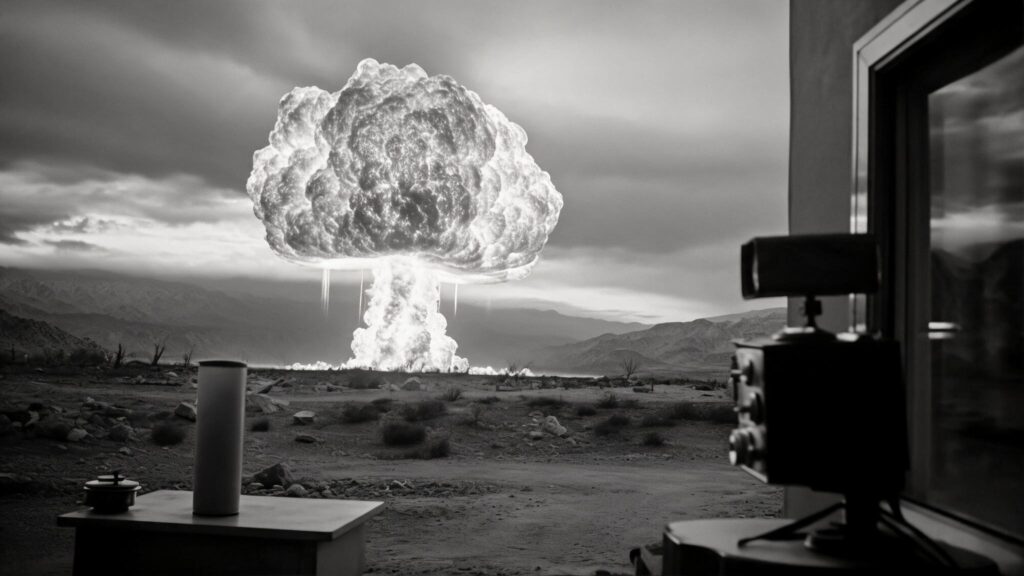
Bajo la presión de Stalin y la vigilancia de Lavrenti Beria, un grupo de físicos encabezado por Igor Kurchatov desarrolló la primera bomba atómica soviética, detonada en 1949.
Stalin learned from President Truman at Potsdam in July 1945 that the United States “had a new weapon of unusual destructive force.” He was not told that it was an atomic device. Stalin, who already knew about the bomb program through Soviet espionage, gave no indication that he understood what the American president meant.
Once back home, however, he urged Lavrenti Beria, the second most feared man in the Soviet Union, to launch an accelerated program, at any cost, to obtain a Soviet bomb. The American weapon, the dictator later told a correspondent from Britain’s Sunday Times, had been built to frighten those with weak nerves. His own nerves were strong, and he believed there was still time to catch up.
Klaus Fuchs, the Soviet spy at Los Alamos, had already provided a detailed description of the plutonium bomb in June 1945. Above all, however, the Soviet Union had a group of world-class physicists capable of building it.
The core of the project was based at Igor Kurchatov’s laboratory on the outskirts of Moscow, a location considered far too close to the capital. A new laboratory was therefore established near Sarov, about 400 kilometres away. It would become known as the “Volga Office” or “Arzamas.”
Scientists and engineers were given privileged living conditions. The so-called “white archipelago” was almost a paradise, and its inhabitants received relatively generous salaries. These material advantages reflected Stalin’s conviction that Soviet scientists, provided with everything they needed, could surpass their foreign counterparts.
The privileges came with absolute secrecy and equally absolute security controls imposed by Beria’s agents. Arzamas was completely isolated from the outside world. An area of 250 square kilometres was enclosed by fences and barbed wire.
As the date of the bomb test approached, the political climate in the country hardened. In August 1948, Trofim Lysenko achieved his victory over what he called “bourgeois genetics.” Soon afterward, the campaign against “cosmopolitanism” began, a euphemism directed largely against Jews.
Stalin remained suspicious of scientists who admired foreign culture and insisted that the Communist Party was the supreme authority in science. Kurchatov himself was investigated on suspicion of protecting Jewish colleagues and displaying excessive admiration for Western science.
The Soviet leadership, however, wanted the bomb as quickly as possible and had no choice but to trust him.
The scientists knew what failure might cost them, but they always maintained that fear was not their main motivation. Those involved in the project believed, on the one hand, that their country needed the atomic bomb for its defence. On the other, they accepted the challenge of demonstrating the strength of Soviet science by building it in the shortest possible time.
Their work also contained a powerful element of patriotism.
Andrei Sakharov, who began working on the superbomb — the thermonuclear or hydrogen bomb — in 1948 and moved to Arzamas-16 in 1950, later acknowledged that they believed their work would create a balance of power in the world.
Nikolai Dollezhal, designer of the first Soviet reactor, wrote in his memoirs that although Hiroshima had been “a repulsive act of cynical anti-humanism,” the existence of a Soviet bomb did not necessarily mean that it would be used.
Si vis pacem, para bellum: if you want peace, prepare for war.
As Lysenko attacked genetics by claiming that “bourgeois genetics sought to undermine the materialist theory of history,” Moscow University began questioning modern physics, particularly quantum mechanics and the theory of relativity.
Both Abram Ioffe, regarded as one of the founding figures of Soviet physics, and Pyotr Kapitsa defended the autonomy of science.
An irritated Beria asked Kurchatov whether relativity was “idealist,” meaning anti-materialist. The physicist replied that rejecting relativity would also mean abandoning the bomb.
Stalin ended the discussion with a brutal remark: “Leave them alone. We will always have time to shoot them.”
In 1949, the Soviet Union detonated its first atomic bomb. The speed with which it had been developed astonished the world.
Until then, American experts had argued that the Soviet Union would need at least ten years, perhaps even twenty, to build such a weapon. The Soviets had done it in four.
A second bomb followed in 1951. It was half the size and twice as powerful as the American weapon. In 1953, the Soviet Union detonated its first thermonuclear device.
Stalin did not destroy Soviet physics because physics had become essential to the power of the state. In that sense, the survival of the country’s scientific community can be regarded as an early example of successful nuclear deterrence.
During the Cold War, Western scientists described the paradox in striking terms. The atomic bomb, the most powerful symbol of hostility between the Soviet Union and the West, had also preserved a scientific community that remained an important cultural and intellectual link between the two worlds.
This became especially clear in the later life of Andrei Sakharov, whose commitment to peace and human rights acquired decisive importance during the political leadership of Mikhail Gorbachev.