Technology and Genetics
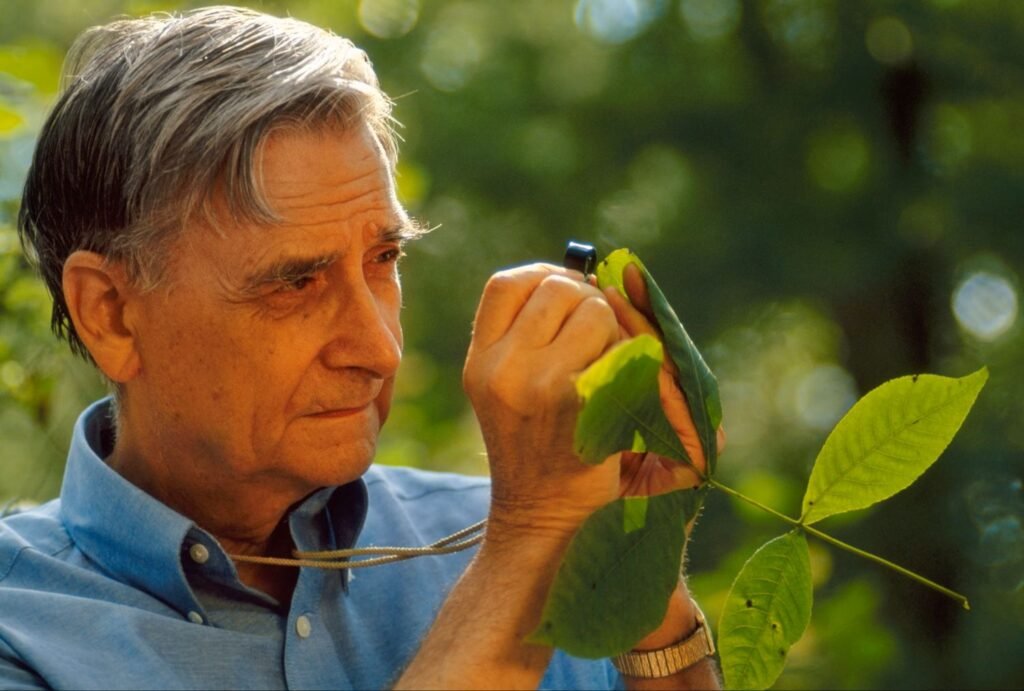
Edward O. Wilson llevó sus investigaciones desde el comportamiento de las hormigas hasta el estudio de la sociobiología, la biodiversidad y la relación del ser humano con la naturaleza.
A few months ago, when Edward O. Wilson’s book Naturalist was published, it was hailed as one of the great scientific autobiographies. The author is an eminent biologist, an early internationally recognized leader in the field of entomology, particularly in the study of ants. One of his fundamental discoveries was that ants, which lack “senses,” communicate through chemical substances (“pheromones”). Later, in highly detailed studies, he clarified the ecology and population dynamics of other insect species.
But the moment that brought him recognition far beyond his specialty came in 1975, when his book Sociobiology: The New Synthesis caused an uproar in the American academic world. It contained a theory about the biological foundations of human behavior and apparently proposed a hypothesis of genetic determinism.
He is convinced that the true nature of gene-culture coevolution is the central problem of the social sciences and, moreover, one of the great unexplored domains of science in general; he has no doubt that its time will come. Now, considering the changes that took place in his intellectual interests whenever he felt that his curiosity had been satisfied and a problem solved, let us look at some of his positions as an ecologist.
When Harvard Magazine asked Wilson in 1980 to identify what he believed would be the most important problem facing the world in the coming decade, he answered that it would be the environment. The biosphere was in danger, and humanity was recklessly damaging the reservoirs of biological diversity.
“I was thinking,” he says, “as an evolutionary biologist, in evolutionary time. The worst thing that can happen is going to happen.”
The austere scientist had taken a position in favor of environmental activism. He immediately put himself at the service of the World Wildlife Fund and the International Union for the Conservation of Nature as an adviser.
In June 1992, the issue of biodiversity acquired worldwide status when a summit on the global problems of ecosystem destruction and species extinction was held in Rio de Janeiro, attended by more than one hundred heads of national governments. Global environmental protocols were adopted there, constituting a milestone in human history.
“Biodiversity” became the most frequently used concept in conservation literature from that point onward. Wilson defines it as “the totality of hereditary variations in living forms, across all levels of biological organization, from genes and chromosomes within individual species to the collection of species themselves and, at the highest level, the living communities of ecosystems, such as forests or lakes.”
Wilson explains that he did not invent the term, as is sometimes claimed. He accepts it because it has achieved public success, but he prefers to use “biophilia” (“love of life,” in Greek), a synthesis referring to the innate affinity human beings have with other forms of life. The term better expresses his naturalistic vision of the planet.
An Interesting Question
What would be the ideal place to live upon which human beings would generally agree? Possibly, Wilson answers, it would be a home located above the surrounding terrain, near a stream or body of water, surrounded by a large park with trees that still allow a view of the horizon.
But why would most human beings agree on such a habitat if they were free to choose?
This preference for certain natural environments would be a basic expression of what the scientist defined as biophilia. It is suggestive that the habitat or landscape described above resembles the tropical savanna prevalent in Africa, where humanity originated and evolved over millions of years.
Primitive humans living there regarded an elevated, open place with water nearby as safer; it made gathering food easier and allowed enemies to be spotted in advance.
Animals of every kind, including the primates that were ancestors of Homo sapiens, possess an innate selectivity toward the kind of habitat on which their survival depends. It would be strange, Wilson reflected in The Biophilia Hypothesis, if our ancestors had been an exception, or if humanity’s comparatively brief history of agriculture and cities had erased that tendency from our genes.
The New York multimillionaire who chooses a penthouse overlooking Central Park —and the lake, if possible— and fills the terrace with pots containing shrubs is, in a profound sense that he may somehow understand, returning to his roots.
Wilson believes that the most important implication of the idea of innate biophilia is the foundation it provides for a lasting conservation ethic. If an inclination toward the rest of life on the planet is part of human nature, and if part of our culture flows from the wild world, then it follows that extinguishing the other forms of life that share the planet with us is fundamentally wrong.
Nature is part of us, and we are part of it.
A man of several great syntheses, E. O. Wilson considers biophilia perhaps the final synthetic idea of his life, bringing together the concepts that had most consistently attracted him throughout it.
My truths, he says, are three: first, humanity is ultimately the product of biological evolution; second, the diversity of life is the cradle and greatest natural inheritance of the human species; and third, philosophy and religion have little meaning if they fail to take these first two ideas into account.
This is his vision of the world as a naturalist.