The difference engine
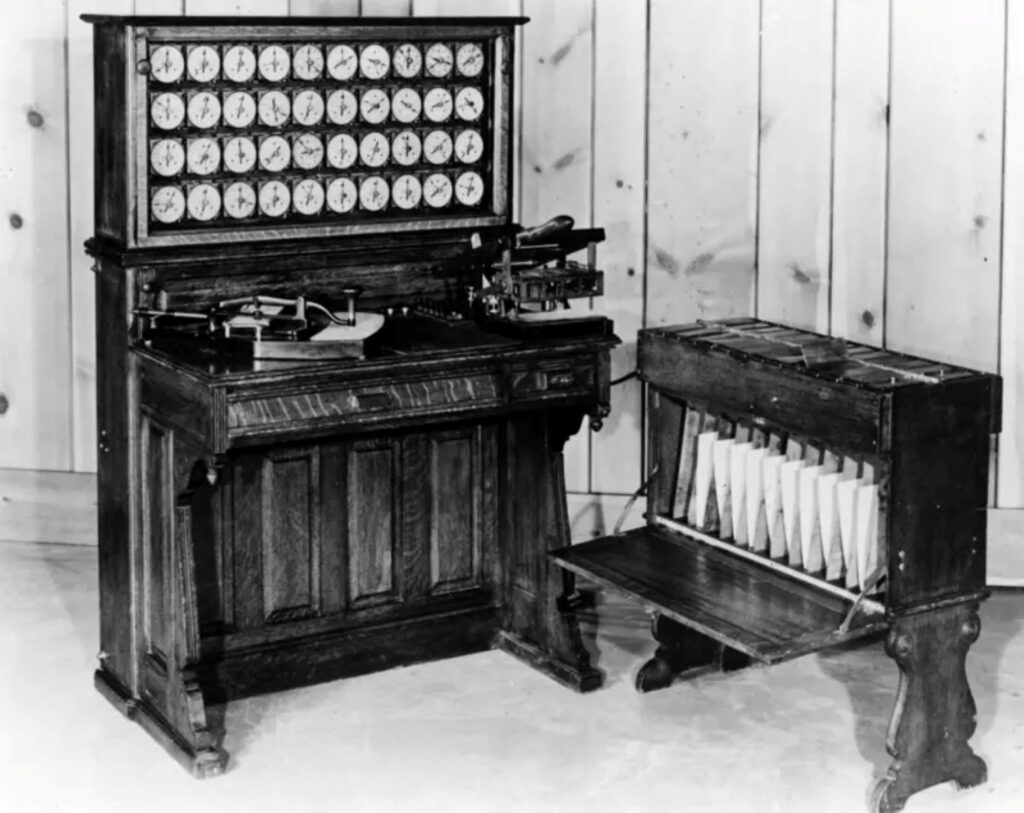
La máquina de diferencias de Babbage y la tabuladora de Hollerith marcaron etapas decisivas en la automatización del cálculo y el tratamiento de datos.
Charles Babbage conceived a new calculating machine at the age of twenty, in 1811, although he would not begin building it until a decade later. At the time, he was a young student working with numerical tables and observing frequent errors in them. The cause of those errors was not single: it lay both in the original calculation and in the later printing work, in which texts were composed by hand and not always faithfully.
These inaccuracies worried Babbage, and he took them as a problem that demanded a solution. He finally conceived the idea of building a machine that would automatically calculate the figures and print them. With this, a notably higher degree of reliability would be achieved. His machine would serve for the calculation of polynomials. Obtaining the numerical value of polynomials would usefully lead to the calculation of tables of mathematical functions.
In 1821, he managed to build a small prototype of his calculator, which he called the difference engine. Two years later, in 1823, the government granted him a subsidy and he was able to undertake the construction of the definitive machine.
If the prototype calculated second-degree polynomials, the actual project encompassed the calculation of sixth-degree polynomials and mechanical tabulation up to twenty digits and eight decimals. The attempt to build a more powerful version would not reach a successful conclusion, despite the efforts he devoted to it over a decade. In the 1830s, the machine remained definitively incomplete for reasons both intrinsic and extrinsic to the project. From an intrinsic point of view, the design of the complex machinery required further refinement. And from an external point of view, the engineering of the time could not produce the necessary mechanisms.
The manufacture of the gears and shafts was deficient and imprecise; the adjustment of the parts did not match the model, which, theoretically, was impeccable. The difference engine consisted of a large set of exquisitely interconnected gears. The necessary degree of tolerance was very narrow. But the mechanics of the time were not up to the demands of Babbage’s genius. The molding and machining of the parts distorted the results. Small excesses in the tolerance of the gears accumulated excessively, given the interdependence of all parts of the machinery. The machine was built repeatedly, and the result was unsatisfactory, as it suffered intolerable vibrations and jolts that radically altered its operation.
The government’s financial aid was exhausted. And the project did not progress. Nevertheless, Babbage not only did not doubt the quality of his idea, but deepened the path he had begun and, in a display of ingenuity and creativity, conceived another much more ambitious project; he went much further. He conceived his analytical engine. In this revolutionary device, we recognize the distinctive features of the modern computer.
The prototype of the difference engine led Babbage to a higher theoretical stage and also produced practical effects. Thanks to it, the inventor himself prepared numerical tables and published the logarithm tables of natural numbers from 1 to 108,000, and undertook analytical considerations on logarithms and functions. The difference engine was also used to calculate navigation and artillery firing tables and, more broadly, facilitated the work of mathematicians and scientists, technicians and economists.
Change or reform?
No matter how many efforts were made, it was not foreseeable that the slow process would be shortened in new censuses. On the contrary, it would grow more difficult as the population increased, which was certain. It was later learned that, between the 1880 and 1890 censuses, the United States went from 50 to 63 million inhabitants. Any reform that might be introduced into the traditional system of preparing the census could bring some improvement, but it would be barely appreciable. Only a change in the system or in the technology used could mean notable progress.
Hollerith’s contribution lies in the line of change, not reform. The cards passed through a reading mechanism and were classified according to their characteristics. Specifically, they passed through a set of contacts, which produced the momentary closing of an electrical circuit each time there was a perforation. This activated a counter and a rudimentary mechanism for selecting the punched cards.
The machine had the capacity to process more than fifty cards per minute. The experiment was a success. The total time required for the census count was reduced by more than 60 percent. The task, which had taken seven years in the previous edition, was completed in two and a half years. This occurred even though the census included thirteen million more inhabitants, having gone from 50 million in 1880 to 63 million in 1890.
Since the economic possibilities of the invention were splendid, Hollerith left the Federal Census Office in 1896 and founded a private company, the Tabulating Machine Company, where he perfected the tabulating machine. Shortly afterward, in 1900, the machine reached a processing capacity of 300 cards per minute.
Toward the creation of IBM
Hollerith’s company marketed its models for use by state and private organizations. Its successes led to an expansion of the market and to the merger of Hollerith’s company with two others in 1911, forming the Computer Tabulating Recording Company. Thirteen years later, in 1924, the company was renamed International Business Machines. From this name came the famous acronym IBM.
Hollerith’s greatest merit lies in his conception of information processing and in the system he used to turn his idea into a practical and effective process. The calculators that existed at the time could not be applied to the task of census-taking, since it was not only a matter of making arithmetic calculations, but of processing information. The information referred to the characteristics of the inhabitants, and the task was to produce statistics.
Hollerith’s work can be described as that of a computing professional. With it, the field of computing or information technology is implicitly defined, as it is not limited to calculations or computations. Most computer activity is dedicated to information processing, followed at a considerable distance by the performance of calculations. Information processing — words, numbers or other data — represents 80 percent of the work currently carried out by computers.
Hollerith initiated the automatic processing of information. In doing so, he paved the way for the configuration of computing or information technology as the science related to the processing and storage of information by automatic means.