Stibitz and the complex number calculator
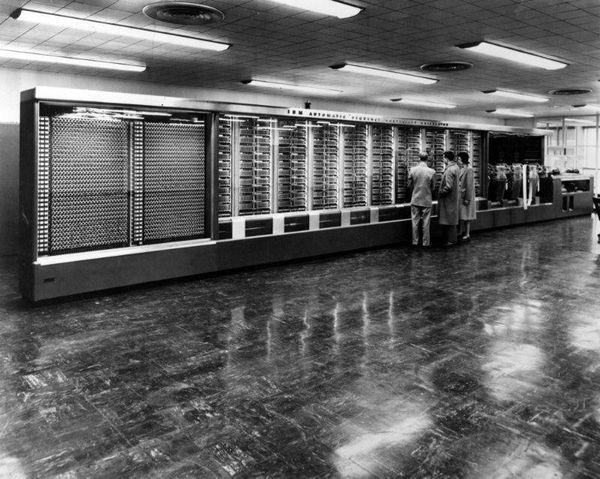
El Harvard Mark I, desarrollado por Howard Aiken con apoyo de IBM, fue una de las computadoras electromecánicas más representativas de la primera etapa de la computación programable.
A colleague of Shannon’s, the American George Stibitz, also entered the design of components for computers. Later, he understood that his circuits, made up of electromechanical relays, could be arranged to form a more complex type of programmable computer. Stibitz worked as an engineer for AT&T, the American telephone and telegraph company. His task was related to the application of calculation systems for the company’s internal organization, and from there came the motivation to design and build what he would call the Complex Number Computer. He began his effort in 1937 and completed it in 1940. It was an experimental electromechanical computer that worked with a binary system. Its internal structure consisted of a combination of relays, and the instruction input system was fed by a teletype or a telegraphic paper tape. The machine could work with complex numbers and accepted conditional or branching instructions, as well as unconditional instructions. Stibitz managed to perfect his original design in successive versions of the device, of which he produced five models. Each later one surpassed the previous one in capacity and ability to perform operations. And his machines represented a fairly close realization of Babbage’s ideas.
Zuse and his family of Z computers
Around the same time, the German engineer Konrad Zuse was following a parallel path. On his own, in his home laboratory, he assembled the pieces of his experimental unit. In 1938 he completed his Z1, a binary digital computer. A set of switches formed the memory, the input peripheral consisted of a keyboard, and the results, in binary code, were displayed by means of a row of lights. The Z1 was followed by superior versions, made possible by the incorporation of relays and the existence of an input mechanism fed by perforated film. In 1941 the Z3 was completed, entering the history of computing as a true milestone. It was not just another model in the series, but this engineer’s most perfected achievement. The Z3 is considered the first complete universal programmable calculator. In other words, the first fully finished and functional computer. The Z3 and the Mark I can be perfectly compared, although with certain qualifications. The Z3 preceded its American counterpart by three years and was also lighter and faster. The Z3 was binary and had a memory of 64 words of 22 bits. The Z3 was followed only by the Z4. Both machines were electromechanical. They were already being developed during the Second World War and were used to design aircraft. During the war, they were destroyed.
Howard Aiken’s work is perhaps the one that has received the greatest recognition within the field of electromechanical computers. Howard Aiken (1900–1973) carried out teaching and research work as a physicist at Harvard University. Starting in 1939, with financial support from IBM and a large number of the brand’s most qualified engineers, he began building the electromechanical computer that would become famous under the name Mark I. The official name of the project was ASCC, Automatic Sequence Controlled Calculator, so the simplified version with a more ordinary name is appreciated. The reason Aiken was interested in an undertaking of this kind was that, as a mathematical physicist, he planned to build a computer that would surpass those already known. The agreement with IBM gave momentum to the initiative, which came to an end in 1944.
The resulting machine satisfactorily fulfilled expectations. It had the appearance of an extremely long and tall panel bordered with plugs, slots and moving devices. Today, its enormous proportions and the large number of elements involved would draw our attention. This is explained by the exclusive use of electromechanical devices or relays, since suitable electronic components were not available. Here are some of its most striking physical characteristics:
This colossal machine was built at IBM’s Endicott plant in New York and donated to Harvard University. The relays used reached almost three quarters of a million, and wiring the parts required nearly one million meters of cable, as well as three million electrical connections. Its structure formed an immense labyrinth of paths traveled by electrical impulses that activated a series of interconnected relays. When it was operating, it produced an intense and repetitive noise, caused by the opening and closing of thousands of those relays. It had 72 registers for numbers of up to 23 digits, in addition to the corresponding sign. It did not work in binary code, but in decimal. It performed the four basic operations. Its calculation speed, although it now seems ridiculous, was astonishing for the time. It added or subtracted in a couple of tenths of a second. It multiplied two eleven-digit numbers in two seconds and divided in a little more than twice the time used for multiplication.
The structure of the Mark I was completed by a memory, which was controlled manually by means of a set of switches. Seventy constants could be entered into it. It also included input and output systems. Instructions were entered by means of perforated tape, which had 24 binary options per row. The output of results could be obtained through two typewriters or, if preferred, directly on perforated tape. As a rule, names are indicative of something. And it could be expected that the name Mark I would also be so, at least with regard to its ordinal number. If we look back at Konrad Zuse’s work, we see that the Z1 — Z for Zuse and 1 for being the first — promised a saga of Zs, and so it happened up to the Z4. The war prevented it from continuing. In the case of Mark, the same could have been expected, given the numbering. It did not happen. Howard Aiken’s computer was a success: the theoretical planning was brilliantly fulfilled and the brand-new computer was born under the patronage of prestigious institutions such as IBM and Harvard University. But it happened that, during the solemn public presentation of the invention and its donation to the university, the celebrated project director, Aiken, apparently forgot to acknowledge IBM’s contribution — which, on the other hand, had been considerable in material and human resources — or perhaps refused to make any mention of the matter. Aiken and IBM did not collaborate again, and a hypothetical Mark II never became a reality.