Science and nuclear explosions
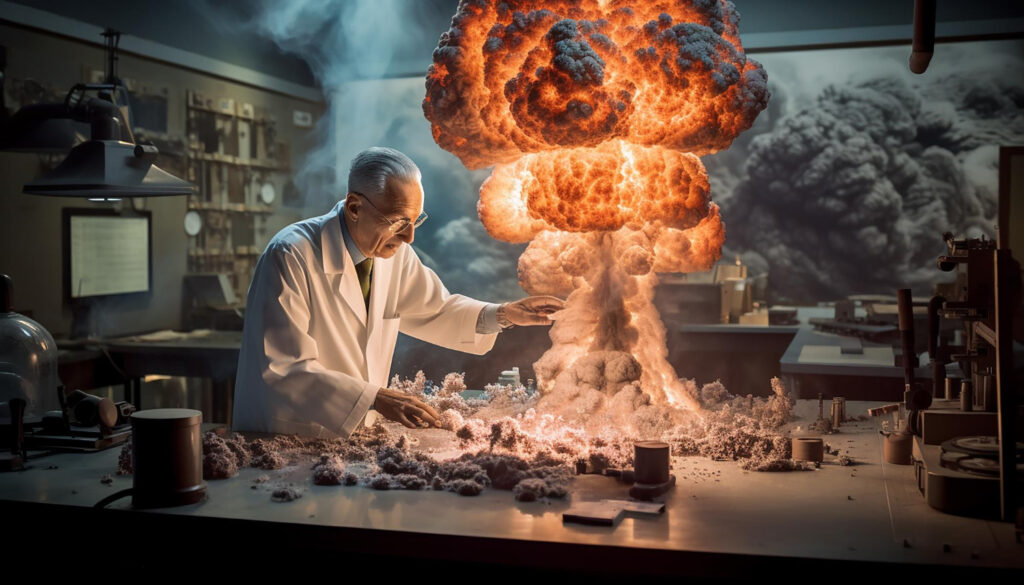
El Proyecto Manhattan reunió a miles de científicos e ingenieros y culminó con las primeras explosiones nucleares de 1945, que cambiaron la guerra y abrieron un debate científico y ético que continúa hasta hoy.
Alamogordo, New Mexico. Groves, a captain in 1935, had a meteoric career that culminated in his promotion to general in 1944. Among the achievements of this consummate military bureaucrat was the supervision of the construction of the Pentagon between 1941 and 1942. He took charge of the entire Project two months before the successful reaction in Chicago.
Tall and increasingly heavy because of his fondness for chocolates, he exercised almost despotic authority and was hated accordingly. “The biggest son of a bitch I ever worked with” was a common judgment among his subordinates. Yet, with virtually unlimited funds that eventually totaled US$2 billion —US$26 billion in 1990 dollars—, he carried out a colossal organizational task that at times involved 15,000 scientists and engineers and put 37 laboratories across 19 states and Canada to work selecting a method for producing fissile material and designing, building and testing an atomic bomb.
The scientific director chosen by Groves was J. Robert Oppenheimer, an imaginative physicist with the complex personality of both a scholar and an aesthete. Groves selected him against the opinion of several respected scientists and pushed aside Szilard, whom he regarded as a disruptive influence and a potential “villain” for the Project. The Hungarian scientist, a visceral antimilitarist, simply regarded Groves as the greatest fool in the whole troupe.
On July 12, 1945, in the New Mexico desert, the scientists were far from calm about what might happen when the mysterious device exploded. The most optimistic expected everything to go well and anticipated a blast equivalent to roughly 200 tons of TNT. But at zero hour, the column of fire that rose 3,000 meters into the clear air and shook the entire landscape revealed a power they had not imagined.
Witnessing the explosion, Oppenheimer murmured a line from the Bhagavad Gita —Sanskrit for “Song of the Lord”—, an epic work of Hindu sacred literature: I am become Death, the shatterer of worlds.
General Groves’s reaction was more prosaic. “Little Boy turned out to be a strong one,” he told Secretary Stimson in code. Stimson was in Potsdam with Truman for his meeting with Churchill and Stalin.
The news exhilarated the new president, who was not entirely at ease, a provincial man suddenly keeping company with such formidable figures. Possession of this tremendous weapon of war and diplomatic tool gave him enough confidence to tell the Kremlin’s formidable leader about it. And not only that: it also strengthened the case made by Pentagon chiefs and Groves for dropping the bomb on Japanese cities that had so far escaped General Le May’s furious bombing campaigns against other cities of the Empire.
Japan was collapsing. Yet several reasons were found for allowing the demonic power of the device to be tested over the heads of its people: saving the American lives an invasion would cost, justifying the enormous expense of the Project, checking the Soviets, satisfying public vengeance for Pearl Harbor and Japanese atrocities… There was little interest in listening to those who called for a demonstration over an unpopulated area.
“I had no doubt about it at the time,” Truman would boast two years later. Dean Acheson later recalled: “Once I accompanied Oppenheimer to Truman’s office. Oppie was wringing his hands and saying, ‘I have blood on my hands.’ Later Truman told me, ‘Don’t ever bring that damn fool in here again. He didn’t drop the bomb. I did. This kind of sniveling makes me sick.’”
Ronald Takaki, a Berkeley historian, later interpreted Harry Truman’s decision in retrospect: “He had an inferiority complex”; “He was inexperienced and insecure”; “He wanted to prove he was not a sissy.” Perhaps. Even so, we may doubt that history works in quite so simple a fashion.
In The Ascent of Man, Bronowski, who had been commissioned by the British to study the consequences of the explosion, wrote: “The first bomb was dropped on August 6, 1945, at 8:15 in the morning. Shortly after my return from Hiroshima, I heard someone say, in Szilard’s presence, that it was a tragedy for scientists that their discoveries had been used for destruction. Szilard replied, as no one else had more right to do, that it was not the tragedy of the scientists; it was the tragedy of mankind.”
Did Japan consider building its own atomic bomb?
As far as is known, Japan did not learn of the existence of the atomic bomb until August 6, 1945, when an American aircraft dropped the first one on Hiroshima. Given Japan’s technological capabilities, some have wondered whether its military ever considered developing a nuclear weapon of its own.
Several factors, however, clearly would have prevented Japan from undertaking a nuclear effort comparable to the American one. The first and most important was the gap in the development of basic science. The concentration of first-rate scientists —from several different countries— in the Manhattan Project was extraordinary: 20 “world leaders in the field” and 57 “prominent physicists,” for example.
The second factor was economic. The bomb first tested at Alamogordo had required enormous expenditure and a vast organizational effort over several years. Japan lacked the capacity for an undertaking of that scale.
There were other factors as well: its insular isolation; the commercial, strategic and supply blockade imposed by the Americans beginning years before Pearl Harbor; U.S. air superiority, evident almost from the beginning of the war; the samurai mentality of the military leadership; and confidence in the conventional weapons perfected by Japanese technicians, especially aircraft and warships.