Politics and science for war
Los programas militares de Japón y Alemania durante la Segunda Guerra Mundial muestran cómo la ciencia, la política y la capacidad industrial condicionaron el desarrollo de nuevas armas.
Leaving speculation aside and turning to the known facts, the most significant point is the absence of any mention of a Japanese nuclear project at the time. There was not even a reference to one during the detailed examination carried out at the war crimes trials.
Before the International Military Tribunal for the Far East, which operated for three years, Australian judge William Webb laid out the responsibilities of Japan’s leaders before and during the war. For the six days it took to read the judgment, the defendants listened impassively to the record of their atrocities: murder and looting in China, thousands of prisoners tortured in Burma and Siam, prisoners left to starve in camps in Java, Luzon and Bataan, devastated and burned cities, rape, and more.
Former prime minister Tojo and six other leading figures were sentenced to death by hanging; another sixteen received life sentences. Yet throughout this detailed and extensive trial there was no reference to a Japanese nuclear weapons project.
What did emerge in connection with unconventional weapons was the production of chemical arms. Not far from Hiroshima, on the small island of Okunoshima, a large factory produced chlorine, mustard gas, hydrogen cyanide, lewisite and other substances of that kind. Their use in China and Burma was documented by U.S. military justice authorities in 1946. The fact that poison gases, liberally used against civilian populations on 12 or 13 occasions, had killed Chinese rather than Western Allied victims ultimately meant that no charges were brought against those responsible.
Hitler and the bomb that never was
One of the mysteries of the Nazi regime is the bomb that never existed. Why did Germany, where nuclear fission had been discovered in 1938, fail to reach the decisive weapon before the Anglo-Americans?
Several explanations have been offered. One is that the persecution of Jewish scientists effectively handed the prize to Uncle Sam. When physicist Leo Szilard obtained Einstein’s signature on a letter warning President Roosevelt that Hitler might develop a nuclear weapon first, the process that led to the Manhattan Project began. With the participation of several émigré scientists, that project would eventually produce the American atomic bomb dropped on Hiroshima.
Another explanation focuses on the Führer’s paranoia, his rejection of “non-Aryan” science and his arrogance as a self-appointed visionary. As one Englishman later wrote: “Thank God Hitler had no scientific advisers!”
A third explanation is that Germany’s most prestigious scientists chose the wrong technological path for turning their scientific discovery into a weapon and were unable to guide the development of an explosive device.
All these possibilities form part of the attempt to clarify one point in history. Behind them lies the dramatic question: what would have happened if Hitler had possessed the bomb in 1944 or 1945? As the English often put it: “What… if?” The answer evokes a word from the Bible, one commonly used to describe the final day of the Apocalypse: “Armageddon.”
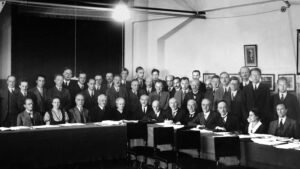
The veil over this mystery has recently been lifted a little further with the declassification of secret files concerning an episode that took place 47 years earlier. In July 1945, after the war in Europe had ended, ten leading German scientists were detained by the Allies at Farm Hall in England as part of an investigation into German uranium research. On August 6, the prisoners learned of the nuclear explosion at Hiroshima.
At first they thought the news was fantasy. Then they began discussing among themselves why Germany had failed to produce an atomic bomb despite having had a one-year head start in the fundamental scientific discovery.
The group included three Nobel laureates: Otto Hahn —Chemistry, 1944—, Max von Laue —Physics, 1914— and Werner Heisenberg —Physics, 1932. Heisenberg, a leader of quantum mechanics and author of the uncertainty principle, was regarded by the Allies as “the most dangerous German in the field because of his intellectual power.”
British intelligence had hidden microphones in each of the prisoners’ rooms and obtained a complete record of their conversations during the months of captivity. The project, known as “Alsos,” kept the results of those recordings secret —or nearly so— for 47 years.
In February 1992, the documents were declassified. It then became possible to read what Heisenberg and his fellow scientists had said in 1945 about why Germany had failed to build an atomic bomb. The Farm Hall reports broaden and illuminate the history of the German nuclear program more than any previous study.